

%204.png) GuestPostMailer
GuestPostMailer





.png)
.png)
Since 2022, AI has taken the world by storm, and no industry is left on the fringes. One of the industries where Artificial Intelligence has made maximum impact is Search Engine Optimization (SEO). Across social media platforms, the questions are rising high. Has SEO become a thing of the past? How do AI Overviews collect their information? Is GEO a new driving force in digital marketing?
Let us clear some misconceptions in this blog and tackle some of these questions in the blog. We will see how AI Overview Optimization works and how AI is actually improving SEO in this blog-
Understanding AI Overview Optimization
AI Overview Optimization can be defined as the process of creating and enhancing content, assessing AI readiness, so it has a higher possibility of appearing in the AI overviews (Google’s AI-generated summaries). It deals with polishing your content and SEO so that it aligns with how AI systems understand and display content, making it simpler for your website to stand apart and get attention.
AI Overviews depend on NLP (Natural Language Processing) and machine learning algorithms to assess large volumes of data. Modern technologies empower AI to understand intent, context, and user behavior. This enables more accurate content suggestions and search result customization. While SEO emphasizes the required backlinks and keywords, AI-driven search goes one step further by assessing patterns in interactions and user searches.
How Do AI Overviews Work?
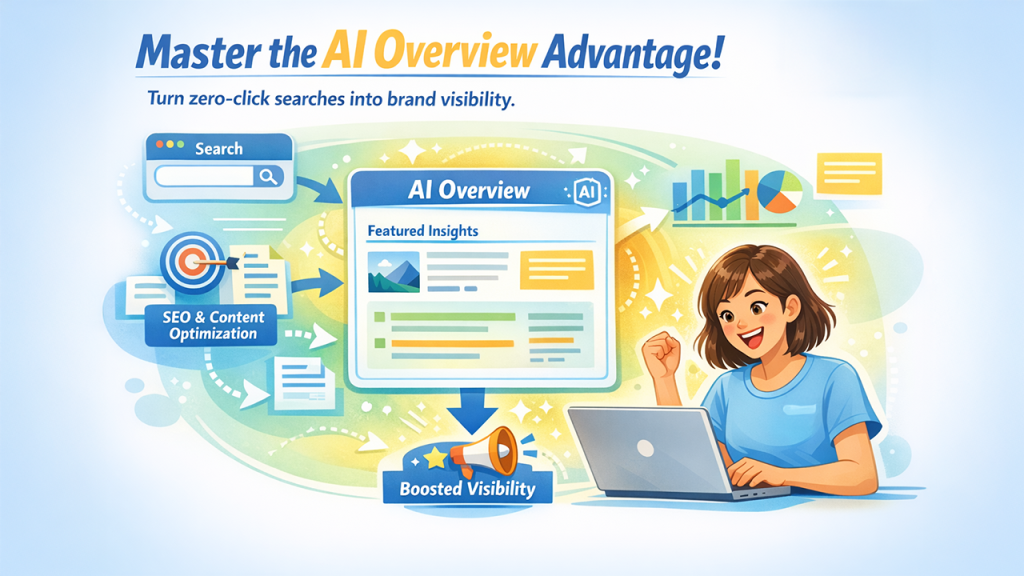
AI basically looks at the intent and context behind searches to comprehend what users really require, aiding users to customize to more accurately meet those requirements. AI can also customize search results and trends as per the individual behavior. Thus, in order to fit the criteria of AI overviews, it is important for SEO professionals to customize the content and make it more targeted and effective.
Read Also: Local SEO for Beginners: A Step-by-Step Guide to Ranking Locally
How It Impacts SEO?
AI Overview Optimization has turned the game in the world of SEO. Not too long ago, if you wanted to purchase something on the internet, you would just entered your query in the search engine and go through a bunch of links to get your response.
Now, with the help of AI Overviews, you generally get the information you need at the top of SERP results. Thus, it has increased the possibilities of zero-click searches where a user can get the information, he or she needs without even clicking on a link. Thus, it naturally impacts the organic traffic that SEO professionals target.
However, there is also an advantage of AI Overviews that many SEOs overlook. By being mentioned, cited, or linked in the AI Overviews, you can get your brand noticed much more easily. Thus, though AI Overviews has made attracting organic traffic a lot trickier, it offers a new way brands can make themselves visible and attract visitors. What is interesting about this is the fact that even if your content ranks lower in SERP results, your brand can still appear in the AI Overviews.
How GEO, AIO, and AEO Works?
If you are in touch with digital marketing trends, then you would know that SEO is no longer sufficient to gain a competitive edge. AIO and AEO have carved their own niche. Let us understand it in a more detail-
- AIO: Artificial Intelligence Optimization is a broad strategy that factors in every facet of your digital strategy including website, content, and be more prepared for AI platforms.
- GEO: Now, there is Generative Engine Optimization. It emphasizes making your content stand apart in AI-driven generative search engines. It customizes your content to make it an important source for the platforms as they generate personalized responses.
- AEO: And, ultimately, Answer Engine Optimization (AEO) emphasizes ensuring that your content remains optimized for direct and concise answers in search results.
Here, each one is a separate optimization technique and plays a unique role. They work together to improve your visibility in the AI-based landscape.
What Are the Myths Related to AI SEO?
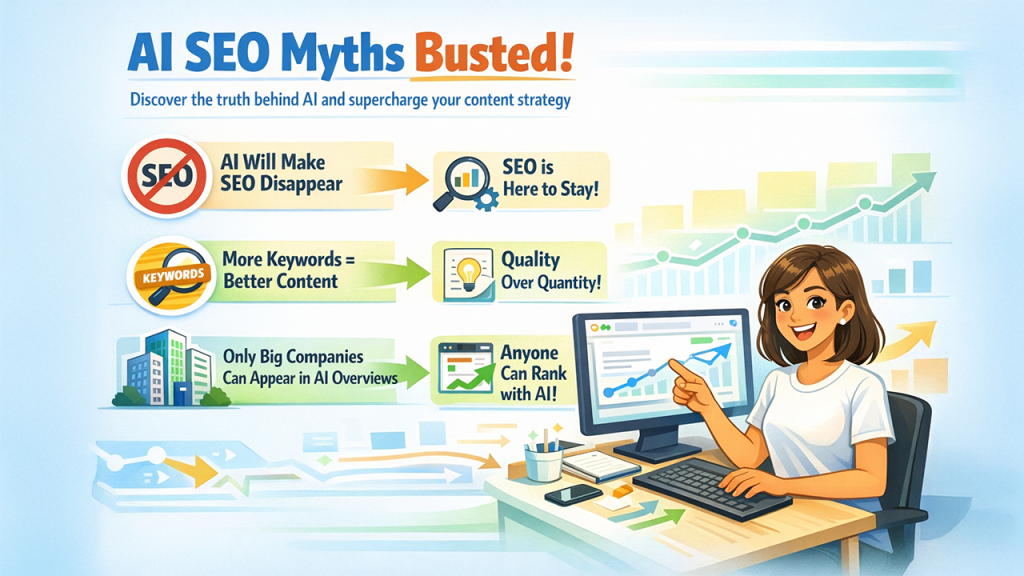
On the internet and on social media, there are a lot of misinformation and myths surrounding AI SEO. So, let us understand what these myths are and clear the air in this section-
Myth 1: AI Will Make SEO Disappear
Misinformed or half-baked predictions have stormed the internet that AI will now make SEO obsolete. However, it is a myth because, like other technologies, it has its way of evolving and establishing new innovations instead of being replaced by them. AI Overviews are a tremendous example of this evolution. Instead of making the SEO disappear, AI Overviews has instead made it more intelligent and advanced by providing in-depth insights and accurate data analysis. If SEO teams adopt AI-first mindset, they can make their strategies even more effective. This enables you to emphasize building quality content and communicate with your audience.
For instance, before Google AI Overviews came around, a small digital bookstore depended on standard keyword research, emphasizing generic terms such as “French Books” without comprehending the specific interests of your audience. Marketing efforts were often less targeted and broad, leading to lower conversion rates and engagement. Nowadays, SEO teams optimize content much more closely, incorporating multiple factors and adding GEO strategies.
Myth 2: If You Use More Keywords, Your Content Will Become Better
Do you remember the time when SEO was all about inserting as many keywords as possible? There was no such thing as keyword stuffing or natural placement of keywords. Marketers just added keywords wherever they liked. While keywords are still intrinsically important in SEO contexts, intent and content quality have taken precedence.
Now, with AI overviews, wider topics and semantics have become more crucial. Instead of targeting solo keywords, AI aids in understanding the larger picture by recognizing concepts and themes that users care about. This shift implies that we are crafting content that speaks to the context and intent behind searches, and just the words.
Going ahead with this topic-driven approach allows AI to understand that websites have authority and relevance across a wide range of queries. This implies greater visibility and better engagement among users.
Myth 3: Only Large Companies Can Appear in AI Overviews
You might think that AI Overviews is only for big companies having a large budget. However, it is a myth since businesses of all sizes can access the power of AI to boost their online presence. AI Overviews show up for searches that require in-depth data, so adopting AI optimization is a smart move for any business looking to capture interest of users and make a lasting impression.
AI Overview Optimization is particularly beneficial in industries such as health, technology, finance, and automotive, where in-depth understanding and complex comparison is significant.
4 Key Strategies You Need to Adopt to Streamline AI Overviews
So, now that we have cleared misconceptions, questions arise: how can you actually get the AI to notice you? It is quite simple, just focus on what AI is looking for.
As stated above, AI favors content that is concise, clear, and directly relevant for what users are searching for. So, make sure that your content aligns with these priorities, and you are all set to catch AI’s attention and improve your possibilities of appearing in AI Overviews.
1. Understand Use Search Intent with Direct Answers:
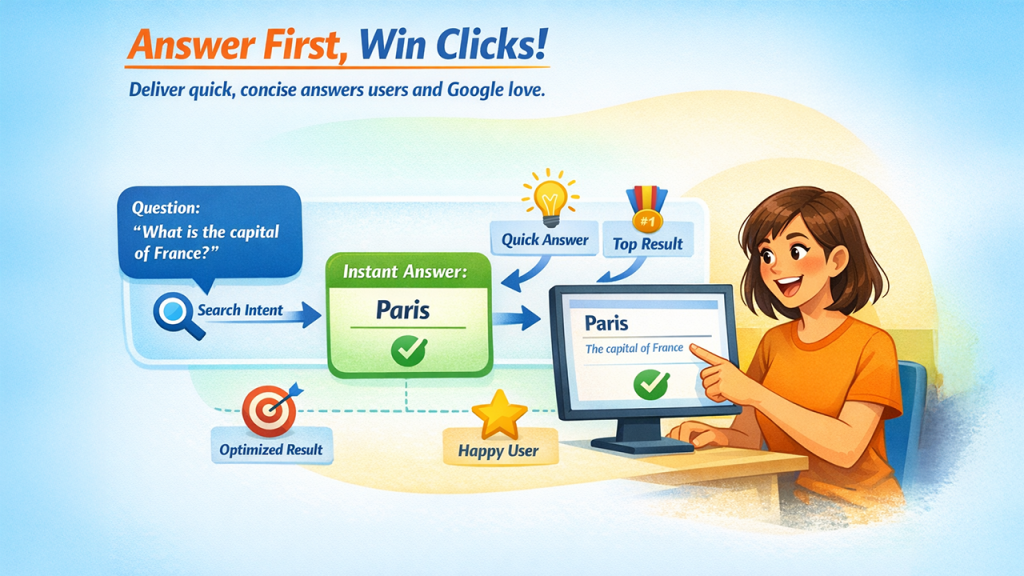
Position your answers directly at the beginning. Put them at the top of your content or in a specific question such as “Quick Answers” or “Frequently Asked Questions.” This helps both the search engines and users find the details they require, which, as we have discussed, because Google emphasizes search intent.
Ensure that your answers are concise, ideally not longer than 1-2 sentences, or close to 40-60 words. This enhances search engine recognition and overall readability, which is crucial.
2. Emphasize on Topics, Not Just the Keywords:
Emphasize your content on topics instead of solo keywords. You must think about the larger picture and what your audience cares about specifically. As we previously discussed, emphasizing your content on these complete topics and integrating long-tail keywords can help you to better connect with your audience. Furthermore, it improves your possibilities of appearing in the AI-generated summaries.
Carry out a deep competitor analysis and notice what they are doing well. Identify what they are doing well and recognize content gaps you need to fill to more effectively engage your audience. Structure your content well with topic clusters by generating a central pillar, which works as a complete guide on a wide topic.
3. Structure Your Content to Appear As Snippets in Search Results:
It is significant to structure your content in a way that it makes it simple for search engines to include it in snippets. Snippets are nothing but the concise summaries or answers that show up at the top of search results. They are an efficient way to capture attention.
- Begin with Content Chunking: Segment your content into bite-sized or manageable sections or chunks. Make your headings clear and use subheadings to guide users throughout the content. This not only makes it simpler for users to digest data but also aids search engines to comprehend the structure and key points.
- Integrate Question-based Headings to Address Common Queries Directly: It is important to consider the common questions that customers might have on their mind regarding a topic or concept. It is a smart tactic that taps into how snippets are created and improves the possibilities of your content being featured.
- Utilize Tables and Lists: You can utilize tables or lists to present information in an organized and clear way. Search engines have a bias toward bullet points, structured lists, and tables because they explain key points or steps clearly. To further align with accessible standards of web design, make sure that the tables are in text form instead of images.
- Highlight Key Segments: Highlight key fragments through italics or bold to focus on important points. This improves their possibilities to appear in snippets.
4. Integrate a Semantic Approach for Quality Content

Adopt a writing style that is more human, rich, and semantic. This will better align with how AI better understand or process data. This implies that creating content that cultivates trust with the audience on a personal level while also being understood by search engines easily.
- Utilize a conversational tone to make your content feel more relatable and natural. In this way, your content will appear more engaging for the audience and more authentic for the AI systems.
- Align your content with N-E-E-A-T-T (Notability, Experience, Expertise, Authoritativeness, Trust, and Transparency) by highlighting real-world insights and experience. This establishes authority and credibility, which are one of the most valuable assets in SEO.
- Incorporate LSI into your content. Add synonyms and related terms to your content to wider your relevance and capture user queries. This approach nurtures a varied and natural writing style, enhancing the visibility of your content in AI-powered search results, enabling it to stand apart in an evolving digital space.
Conclusion
AI Overview Optimization showcases the transformation of SEO instead of its replacement. By emphasizing the search intent, topic-driven content, structured formatting, and semantic richness, businesses of diverse sizes can appear in the AI-powered summaries successfully. The differentiator exists in generating content that caters to both human readers and AI algorithms through quality data, clear answers, and strategic formatting of data. Incorporate GEO, AIO, and AEO principles along with conventional SEO practices position your brand to improve visibility in this AI-powered digital landscape, creating new pathways for engagement apart from conventional organic traffic.
Related Posts:
Revolutionize Your SEO: How Ben Stace Semantic Writing Tool Drives Higher Rankings


.png)
.png)
.png)
.png)