





.png)
.png)
Sarah was huddled in front of her computer screen at 11 PM, exhausted. She was the founder of a thriving e-commerce startup, but she required brand kits, templates, and marketing materials – yesterday. She had asked a designer, but they were booked for three weeks, while design agencies were requesting $15,000 for the most basic brand identity design. A colleague introduced her to the existence of automated branding solutions. The brand kit, templates, and guidelines were all hers in a mere two days. What was once highly challenging has now become straightforward.
This is the reality of modern branding. Automated branding is changing the way businesses build, manage, and expand their branding identity without disrupting the financial or time boundaries.
Comprehensive Summary of blog
- Speed Through Automation: Automated branding cuts the time it takes to create brand assets from weeks to minutes through the use of artificial intelligence powered tools and templates.
- Cost-Effective Brand Management: Small businesses are able to save thousands of dollars as a result of automating repetitive branding processes without compromising on quality.
- Consistent Brand Identity: Automation will ensure consistency in the visual elements, messages, and tone associated with every platform, as well as the various members involved.
- Scalable Branding Solutions: Companies can effectively and efficiently administer multiple sub-brands and even franchises.
- Data-Driven Brand Decisions: It analyzes various patterns of engagement by users to offer improvement suggestions for logos, colors, and messaging strategies.
- Human Creativity Remains Essential: Execution is left to automation, whereas strategic thinking and storytelling are still capabilities reserved for humans.
Understanding Automated Branding
Automating branding uses artificial intelligence as well as specialized software to accomplish brand-related tasks with little or no human assistance. It provides logo development, color schemes, templates, or any other brand-related development with consistency.
In traditional branding, weeks of work involving designers, strategists, and copywriters would be needed. But through automation, this time frame can be drastically brought down without comprising on professionalism. This technique has understanding capabilities of the brand values, target market, and design concepts.
Contemporary tools and services include digital asset management platforms, brand guidelines creators, template builders, and artificial intelligence-based tracking tools. Each of these building blocks contributing to branding solutions aims to create a central hub for brand files and enables automatic notification for usage issues.
The Business Case for Automated Branding
Efficiency and Speed
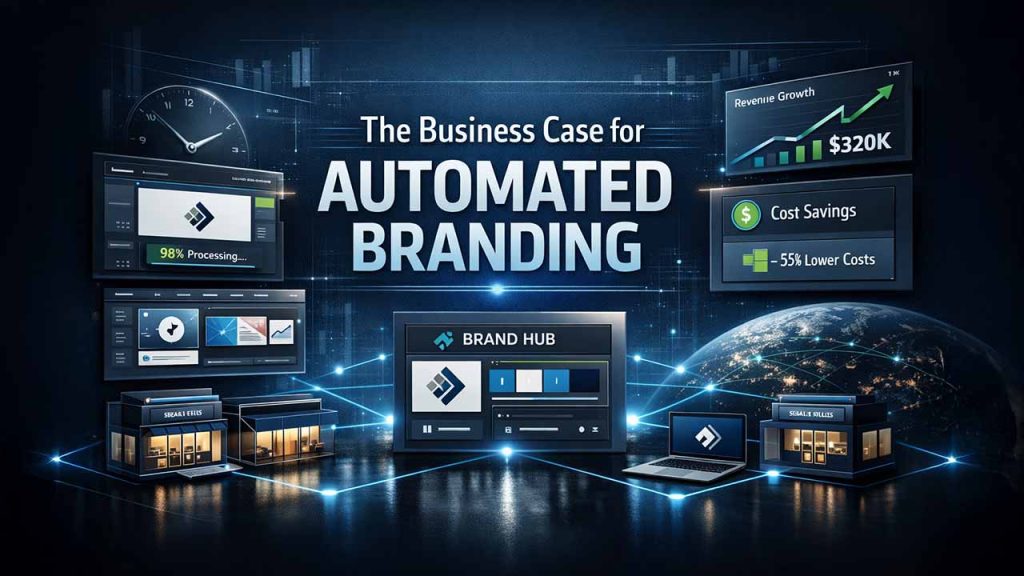
Companies that have implemented automated branding solutions have seen a reduction in creation time of brand assets by 60-70%. Things that used to take hours now take minutes. Marketing departments launch campaigns more rapidly when template libraries instantly provide access to brand-compliant materials. Sales teams self-create presentations without waiting for design support.
Financial Benefits
Startups opt to avoid spending between $10,000 and $50,000 on the services of a branding agency by using automated platforms, making affordable digital marketing accessible to businesses of all sizes. Based on a Marq study, automation of branding ensures that a company makes more than 20% additional revenue as a result of using a cooperative branding approach. Small businesses focus on strategic projects instead of designing templates.
Brand Consistency at Scale
Franchise with hundreds of outlets ensure a consistent brand presence via automated systems. The franchises are able to use the central brand resources but cannot alter the basic identity components. Large corporations control various sub-brands via hierarchical automated systems.
Who Benefits Most from Automated Branding
Startups and Small Businesses
When it comes to the launch of a business, entrepreneurs require a branding identity within a short time without the cost of hiring a creativity agency that may cost thousands of dollars. Branding automation tools allow a startup company to develop a logo, colors, and a message within a matter of minutes.
Marketing Agencies
Organizations handling several clients at once employ automation to create individual brand identities for each client account. The customized template solutions for each client help organizations quickly create brand-compliant content. The approval process for clients accelerates as long as it is brand compliant.
E-commerce Operations
E-commerce websites handling large product variations are facilitated by automatic templates in ensuring standardization of display even on the thousands of SKUs. Seasonal marketing campaigns are launched easily through automated processes that generate variations in email, social, and display marketing.
Enterprise Organizations
Global enterprises with remote employees use automated branding. Brand managers set guidelines on the visual identity of the brand, which the platforms automatically enforce on all user-created content.
Strategic Implementation of Automated Branding
Selecting the Right Platform
Brand portals offer a way to combine a number of automated tasks into one interface. Such software offers the benefits of digital asset management, guidelines, templates, and permission settings for users. A priority for organizations should be software with the capacity for integration with available tools, for instance, project management software and marketing automation software.
Scalability needs differ based on the size of the organization. Start-ups demand platforms that can scale with the growing team without increasing prices. Larger organizations demand technology with thousands of users worldwide.
Training and Adoption
It requires a wide knowledge of the teams for successful implementation. Marketing people, sales representatives, and regional managers will be trained on how to access brand assets, how to use templates, and how to understand brand guidelines. Documentation libraries with video tutorials support ongoing learning.
Change management strategies provide a way to deal with the resistance from team members who are comfortable with existing processes. Emphasizing time savings, greater autonomy, and professional-quality output can help overcome skepticism. Success stories from early adopters will motivate wider organizational buy-in.
Maintaining the Human Element
Strategic Direction Requires Human Insight
While automated branding executes tactics, humans develop strategy. Brand positioning, targeting, and value proposition creation require human acumen about market dynamics. Developing the brand's personality requires emotional intelligence that artificial intelligence simply cannot replace.
Creative Storytelling
Effective brand marketing campaigns require creative storytelling. Although automation enables the creation of consistent assets, creative work comes from the mind of a person. Writing copy for brand marketing campaigns requires a human understanding of language, humor, and emotional connections.
Cultural Sensitivity
Global brands must navigate cultural differences in color symbolism, imagery interpretation, and messaging appropriateness. Human brand managers understand these nuances in ways algorithms cannot. Crisis management and reputation protection require human judgment considering stakeholder relationships and long-term implications.
The Future of Automated Branding
The brand automation industry achieved a value of 3.9 billion dollars in 2024. The industry forecasts further growth and will reach 22.3 billion dollars by 2033.
"The next generation of platforms will provide predictive brand performance analytics—recommending design changes based on engagement behaviors and patterns. The voice and conversational AI area will enable the automation of branding processes via audio media. Virtual and augmented reality will bring a fresh set of branding issues with them,"
"The future state would marry efficiency through automation with the creativity and strategic thinking of human beings. Brand staff would transform into strategic orchestrators, controlling automated processes as opposed to performing human tasks."
Common Implementation Challenges
Resistance to Change
Team members who are used to the workflows may be very resistant to the change in automation adoption. Conquer these concerns with openness to communicate the benefits, sufficient training, and gradual implementation. Demonstrate quick wins through high-impact applications that show immediate value.
Maintaining Creative Differentiation
But there is also a risk that organizations lose some creative differentiation when every decision defers to automated systems. Set guidelines that indicate when human creativity should overrule the automated suggestions. Refresh templates on a regular cycle to maintain a contemporary aesthetic and invite customization within brand parameters.
Technology Integration
The existing systems may not be easily integrated with the latest automation platforms. Strategies should be developed in a way that ensures a smooth transition with minimal downtime. The design of the interfaces and support services offered should be user-friendly to overcome adoption issues.
Conclusion
Automated branding represents a significant shift in how brand identities are created, managed, and scaled. It brings massive benefits, such as reduced production time, cost savings, and uniform brand expression across all platforms. In today’s complex digital environments, automation helps lend necessary infrastructure support to managing brand experiences.
However, the success of automation as a process must occur with due recognition of the important roles of human creativity, human intuition, as well as human emotional intelligence. The best organizations do not simply focus on automated excellence with human strategizing.
As the platforms continue to get more intelligent and user-friendly, automated branding evolves from competitive differentiation to competitive imperative. Those organizations making the leap today position themselves to sustain success in a set of markets that get noisier by the day, where brand consistency and professional presentation separate the leaders from the followers.
The future belongs to brands that can balance technological efficiency with human creativity, scaling excellence through automation without sacrificing an ounce of authenticity or emotional resonance. Whether you're a startup founder, marketing director, or agency professional looking to understand and implement automated branding solutions, this is the key to competitive positioning in the evolved digital marketplace.
Frequently Asked Questions
Q1. How does automated branding differ from traditional design services?
A1. Automated branding is a process in which brand assets are created in minutes by AI software, whereas in traditional branding, designers work manually, taking weeks to create brand assets. The strength of automation is in executing tasks, whereas designers' strength is in their creativity.
Q2. Can small businesses benefit from automated branding tools?
A2. Small businesses gain tremendous value from automated branding platforms. These tools eliminate expensive agency relationships while providing professional-quality brand assets. Startups establish cohesive brand identities for hundreds rather than tens of thousands of dollars.
Q3. Does automated branding reduce the need for creative teams?
A3. Rather, automated branding is an evolution of the roles of creative teams. Designers become more involved in creative work requiring human brains as opposed to engaging in repetitive work. It is mostly creative teams that take longer working on ideas of breakthrough advertising campaigns.
Q4. What types of brand assets can automation create?
A4. The automation platforms can produce logos, color schemes, typography packages, social media design templates, presentation files, email signatures, marketing material, or brand style guides. Most of the normal visual elements, which generally require consistencies in branding, can be suited for automation.
Q5. How do companies maintain brand uniqueness with automation?
Q5. Organizations retain their uniqueness through the application of human input on strategies that entail brand personality and positioning as well as creative direction. Automation implements these strategies without formulating the strategies themselves. The platforms provide the means for the input of uniqueness that sets a brand apart from its competitors.


.png)
.png)
.png)
.png)