

%204.png) GuestPostMailer
GuestPostMailer




.png)
.png)
Agencies that depend on guest posting revenue know that every lead, every negotiation, and every pending deal represents money that can either be won or lost. A deal stored inside your CRM is not just an entry or a label attached to a conversation; it is an active revenue possibility that needs consistent nurturing.
These challenges redefine the foundation of GuestPostCRM. More than an email organization system, the platform is designed to track deal progress, identify silence in negotiations, secure potential opportunities, and minimize the risk of revenue loss seamlessly because a lead forgot to take action. This is where Deal Reminders in GuestPostCRM become crucial.
Many agencies intentionally lose track and let deals slip away. A conversation begins strongly, prices are discussed, requirements are shared, and then suddenly — the buyer becomes silent. Sometimes the buyer is busy, sometimes they get distracted, and sometimes they simply forget to place the first order. Without intervention, these deals quietly expire over time and are lost without ever reaching conversion.
This blog explains how Deal Reminders in GuestPostCRM prevent common problems of agencies, along with how they work, why they matter, and how you can customize them.
Understand What the Deal Reminder Is
GuestPostCRM offers a robust reminder system, and Deal Reminder is one of its most crucial features. It is designed to send automated follow-up to customers when a deal has been created but the order has not yet been placed. The goal of this reminder is not to receive payments or invoices. Instead, it focuses entirely on reengaging inactive customers and guiding them to submit their first order.
Deal Reminders in GuestPostCRM help the system to make negotiations stay active. It gives customers a polite nudge to start the conversation again where buyers went silent and move forward to the next step in the buying process. As a result, these reminders drive conversion growth, minimize the number of inactive leads, and keep the pipeline of opportunities active and focused.
The tone of messages is designed to be soft and non-intrusive, giving an effective yet respectful nudge without pressure.
How Deal Reminders Trigger Automatically
GuestPostCRM follows a precise logic to determine when a Deal Reminder should be sent. The system identifies three conditions and triggers the reminder only when all of them are met:
- A deal has been created, which means a negotiation exists.
- No order has been placed, indicating the buyer has not acted yet.
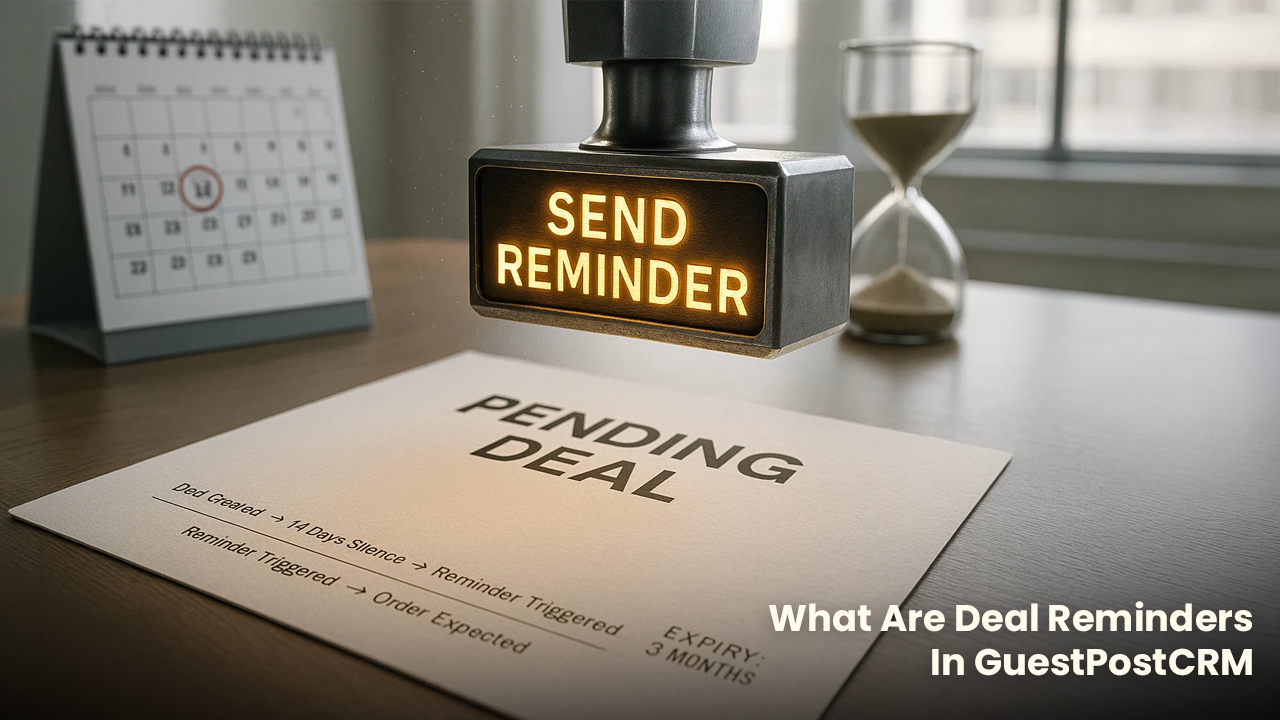
- The deal becomes older than two weeks, meaning it has crossed fourteen days without movement.
Once these conditions are satisfied, the system sends a message reminding the customer that their deal has been pending for more than two weeks and that they can proceed by placing their first order.
Deal reminders in GuestPostCRM are carefully designed to look like a natural continuation of the conversation. It does not overwhelm customers, but it ensures they are aware that the next step is pending. For agencies handling large volumes of leads, this automation removes the burden of manual follow-ups and significantly increases the chances of conversion.
Can Deal Reminders Be Customized or Controlled?
One of the strongest advantages of GuestPostCRM is that every automated feature—not just payment reminders—offers complete flexibility, and Deal Reminders follow the same rule. You can either skip this feature entirely if your workflow doesn’t require nudging inactive leads, or you can activate the default reminder system that runs automatically after 14 days of inactivity. For agencies with unique sales cycles or long negotiation windows, GuestPostCRM also allows full customization so the reminder system behaves exactly the way your business demands. This robust control ensures that deal follow-ups never feel intrusive, never fire unnecessarily, and always match the rhythm of your own client pipeline—resulting in cleaner communication and higher conversions without extra work.
How Deal Expiry Impacts the Reminder Flow
Every deal created in GuestPostCRM has a three-month expiry period, ensuring that pipelines stay fresh and updated. The Deal Reminders work in harmony with this expiry logic by informing the customer before the deal reaches its expiration stage. In addition, this reminder logic also works seamlessly alongside other automated nudges, such as order reminders in GuestPostCRM. This helps agencies never miss or ignore valuable opportunities even in a busy inbox—whether it is a deal or a first offer.
If the customer still chooses not to act even after reminders, the deal will naturally expire according to your normal workflow. This keeps the CRM organized and allows sales teams to focus on active negotiations rather than outdated or abandoned opportunities.
What the Purpose of Deal Reminders in GuestPostCRM
A Deal Reminder serves several crucial purposes simultaneously. It reopens conversations that have gone quiet, informs the customer that their deal has been pending for a while, and subtly encourages them to submit the first order. In doing so, it prevents the pipeline from growing cold and reactivates silent leads.
Because the message is framed as a simple reminder rather than a pushy demand, it often results in significantly higher conversion rates. Agencies that receive large numbers of placement requests or pricing inquiries benefit greatly from this feature, as the system ensures no opportunity is forgotten or buried under newer conversations.
Can Deal Reminders Be Cancelled?
Yes. GuestPostCRM gives you complete control over Deal Reminders, ensuring the system behaves exactly according to your workflow and customer handling style.
1. Automatic Cancellation When an Order Is Placed
As soon as a customer submits the first order linked to the deal, the reminder flow immediately stops. No further reminders will be triggered because the system understands that the customer has taken action. This allows teams to keep communication authentic and avoid unnecessary follow-ups.
2. Manual Cancellation by Staff
Automated or scheduled reminders can be stopped manually by sales teams for any deal. Whether you prefer to avoid pressuring a particular buyer, or you want to handle follow-ups manually, the system lets you pause or block reminders instantly.
3. Sending a Manual Reminder Anytime
Users can schedule manual reminders anytime with the “Send Reminder” option. This gives teams the ability to force a buyer instantly without waiting for the two-week automation. It is perfect for urgent circumstances, premium clients, or negotiations that need more constant touchpoints.
This level of versatility guarantees that Deal Reminders in GuestPostCRM align perfectly with your business style rather than forcing you into rigid automation.
Why Deal Reminders are Crucial
When agencies do not use automated reminders in their sales pipeline, they often face similar repeated problems. Without timely follow-ups, negotiations lose momentum, leads go inactive, and deals slip away without ever turning into revenue.
Meanwhile, Deal Reminders in GuestPostCRM help agencies maintain ongoing interaction with high-potential buyers. Customers reopen the conversation, deals stay active, and first orders are placed immediately. The system reengages silent customers, strengthens revenue potential, and helps every negotiation reach its natural closure instead of stalling or disappearing.
Think of GuestPostCRM as a silent salesperson that consistently tracks every deal and gently forces buyers at the right moment to keep the sales cycle active.
Conclusion
Deal Reminders in GuestPostCRM are crucial for keeping deals moving forward, preventing them from stalling. Here is the full lifecycle in simple terms:
| Activity | Result |
|---|---|
| Deal is created | Reminder timer begins |
| First order is placed | Reminder flow stops immediately |
| No order is placed | System waits 14 days |
| Deal age exceeds 2 weeks | Deal Reminder automatically triggers |
| Deal expiry | Deals expire after 3 months unless acted upon |
| Manual control | Staff can cancel or send reminders anytime |
Deal Reminders protect your pipeline, reactivate silent leads, and ensure revenue does not disappear simply because a potential buyer forgot to take action.
GuestPostCRM doesn’t just record deals—it protects them and ensures they move forward.
FAQs for Deal Reminder in GuestPostCRM
Q. What exactly triggers a Deal Reminder in GuestPostCRM?
A. When a deal is created, but no order has been placed, and the customer remains inactive for more than 14 days, GuestPostCRM instantly triggers an automated Deal Reminder. This soft, polite follow-up is sent to revive the inactive customers.
Q. Does GuestPostCRM send reminders if a customer already placed an order?
A. No. As soon as the first order synced with the deal is placed, GuestPostCRM automatically cancels all scheduled reminders. The system frees customers from facing unnecessary follow-ups.
Q. How frequently does GuestPostCRM send Deal Reminders?
A. By default, reminders are sent once the deal crosses 14 days with no order. However, you can also customize them and send manual reminders anytime if a negotiation requires urgent follow-up.
Q. What happens when a deal reaches its expiry date?
A. Every deal expires automatically after three months. If no order is placed by then, reminders stop, and the deal is removed from your active pipeline to keep your CRM clean and updated.
Q. Can staff manually stop Deal Reminders for specific clients?
A. Yes. Sales teams can cancel scheduled reminders anytime—perfect for premium clients or negotiations that need personalized handling instead of automation.
Related Posts:
How Payment Reminders Are Automatically Cancelled in GuestPostCRM


.png)
.png)
.png)
.png)