





.png)
.png)
In the competitive space of guest posting services, email management presents an operational bottleneck. While Guest Post CRM automates the entire guest posting workflow, from managing requests all the way to generating invoices, the effectiveness of the system depends on one key factor: making sure that only relevant guest posting inquiries reach your primary workflow. This is where Inbox to Spam2 becomes an indispensable part of the automation architecture that powers this platform.
The Limitation of Conventional Junk Mail Detection
Classic junk email filters rely on binary models—junk or not—using pattern recognition, blacklisting, and shortcut solutions to identify malicious content. Thus, this approach has a major blind spot for guest posting operations. Most of the irrelevant emails you get are from very legitimate sources that have clean sender reputations, which include promotional newsletters, proposals for partnerships, and business enquiries irrelevant to your objectives in GP (Guest Post)/ LI (Link Insertion).
In fact, studies have shown that guest posting professionals receive hundreds of unsolicited emails from automated outreach campaigns,The feature Inbox to Spam2 performs a step-by-step decision process that operates in different stages of classification, each of which is designed to handle particular categories of emails with accuracy. As one of the most advanced email productivity tools for guest posting teams, it ensures that you can manage guest post leads efficiently without getting overwhelmed by irrelevant messages. many with irrelevant niche requests that clutter inboxes and reduce operational efficiency. When your inbox is a mix of real guest post opportunities and unrelated business communication, the cognitive load of manual sorting creates a productivity barrier.
Technical Architecture of the Inbox to Spam2 Workflow
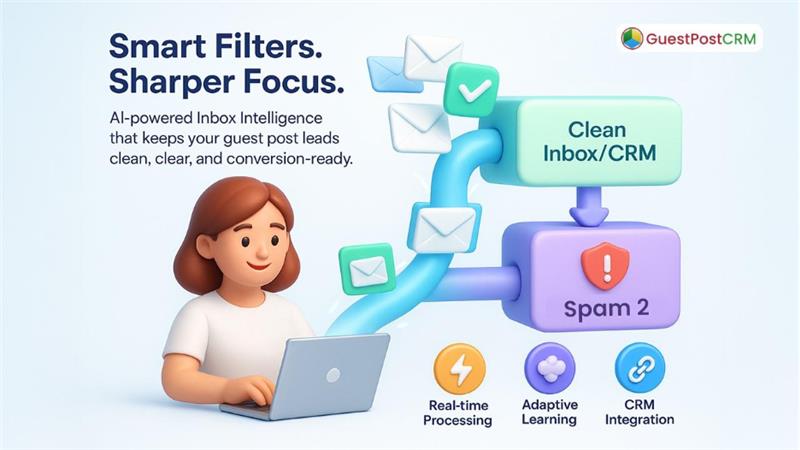
The feature Inbox to Spam2 performs a step-by-step decision process that operates in different stages of classification, each of which is designed to handle particular categories of emails with accuracy. As one of the most advanced email productivity tools for guest posting teams, it ensures that you can manage guest post leads efficiently without getting overwhelmed by irrelevant messages.
1. Content Intent Analysis
Emails that fall under the category of Non-GP/LI are not deleted directly but instead go into a second layer of analysis, whereby their content is checked for unwanted-email characteristics that the regular filters may miss. Among many other things, at this level, the following parameters are checked:
- Pattern Recognition: Learn to identify formulaic language structures common in mass generated outreach.
- Sender Reputation: Based on history of sending and domain reputation.
- Content Authenticity Makers: Shallow vs. Deep Personalization and Template-Based Communication.
- Engagement Probability Scoring: Assessing the likelihood of legitimate future value
Upon classifying an email’s content as suspicious or containing unsolicited-message indicators, it is automatically forwarded to the Spam2 label, a kind of quarantine zone, not going to either your inbox or regular spam folder.
2. Implicit Classification for Clean Emails
Non-GP/LI emails that pass the relevance review are automatically categorized. Irrelevant to your current guest posting operations, these messages do not carry malicious characteristics and thus have been let through. They remain accessible but are moved out of the way to keep your primary workflow noise-free while retaining a complete archive of your communications.
Technical Implementation Benefits
The architecture of the system provides a number of technical advantages over more general email filtering solutions:
- Real-time Processing: The classification happens right at the time of arrival to make your inbox reflect updated priorities at any moment. There’s no delay in batch processing that may have you seen irrelevant e-mails before they get filtered.
- Adaptive Learning Capability: While the system operates based on predefined classification logic, it is able to include user feedback loops wherein manual reclassification of emails helps in refining the future filtering accuracy.
- Integration with the Guest Post CRM Ecosystem: In the filtering system, integrations are deeply tied to deal creation, order management, and invoicing workflows to ensure that relevant communications automatically sync with your broader CRM operations. When an email stays in your inbox, it’s immediately available to be converted into trackable deals.
This intelligent email filtering approach helps you Keep Your Gmail Organized while ensuring that every guest posting opportunity receives prompt attention.
Conclusion
The Inbox to Spam2 feature is more than email filtering; it's the critical first stage of Guest Post CRM's overall automation architecture. It implements multi-stage classification that is context-aware, tuned for guest posting operations, and ensures that only relevant GP/L1 inquiries make their way to your workflow automation pipeline. This precision filtering protects the downstream systems against irrelevant data contamination—creation of deals, management of orders, generation of invoices, and processing of payments—and enables you to focus on activities that drive business growth alone.
FAQs for Inbox to Spam2
Q. How does Inbox to Spam2 differ from Gmail's filter?
A. Gmail blocks harmful emails, while Inbox to Spam2 separates irrelevant but genuine emails, so only real guest post leads remain in your inbox.
Q. Can it filter real opportunities by mistake?
A. No, the system employs several checking processes to avoid that, and nothing is deleted — everything remains reviewable in Spam2.



.png)
.png)