






.png)
.png)
In a data-powered world, the capability to incorporate and assess information smoothly is more vital than ever. Introducing Gldyql, a creative platform leveraging the power of AI to revolutionize the way you approach data integration. The innovative platform streamlines complex processes, allowing businesses to make intelligent decisions quickly. As businesses scramble with vast volumes of data from distinct sources, Gldyql emerges as a beacon of clarity and efficiency. Let us delve deep into how this game-changing technology is transforming the evolving landscape of data management and what it implies for the future of your organization.
What Are the Advantages of Artificial Intelligence in Data Integration?
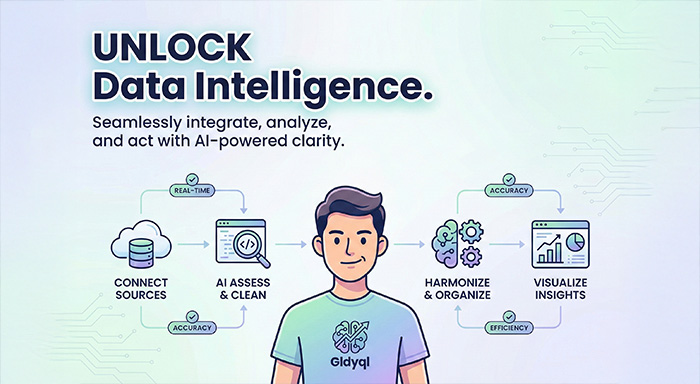
AI modernizes the way we approach data integration. It automates complex processes completely, minimizing human error and saving time. With efficient machine learning algorithms, AI can assess large data sets quite quickly. This empowers businesses to extract actionable insights immediately. Furthermore, AI-powered tools adjust in real-time. They learn from new data patterns and enhance their integration strategies consistently. This adaptability is vital for businesses to remain agile in the fast-moving environment of today. Another key benefit is the capability to handle distinct data sources smoothly. Irrespective of whether it is unstructured or structured data, AI streamlines connectivity across applications and platforms.
Cost efficiency is also a critical aspect. By simplifying workflows and reducing manual interventions, organizations can more effectively allocate resources while enhancing overall productivity. The potential for improved decision-making through rich insights further boosts the role of AI as a critical role in modern data integration efforts.
Also Read: Gadgetfreeks.com: The Trusted Hub for Tech Reviews and Gadget Insights
How GDYQL Works: A Detailed Guide
Gldyql streamlines data integration through a simple approach. Firstly, it connects with diverse data sources. This can include cloud storage, databases, or APIs. Once it is connected, GDYQL assesses the incoming data structure. It recognizes important fields and relationships between datasets. This step makes sure that all relevant data is accurately captured. After that, the platform implements AI algorithms to harmonize the data. Such smart systems clean and organize data for higher visibility. Users benefit from improved accuracy and fewer errors.
After processing, Gldyql provides innovative dashboards to easily visualize insights. Stakeholders can access analytics in real-time,e personalized to their requirements. Users can automate workflow processes as per the integrated data insights. By simplifying tasks and removing manual effort, Gldyql improves productivity across various teams.
Gldyql Real-life Applications
Gldyql is establishing its presence across diverse industries, demonstrating its versatility in data integration. In healthcare, for example, it simplifies patient records from diverse sources. This makes sure that professionals have access to accurate and precise information.
In finance, Gldyql improves real-time analytics by consolidating data from diverse platforms. Businesses can make quicker decisions based on complete insights. It is also beneficial for retail businesses as well. By incorporating data from offline and online channels, Gldyql aids brands in crafting customized shopping experiences.
Technology reaches out to logistics as well. It streamlines supply chain management by unifying data from shipment statuses and inventory levels. Every application showcases how Gldyql not only streamlines processes but also ensures innovation in routine operations across sectors.
Beyond traditional industries, AI-powered platforms are also transforming digital marketing and content management workflows. For instance, AI-powered systems like GuestPostCRM leverage smart task monitoring and automated assignments to simplify guest post management, showcasing how workflow automation and data integration principles apply across different business landscapes.
Possible Gldyql Challenges and Limitations
While Gldyql provides crucial advancement in data integration, it faces numerous key challenges. One significant limitation is the input data quality. If the information input into Gldyql is inconsistent or inaccurate, even the most advanced algorithms can create subpar results. Another key challenge exists in its complexity. It can be slightly challenging for users to completely comprehend how to effectively utilize Gldyql’s capabilities. This gap can impact the ease of adoption among non-technical users.
Furthermore, integration with the present platforms can be troublesome. Organizations generally have legacy infrastructure that does not smoothly connect with new Artificial Intelligence technologies such as Gldyql. There are also concerns associated with security and privacy. As organizations collect more data through platforms such as Gldyql, making sure that the data remains protected becomes greatly important at a time of growing cyber threats.
What Is the Future of AI in Data Integration?
In the future, AI is expected to play a significant role in data integration landscapes. As technology evolves further, we can expect more intelligent algorithms that improve the speed and accuracy of data processing. Consider systems having the capability to learn from large datasets to recognize patterns without human intervention. This can transform decision-making for businesses across diverse industries.
Furthermore, as cloud computing becomes more advanced, AI will smoothly integrate across numerous platforms. Organizations will be able to leverage real-time insights like never before. The platform is also expected to make improvements in the area of security. With sophisticated machine learning algorithms, anomaly detection in data flow becomes more effective, protecting confidential information.
Collaboration among AI platforms promises simplified workflows as well. We can anticipate seeing ecosystems where diverse applications communicate flawlessly, reducing silos within organizations. As these innovations become more apparent, technologies such as Gldyql are expected to lead the market in completely changing how we perceive and use data integration solutions to shape the high-tech future.
Conclusion
Data integration is a critical aspect of modern business processes. Gldyql leads the market, providing creative solutions driven by Artificial Intelligence. As businesses greatly turn to informed decision-making based on real-time data, platforms such as Gldyql are not just advantageous; they are intrinsically important.
By utilizing Artificial Intelligence, Gldyql simplifies processes and improves accuracy in the management of data. Its user-convenient interface, coupled with advanced algorithms, enables organizations to incorporate distinct data sources effectively. This capability changes how organizations assess data and extract insights.
However, as promising as it sounds, there are intrinsic challenges that come with executing platforms such as Gldyql. Concerns related to data security and the constant need for hurdles can create problems. Comprehending these limitations is crucial for users looking to enhance their experience.
FAQs for Gldyql
Q1. What is Gldyql, and what does it do?
A- Gldyql is an AI-driven platform that transforms data integration by automating complex processes and allowing businesses to smoothly integrate and analyze information from distinct sources. It simplifies workflows, minimizes manual effort, and ensures real-time analytics through innovative dashboards.
Q2. How does Gldyql work to integrate data?
A- Gldyql integrates diverse data sources such as databases, cloud storage, and API. It assesses incoming data structures, leverages AI algorithms to streamline and clean data, and then offers real-time insights via an intuitive dashboard.
Q3. What industries can benefit from using Gldyql?
A- Gldyql is flexible across diverse industries, including finance, healthcare, retail, and logistics.
Q4. What are the main challenges or limitations of Gldyql?
A- Main challenges involve complexity for non-technical users, input data quality, integration difficulties with legacy platforms, privacy, and security concerns.
Q5. Are there any other meanings of Gldyql?
A- This blog focuses on the AI-driven data integration context of Gldyql. However, as per Google, there are blogs on different meanings and contexts for Gldyql.


.png)
.png)
.png)
.png)