




.png)
.png)
Whether you are sending an email in corporate, to the university, or bank, sending one email generally is not sufficient. Most inboxes these days are filled with emails and chances of getting a reply after the first email is very slim. Most clients, prospects, universities, and publishers need a nudge or reminder before they can pay attention to your email and respond to you. This is why you need an effective follow up email strategy. Whether you are checking a job application, chasing a sales lead, sending another email to your publishing, or inquiring about your admission status, you need a follow up email to push the conversation forward. In fact, it can be the difference between a dead conversation or a completed objective.
This is a detailed guide on a follow up email and explains why is it important, how to create one, and a complete list of follow up email templates you can use in your outreach, and other follow-up email examples categorized by use cases, from sales and networking to admissions and job applications.
What Is a Follow Up Email?
A follow up email refers to a message sent after the first email, interaction, or call that did not get you a response or push the lead to the next stage. It works as a polite reminder, ensures that the conversation remains active, and encourages the recipient to take action or make a decision.
Follow-up emails generally can be divided into a few categories:
- Sales follow-ups – Sending a follow-up to leads after a demonstration, pitch, or proposal.
- Meeting follow-ups – Confirming next steps and recapping discussion points.
- Outreach follow-ups – Re-engaging partners, publishers, or collaborators who have not yet replied.
- Inquiry or Application Follow-ups – Checking the overall status of the submitted request.
- Networking Follow-ups – Getting in touch with a new contact after a formal introduction at an event.
- Invoice or Payment Follows– Sending a reminder to the client about the pending payment.
Irrespective of the category, each effective follow up email shares a similar goal: sending a reminder to the recipient about the original message while providing them with a low-effort or clear reason to respond.
Why Are Follow-Up Emails Important?
As you already know, even a normal person's inbox gets crowded, clients get engaged in other work, and your recipient can simply fail to see or ignore your email. Most recipients require context and clearly stated purpose before they will work on a message because a repetitive or vague "just checking in" note seldom gives them a response.
A robust follow-up strategy enables you:
- Recover interactions or leads that can go cold if the conversations do not move forward.
- Show persistence and professionalism without appearing too pushy.
- Improve the reply rates by providing recipients with a reason to act.
- Ensure projects, deals, and outreach campaigns before going forward.
- Establish your brand’s reputation as a company that always follows through and cares about clients, which is important for lasting relationships.
If you handle a big volume of outreach, monitoring who still requires a manual follow-up becomes tricky. Specially built outreach management software helps in automatically flagging unanswered threads, so no contact ever slips through the cracks just because a human forgot to check.
Best Practices for Writing a Follow-Up Email
While writing your follow-up email, keep the following points in your mind:
- Clearly State Your Objectives: Be clear on what you want the recipient to do, reply to you, confirm the meeting time, approve a request, etc. If you are clear with your objectives, it will show in your follow-up email.
- Open with context: Re-introduce yourself and give a context of the follow-up. If you had sent your email a couple of weeks ago, your recipient might have forgotten about it already.
- Keep it short: Attention span of everyone is decreasing including your recipients’. They are likely to skim through long paragraphs. Thus, just stick to a few lines and highlight important points.
- Use a Particular Subject Line: Avoid using generic lines such as “Checking In,” reference the date or topic instead.
- Include One clear CTA: Ask one direct and single question instead of asking a lot of questions at once.
- Timing Is Everything: You can wait a couple of days after sending your first email before drafting your follow-up email. And this is for urgent matters. For casual follow-ups, you can wait for 1-2 weeks as well.
- Avoid sounding Impatient: This is true in all use-cases but especially in marketing. A courteous or value-based tone can generally get you better outcomes than creating pressure.
- Change Your Angle with Each Attempt: Avoid sending the exact same message in your follow-up. Add something new, which can be new data, a resource, discount code, or a slightly different question.
- Proofread Before Sending: If the purpose of sending a follow-up is to show professionalism or persistence, sending a follow-up with grammatical mistakes, typos, and spelling mistakes is not helpful.
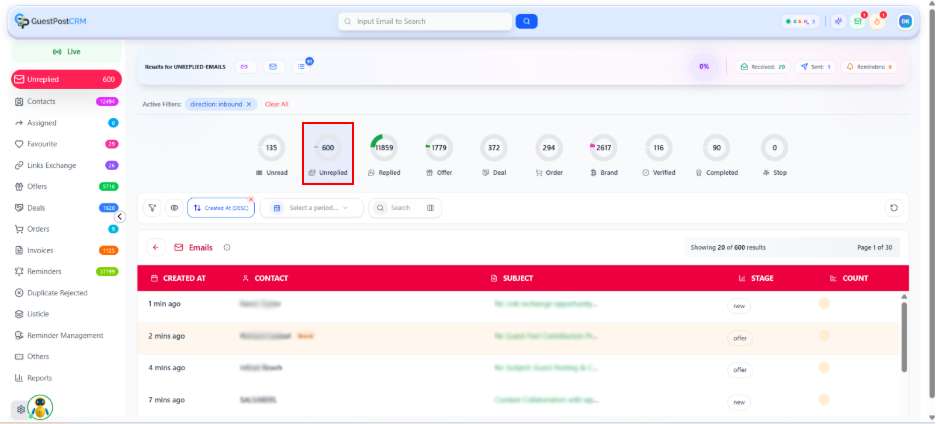
Tracking and timing is everything while responding to the client or sending follow-ups. If you want to demonstrate professionalism, timely responding to emails becomes as important as sending follow-ups. If you depend on a spreadsheet or Gmail, unanswered emails are quite easy to lose track of. A CRM with an in-built Unreplied Emails Category in GuestPostCRM automatically separates contacts you have not responded to yet (see the below screenshot). It helps in making sure that no relevant email ever goes unnoticed.
Time Factor in Sending Follow-up Email
Timing changes as per the situation. You can utilize this as a general reference:
| Situation | Suggested Timing |
| Thank-you note after the interview or meeting | Within 24 hours |
| Submitted Documentation or Urgent Request | Within 48 hours |
| Meeting request or sales proposal | 3–7 days |
| Guest post pitch or cold outreach | 5–7 days |
| Checking job application status | 1–2 weeks |
| Re-establishing connection with an inactive contact | Every 2–3 months |
Sending an email too soon can prove to be too pushy, while waiting for too long can pose risks if the recipient forgets about the original contexts altogether. When you are in doubt, a week can be a safe middle-ground for most professional follow-ups.
Top Follow Up Email Template You Can Use
You can utilize the below-mentioned general-purpose follow up email template as your starting framework, then you can adjust the details and tone to align your relationship with the recipient.
The following is a general follow-up, which is applicable in mostly all use-cases:
Subject: Following up on [Topic/Proposal Name]
Hi [First Name],
This is an email to my previous follow up about [brief context — the proposal, meeting, or request]. You might have gotten busy, which is okay. So, I just wanted to check whether you had an opportunity to go through it.
If you need more details or have any questions, feel free to reach out to me. Would [particular day/time] be good enough for a quick call, or would you want me to send more information first?
Looking forward to hearing from you.
Best,
[Your Name]
[Your Title/Company]
Your sign-off can also influence how your message feels, especially when you want to keep the tone friendly and memorable. If you are looking for creative ideas beyond traditional email endings, check out these funny email sign-offs for inspiration.
Additional Follow-Up Email Templates Categorized by Scenario
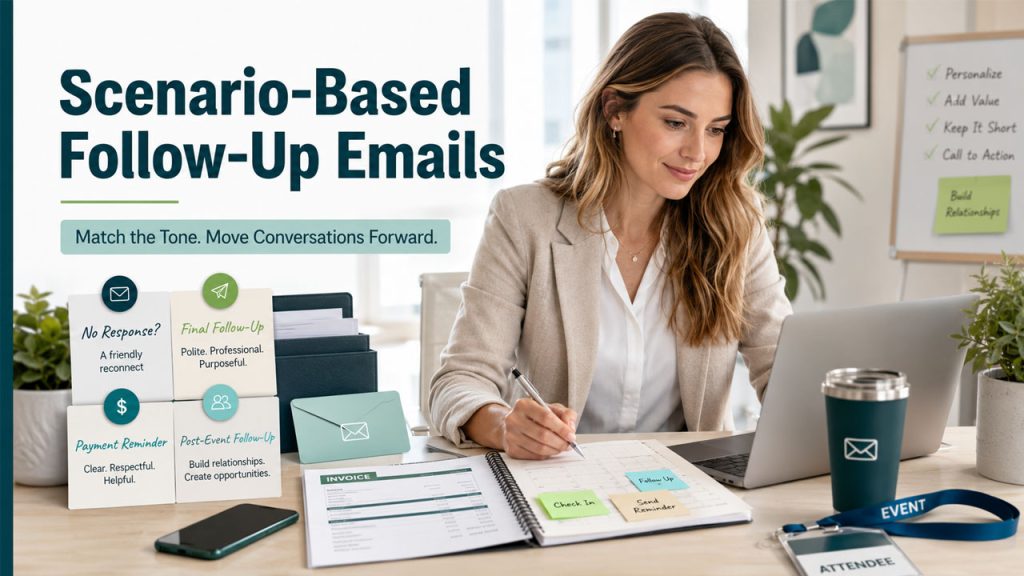
Different situations need different tones. Let us see a few additional follow up email templates for professional use-case and prevalent use-cases:
1. Second Follow-up (After No Response to the First)
Subject: Reconnecting Back On [Topic]
Hi [First Name],
I understand that inboxes do get full. This is just circling back on what I had shared earlier in my email. I am still happy to assist you with [request/topic] whenever it is convenient for you.
If now is not the right time, just let me know when you will be available for a quick call, and I will connect with you then.
Best,
[Your Name]
2. Final follow-up (Breakup Email)
Subject: One Last Try Before I Close This
Hi [First Name],
I hope you are doing well. I am checking in on you one last time. I have not heard back from you. If [topic/request] is not a priority for you anymore, this is completely fine. Just let me know and I will stop bothering you.
However, if you do change your mind in the future and would like to move things forward, just find me here. I will be happy to restart everything whenever it works for you.
Best,
[Your Name]
3. Client Payment Reminder Follow-up
Subject: Payment Reminder: Invoice #[Number] due on [Date]
Hi [First Name],
This is another friendly reminder that your invoice #[Number] is due on [date]. If you have any queries regarding the payment details or need a copy resent.
Thank you in advance,
Best,
[Your Name]
4. Following Up for the Network After the Event
Subject: Pleasure Meeting You at the Event [Event Name]
Hi [First Name],
I suppose you missed my first email. Anyhow, it was great meeting you at [event name] event. I was intrigued by what shared about [topic]. I have thought and researched it, and I have something to share that you will find interesting.
Shall we set up a quick call in the coming weeks? Let me know your availability so that I can check my calendar.
Best,
[Your Name]
Follow Up Email Examples
Now, follow-up emails also depend on the use-case. Exactly, who are you sending it to and why? Let us go through a few follow up email examples customized to a few real-world situations:
1. Post Sales Meeting
Subject: Great Having Conversation with You, [Name]
Hi [Name],
I had a great time discussing [topic] with you. According to what you have shared about the problem [pain point], I think [solution] can be a great fit. Would you be open to a follow-up call next week to go over the details? I would like to hear your thoughts on this.
Best,
[Your Name]
2. After You Receive No Response to a Proposal
Subject: Any thoughts on the proposal I sent earlier?
Hi [Name],
Did you get a chance to look at the proposal that I sent on [date]? Please share your thoughts or queries. I will also be happy to come over a call to discuss them further with you.
Best Regards,
[Name]
3. Guest Post or Outreach Follow-Up
Subject: Follow-up on Guest Post or Link Insertion Inquiry
Hi [Name],
I had expressed my interest in publishing a blog on your website. Unfortunately, I didn't hear back from you. This is just a follow-up on the pitch that I had sent regarding the [topic]. If the timing is not right, there are no issues. Just let me know and I will follow up later, or feel free to suggest any other topic that algins with your editorial calendar.
Wishing you a great day,
[Name]
4. Checking Your Application
Subject: Checking My Application Status
Hi [Name],
I had earlier submitted an application for [position/request] on [date] and wanted to confirm whether it was received. Please let me know if I can help you with additional information or documents.
Would appreciate a response,
Best Regards,
[Name]
5. Following Up After a Referral
Subject: [Mutual Contact] suggested that I connect with you
Hi [Name],
Hi, this is a follow-up to an earlier email. [Mutual contact] mentioned you might be the right person to connect with regarding [topic/issue]. I wanted to know if you would be up for a quick call to discuss a few points.
Warm Regards,
[Name]
6. Following up on the Job Interview
Subject: Following up on our conversation about [Position]
Hi [Name],
I applied for the position of [Position] and completed [number] rounds of interview. This is a follow-up to an earlier email I sent regarding the status of my application. I am still interested in the position, but I am expecting/have a few offers so let me know your decision so that I can decide with clarity.
With Best Regards,
[Name]
7. Re-engaging a Cold or Inactive Lead
Subject: Still interested in [topic]?
Hi [Name],
It has been while since we last got in touch with [topic]. I wanted to follow up and see if you have changed your mind on your end, or whether I can help you understand it better. Let me know your thoughts.
Best Regards,
[Name]
Notice how every example starts with context, provides a purpose, or concludes with a particular call-to-action. The similar structure is utilized in the templates above.
Major Mistakes You Can Avoid in Follow-Up Emails
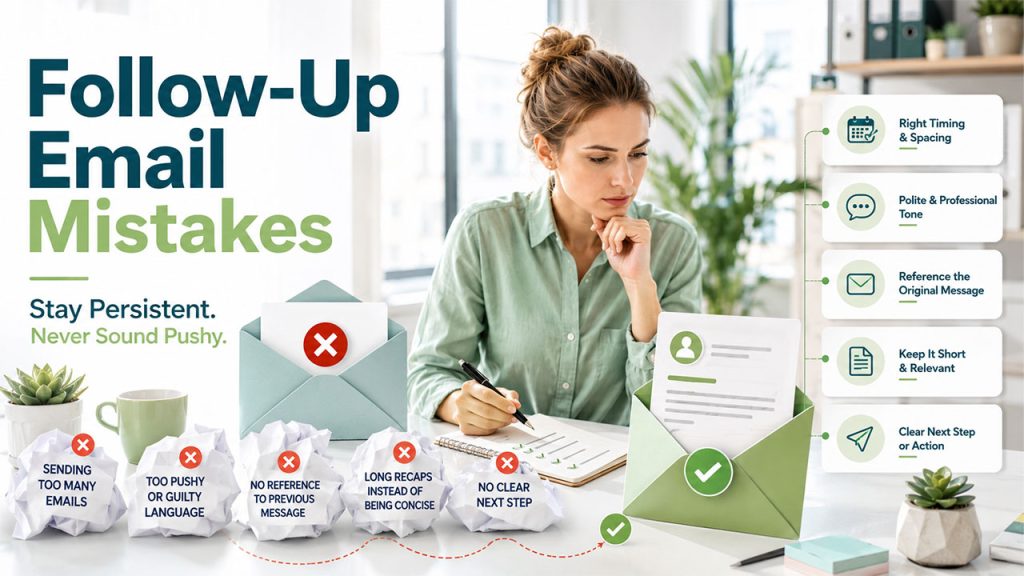
- Spamming Inbox in a Short Window: Sending 3-4 follow-ups within a short window can make you appear aggressive instead of being persistent.
- Using Pressure or Guilt Language: Avoid phrases such as “I have reached out multiple times” or “I suppose you have been too busy” can push your recipients back.
- Forgetting to Give a Reference on the Original Message: Without the right context, your follow-up will not be useful for you. You cannot expect the recipients to go through old emails to remember what you are talking about.
- Writing Long Paragraphs of Recaps: A follow-up must quickly refresh your memory and not restate the original email entirely.
- Clearly Skipping the Next Step: Every follow-up must end with something particular and simple to work on.
How GuestPostCRM Helps You Stay on Top of Follow-Ups
As you can see, writing an effective follow-up email is a complex task that can eat a lot of your productive hours if you want to do it right. Furthermore, writing follow-ups is only half of the problem; the actual dilemma comes when you want to figure out when you should send it. The task becomes specifically tricky when you are juggling between multiple conversations at once. This precisely where GuestPostCRM becomes an unquestionable choice.
GuestPostCRM is an AI-powered CRM specially-built for agencies and SEO teams that handle guest post inquiries from the first email to the final published link. It manages filtration and passes only relevant inquiries so that you do not have to deal with the noise. It also automatically sends the first reply messages so that no inquiry ever goes unnoticed, automates negotiation with user-friendly buttons, tracks and manages orders and deals, generate invoices, and most importantly sends follow-ups or reminders. All of this happens inside a single workspace so that you don't have to scramble through spreadsheets or inboxes.
The Automated Reminder System solve the exact issue that this guide talks about. It takes care of it automatically so that you don't have to worry about what to send, how many times to send, and when to send. GuestPostCRM triggers pre-set reminders automatically at each stage of the workflow. Thus, if the system sees that client has not replied in a while at any stage of the conversation, it sends a follow-up which helps in pushing the pushing the conversation forward instead of allowing it to die down. The types of follow-ups (reminders) that GuestPostCRM sends are as follows:
- Before Reply Reminder – This is sent if the client does not respond to the automatic first reply.
- Offer Stage Reminder – If the client reaches the offer stage but does not negotiate and leaves the conversation, a follow-up is sent that encourages clients to continue conversation.
- Deal Stage reminder – A deal summary is sent, but the client has not sent any orders. It is triggered when an agreed deal becomes inactive for a set period.
- Invoice stage reminder – The work is done and the invoice is sent but the client has not completed the payment. GuestPostCRM automatically sends a fixed number of payment reminders after a predefined period.
- Renewal reminder – It automatically sends an alert to the client that the live link expiration is approaching soon.
Automated Reminder System in GuestPostCRM is capable enough that you have to forget about sending follow-ups altogether. Essentially, depending on the stage where the conversation is stuck, whether it be first reply, offer, deal, or invoice stage, GuestPostCRM takes over and sends a contextually relevant follow-up on your behalf. This saves you crucial time in strategizing, drafting, and sending follow-ups. What's more? You have total control to review and personalize each message before it is sent from the system.
To learn more about specialized capabilities of GuestPostCRM, explore our website.
Conclusion
A well-written follow-up email is important in so many ways. It is not about "just checking in." It is about providing your recipient with a clear reason to respond. By being clear on the objective, starting with the context, and closing out with a particular CTA, you convert a routine reminder into a message that moves the conversation forward. Utilize the follow up email examples and follow up email templates provided above as a starting point for outreach, sales, networking, or applications, and then adjust the tone to make it aligned with your relationship with every contact. Integrated with a relevant tracking system, a consistent follow-up habit is one of the most effective ways to close more opportunities and recover stalled interactions.

.png)
.png)