




.png)
.png)
Google continues to refine how Search identifies and handles spam, and 2026 brings several confirmed updates. Google rolls out spam updates in March, June, August, and September, making spam detection a recurring part of Search this year. The Google September Spam Update is the latest rollout and begins on September 24, with Google saying the process may take up to two weeks. Google provides limited details about each rollout, but the pattern gives website owners reason to review their SEO practices. This article examines the 2026 updates, Google's confirmed information, and what website owners should watch.
How Does Google's Spam Update System Work in 2026?
A Google spam update is one of Google's algorithm updates that updates Google's automated search spam detection systems. Google Search updates have the potential to impact a website's performance in Search, with spam updates being one of the tools Google uses to "lower a site in Search or keep it out of Search entirely." Google considers spam to be "any behavior that deceives users or manipulates our systems to boost a site's ranking in Search."
Google’s September Spam Update rolls out worldwide across all languages. It can take up to two weeks to finish. Google hasn't announced a new spam type or tactic for the spam update; Google is calling it a spam update, and you should refer to the Google spam policies when reviewing your site. Google announced in the past that updates during the spam update are not indicative of a policy violation.
Major Google Spam Updates in 2026
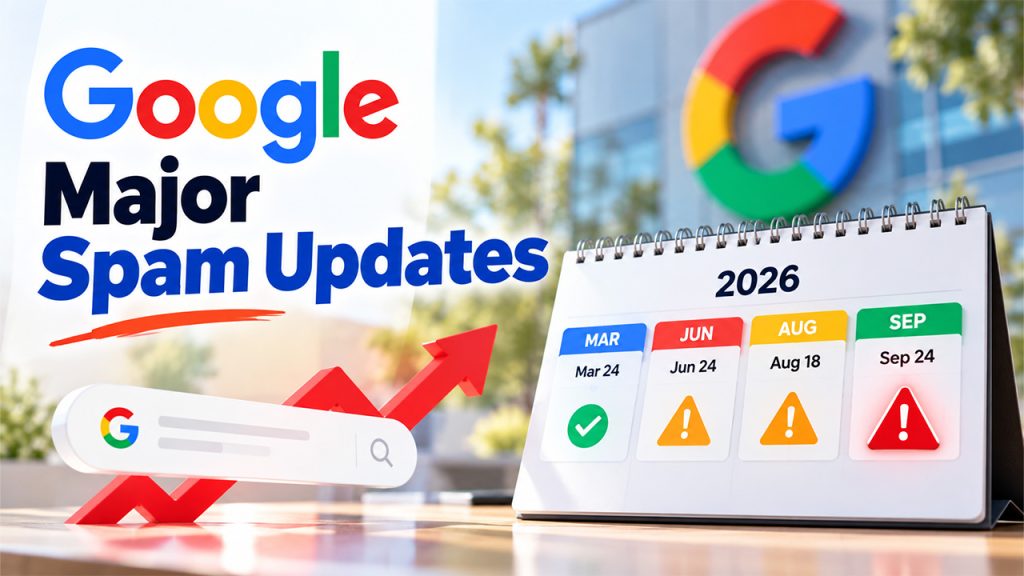
Google's Search Status Dashboard lists four confirmed spam updates in 2026. The timing and duration vary, but all four are global and cover all languages.
| Google Spam Update | Start Date | Rollout Duration |
| March 2026 Spam Update | March 24, 2026 | 19 hours, 30 minutes |
| June 2026 Spam Update | June 24, 2026 | 2 days, 1 hour |
| August 2026 Spam Update | August 18, 2026 | 2 days, 16 hours |
| September 2026 Spam Update | September 24, 2026 | In progress |
The March rollout completes in less than a day, while June and August take several days. Each Google spam update matters for website owners. The Google September Spam Update has the longest announced rollout window so far, with Google allowing up to two weeks for completion. The longer window does not mean the update takes the full period, so website owners should avoid drawing conclusions while it remains active.
The 2026 timeline shows why website owners should not treat spam updates as rare events. Google repeatedly improves spam detection systems, so SEO teams need a process for monitoring sites. Google has not published a detailed list of specific changes for every 2026 rollout, making it important to separate confirmed information from early SEO observations.
What Types of Spam Should Website Owners Watch?
Google does not provide a detailed target list for every 2026 spam update. Website owners should therefore avoid claiming that one rollout specifically targets AI content, links, or another tactic without supporting evidence. Instead, the existing Google spam policies provide a useful framework for understanding practices that can create Search problems.
- Scaled Content Abuse: It involves creating many pages mainly to manipulate Search rankings rather than help users. Google says this can include large amounts of unoriginal content produced with generative AI or other tools when the content adds little or no value. The use of AI itself is not a violation. The concern is producing content at scale for ranking manipulation without meaningful value.
- Keyword Stuffing: This occurs when a page contains an excessive or unnatural amount of keywords or numbers to influence rankings. Repeated phrases, keyword lists, and location terms without useful context can create this problem. Content should use relevant language naturally and serve the reader's search intent.
- Link Spam: It involves creating or acquiring links mainly to manipulate rankings. Examples include buying or selling links for ranking purposes, excessive link exchanges, and automated link creation. Legitimate sponsored or advertising links can use appropriate link attributes.
What Should Website Owners Do Now?

The best response to the Google September Spam Update is to focus on the website rather than trying to reverse-engineer the update. Google does not provide a detailed list of changes for the rollout, so following established Search guidance is more useful than reacting to speculation.
- Review Content Quality: Check important pages for originality, useful information, clear purpose, and value for readers. Review content produced at scale, including content created with automation or AI, and improve or remove pages that provide little value.
- Review SEO Practices: Audit keyword use, internal linking, external links, redirects, and other optimization practices. Look for tactics that exist mainly to manipulate rankings instead of helping users. Following white hat link building practices can help keep link acquisition aligned with search engine guidelines.
- Monitor Search Console: Track clicks, impressions, average position, and indexing data in Google Search Console. Mark the dates of confirmed Google updates in reporting so your team can compare performance before, during, and after a rollout.
- Avoid Rushed Changes: Do not make large site-wide changes simply because rankings move during an active update. Wait for the rollout to finish, review the data, and then investigate consistent patterns. This approach helps separate temporary volatility from a sustained problem.
What Comes Next After Google’s September Spam Update
The Google September Spam Update is the latest event of the year that already includes three other confirmed spam updates. In our view, the bigger SEO story is the frequency of Google's ongoing attention to search spam rather than any single rollout. Google’s latest Update also shows why website owners need a continuous approach to SEO compliance. Instead of trying to predict every Google change, businesses can focus on useful content, natural optimization, clean technical practices, and regular monitoring. These habits do not guarantee stable rankings, but they create a stronger foundation for handling future Search changes without relying on short-term tactics.


.png)
.png)