





.png)
.png)
Most SaaS companies invest their money into paid ads, product-led growth, and outbound sales. SEO is often at the bottom of the priority list. Every month without a working SaaS SEO strategy is a month of compounding organic opportunity lost to competitors who started earlier. This blog makes a simple argument: SaaS SEO is not just a traffic channel. It is one of the most cost-efficient growth levers available to a SaaS business, and most companies underinvest in it because they do not fully understand what it is built to do.
What Is SaaS SEO?
SaaS SEO refers to the process of optimizing a website of a software-as-a-service company so that it can rank in search engines and bring organic traffic that converts into trials, demos, and paying customers. Many companies choose to partner with a dedicated SaaS SEO agency to build and execute this strategy from the ground up.
What makes it different from general SEO is context. SaaS products are subscription-based, that’s why the buying decision takes time, and customers also research extensively before committing. Therefore, the goal is not just to rank. Rather, it is to show up in front of the right people at the right moment while they are in their decision-making process. When done well, SaaS SEO brings in qualified leads without a recurring ad spend attached to every click, and that is exactly what makes it worth investing in.
Why SaaS SEO Is Important for SaaS Companies

SaaS SEO plays a critical role in driving sustainable growth by attracting qualified leads, reducing acquisition costs, and building long-term visibility.
Lower Customer Acquisition Costs with SaaS SEO: Paid ads deliver results only when you keep paying. However, once organic content starts ranking, it keeps working. A well-optimized blog post or landing page can bring in leads for months or years without any additional spend.
Reach Buyers at Every Stage of the Funnel: SaaS buyers do not make impulse decisions. They research, compare, read reviews, watch demos, and revisit options multiple times before committing. From someone first discovering they have a problem to someone comparing your product with a competitor and starting a free trial; SaaS SEO allows you to show up at every stage of that journey. Each stage needs different content, and a strong SaaS SEO strategy covers all of it.
Build Long-Term Brand Authority: When the content that your buyers care about appears consistently in search results, your brand becomes the recognized authority in your field. Strong search engine positioning is what separates brands that get discovered organically from those that remain invisible without paid spend.
Drive Compounding Organic Growth: Paid campaigns stop working when the budget runs out, but organic rankings build on themselves. A strong content foundation today makes every new piece of content more effective tomorrow. This growth dynamic makes early investment in SaaS SEO valuable.
SaaS SEO vs Traditional SEO: Key Differences
Even though SaaS SEO and traditional SEO share the same technical foundations such as keyword research, backlinks, on-page optimization, and site performance; they differ in strategy, priorities, and content approach.
| Factor | Traditional SEO | SaaS SEO |
| Primary goal | Drive traffic and sales for product or service | Generate trials, demos, and long-term subscriptions |
| Sales cycle | Often short, sometimes impulsive | Long, research-heavy, multi- touchpoints |
| Content focus | Product pages, local SEO, transactional content | Botton-of-funnel comparison, use case pages, educational content |
| Keyword intent | Mostly transactional or informational | Mix of awareness, consideration, and decision-stage intent |
| Customer value | Often one-time purchase | Recurring revenue |
| Competition | Varies by industry | Often competitive, dominated by large SaaS players |
| Conversion path | Add to cart, call, or visits | Free trial, demo request, or freemium signup |
Steps to Create an Effective SaaS SEO Strategy
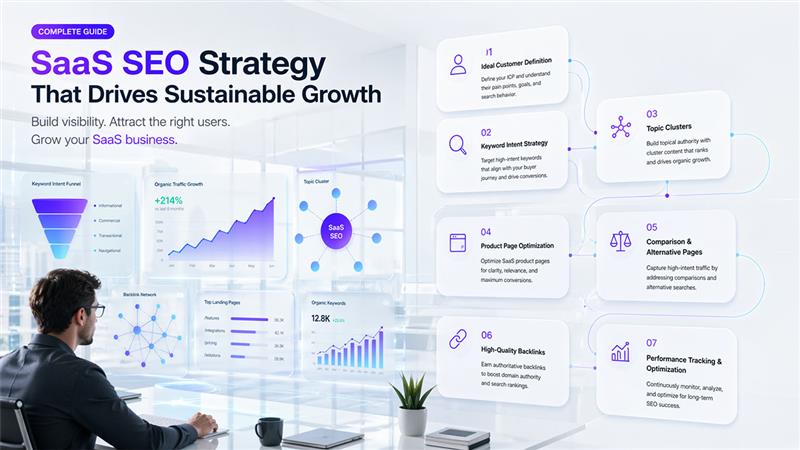
A strong SEO strategy isn’t built randomly. It follows a structured process that aligns your content, keywords, and goals with the real user intent.
1. Define Your Ideal Customer First
First of all, specify your target audience. Think about what problems are they facing? How do they describe those problems in online search? What are they comparing before they buy? Your SEO strategy is only as good as your understanding of the person it is built for.
2. Focus on Keyword Intent
Not all keywords carry equal weight. A keyword with high search volume means nothing if the people searching for it are nowhere near a buying decision. Map your keywords across awareness, consideration, and decision stages. Give priority to bottom-of-funnel terms like comparison pages, alternative searches, and use-case specific queries because those visitors are the closest to converting.
3. Build Topic Clusters
Instead of targeting one keyword in a blog post, build clusters. Select a broad core topic, create a strong pillar around it, and support it with more specific content that links back to the pillar. This approach builds topical authority and creates a content experience that feels connected rather than scattered.
4. Optimize Core Product Pages
There are a lot of SaaS companies that pour their attention into the blog and leave their core pages like homepage, feature pages, use case pages and pricing pages under optimized. These pages, too, need proper keyword optimization.
5. Create Comparison & Alternative Pages
When somebody wants to evaluate or compare something, they search “Tool A vs Tool B” or “best alternative to Tool X”. If your page shows up for these searches, it will convert well because it puts your content directly in front of someone who is actively deciding.
6. Earn High-Quality Backlinks
Backlinks earned from relevant and credible sites significantly improve rankings. To get links, publish your original, useful content, build free tools, and contribute to guest posting websites. Do not chase low-quality links as they will not build the kind of authority that compounds.
As your efforts grow, the right link building tools help you track outreach and monitor new backlinks. Do not chase low-quality links as they will not build authority that compounds.
7. Track, Analyze & Improve Performance
Track what matters such as keyword rankings, organic traffic, and most importantly, how many trials or demo requests are coming from organic. Audit your content regularly using SEO audit tools. Update pages that have dropped and double down on what is working. SaaS SEO is not something you set up once and forget about it. It needs constant attention.
Top 5 Essential SaaS SEO Tools
You do not need every tool on the market. You need the right ones. Here are five that are genuinely worth your time:
- Ahrefs: Ahrefs help you understand what is driving the organic growth of your competitors. Its keyword research, backlink checker, and content gap features give you a clear picture of where opportunities exist and what it will take to compete for them.
- SEMrush: SEMrush offers strong SEO capabilities. Its keyword intent filtering is particularly useful for those SaaS teams that want to build content across multiple funnel stages. It tells you whether a keyword is informational, commercial, or transactional.
- Surfer SEO: Once you know what to write, Surfer helps you write it in a way that competes. It analyzes the top-ranking pages for your target keyword and tells you how your content stacks up in terms of structure, length, and the terms you need to cover.
- Google Search Console: Search Console shows you exactly which queries are attracting people to your site, which pages are gaining or losing traction, and where technical issues might be hindering your growth. It is fee, reliable, and essential.
- Clearscope: It helps writers cover topics thoroughly by surfacing the related terms and concepts that top-ranking pages tend to include. It is especially useful for content teams who need to maintain quality consistently across a high volume of output without manually auditing every article.
Conclusion
SaaS SEO doesn’t produce instant results. It takes time to build, requires consistent efforts, and demands a level of strategic thinking that goes beyond simply publishing the content and hoping it would rank. Companies that invest early in SaaS SEO bring in qualified leads, reduce reliance on paid channels, and strengthen brand authority over time. Whereas the companies that delay find themselves paying more and more for the same customers that a well-built organic strategy could have been delivering for free. The choice is really that straightforward.
Start with clarity on your ICP (ideal customer profile), build content that matches how your buyers actually search, and treat SaaS SEO as the long-term business investment for long-term sustainable growth.

.png)
.png)