




.png)
.png)
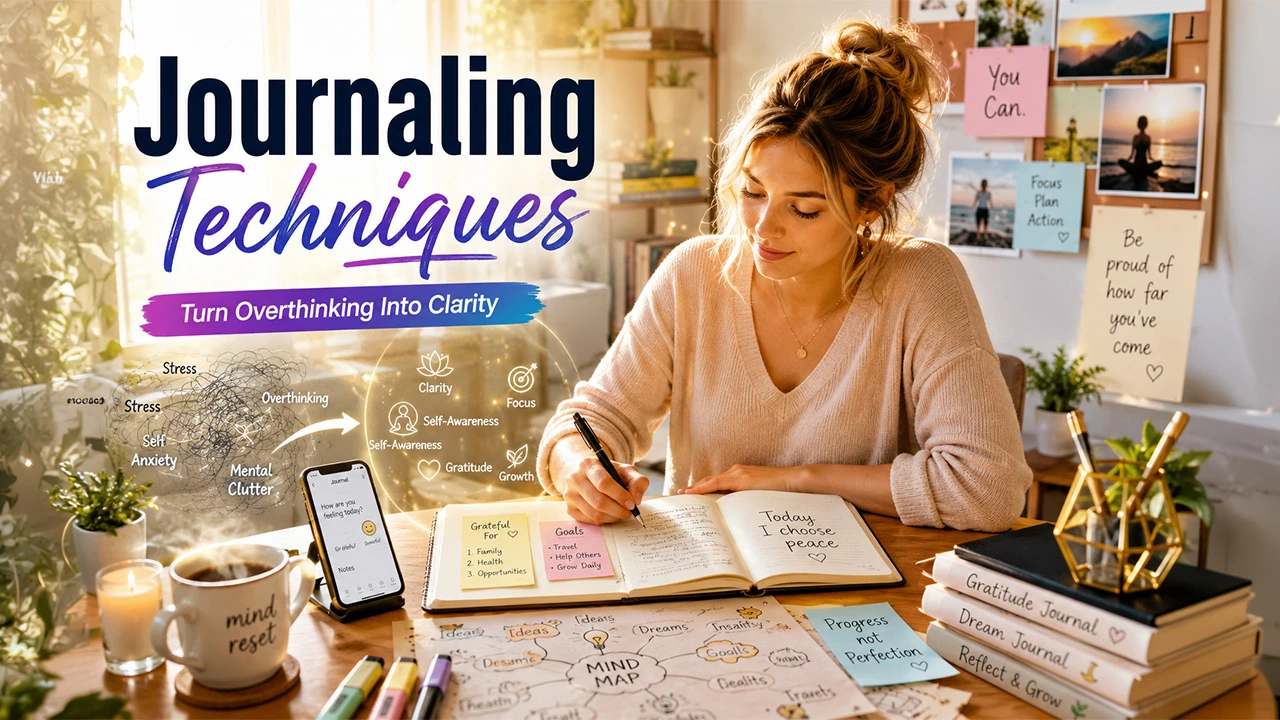
There is something quietly defeating about opening a blank notebook with the best intentions and then closing it ten minutes later without writing anything. You wanted to journal but couldn’t.
This happens to almost everyone, and it rarely has anything to do with motivation. It usually means the format isn't right for what you're carrying that day. Some days need structure, some need chaos, and some days need nothing more than a list of three things you noticed before noon.
That's what journaling techniques are really for. Not to make journaling feel more serious or productive, but to give you a way to jot down your thoughts and feelings.
What Is Journaling?
Journaling is the practice of writing down your thoughts, feelings, and experiences in a personal and private space. There are no rules about what it should look like. It can be a leather-bound notebook on your desk, a notes app on your phone, or a loose sheet of paper you find in a drawer.
In simple words, journaling is a conversation that you have with yourself. It is the place where you can be completely honest without worrying about how it sounds. There is no audience, performance or need to explain yourself. It’s just you and whatever is actually going on inside.
How to Start Journaling as a Beginner
Starting a journaling practice doesn’t have to be complicated, and honestly, the simpler you keep it at the beginning, the more likely you are to stick with it.
Here’s what helps when you’re just getting started:
- Pick a format and stick with it for a week: Don’t try three different techniques on day one. Choose one that sounds natural and give it a few days before deciding if it’s working for you.
- Set a realistic time: Even five minutes counts. Morning works well for most people because it clears mental noise before the day adds more, but evening works just as well if that fits your routine better.
- Use whatever you have: A notebook, a notes app, a loose piece of paper. The tool doesn’t matter nearly as much as the habit of showing up to write.
- Don’t aim for perfect entries: Beginners often stop because what they write doesn’t feel meaningful enough. It doesn’t need to be. Even a few scattered lines about how you’re feeling count as a legitimate journal entry.
- Keep it somewhere visible: Out of sight usually means out of mind. Keeping your journal on your desk or nightstand makes it easier to remember and harder to skip.
The goal at the start isn’t depth or consistency; it’s just showing up. Everything else builds from there.
10 Best Journaling Techniques That Actually Work
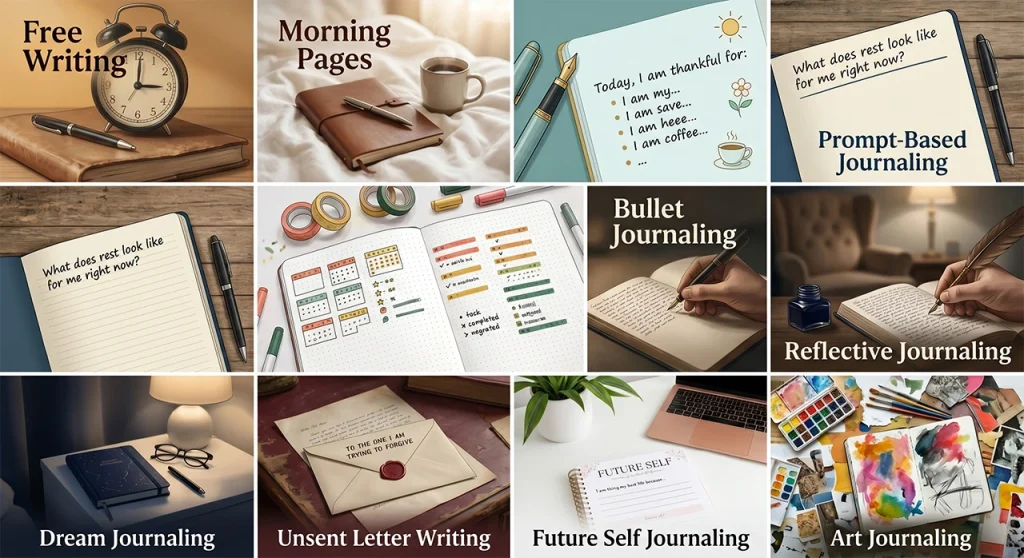
Different journaling techniques serve different purposes, helping you process emotions, organize thoughts, build self-awareness, and make journaling feel more natural and consistent.
1. Free Writing
First, set a timer from five to fifteen minutes and write without stopping, editing, or second-guessing. There are no rules for this. The grammar doesn’t matter, and sentences do not need to be complete. The only rule is to keep writing. Free writing is particularly effective in the morning because it clears your mental clutter before the day builds up more of it. Even if you can’t think of anything after three lines, keep going. Something usually flows.
If you often lose good ideas before you can develop them, using a quick note-taking system can help you capture thoughts instantly and organize them into well-structured content later.
2. Morning Pages
It was popularized by writer Julia Cameron. Morning pages involve writing three pages by hand first thing in the morning, even before checking your phone or doing anything else. The idea is that in those early minutes, you have a more honest connection to your own thoughts. Many people find that writing morning pages surfaces new ideas, buried concerns, and feelings that they were carrying without even realizing.
3. Gratitude Journaling
This one is simple and people often underestimate it. So, what you have to do is, at the end of the day, write down three to five things that you are grateful for. They do not need to be important. For instance, it can be a good cup of coffee at your favorite spot or a conversation that made you laugh. This practice works because it focuses your attention towards positive and good things, which is a surprisingly difficult thing for most people to do consistently. Over time, gratitude journaling starts shifting lens rather than forcing positivity.
4. Prompt-Based Journaling
If you don’t know where to begin, prompts are the solution. A prompt gives you a specific question or starting point to respond to, removing the pressure of figuring out what to write about. Prompts can be tender, such as "What does rest look like for me right now?" or practical, such as "What is one thing I keep putting off and why?" Prompt-based journaling works well for those people who want to go deeper but don't know where to start.
5. Bullet Journaling
Bullet journaling is less about writing and more about organizing your life inside a notebook. It was created by designer Ryder Carroll. It combines task management, habit tracking, goal setting, and reflection in one flexible system using short bullet points, symbols, and simple layouts. It suits people who feel more comfortable with lists than paragraphs, and who want their journal to feel useful on a practical level as well as a personal one.
6. Reflective Journaling
This technique asks you to slow down and look back. You write about something that happened, not just what occurred but how it affected you, what you made of it, and what you might do differently to deal with it. Reflective journaling is particularly useful when you are dealing with change or during periods of difficulty. It helps you move from simply experiencing life to actually understanding it. Many therapists recommend it because it builds the habit of examining your own reactions with curiosity rather than judgment.
7. Dream Journaling
In this journaling technique, keep a notebook next to your bed and jot down whatever you remember from your dreams the moment you wake up. Since dreams fade quickly, the sooner you write, the more you capture. Dream journaling is not about interpreting every symbol. It is about noticing patterns, recurring feelings, and images that surface when your conscious mind is not in charge. Over time, it can reveal emotional themes you might not have access to during waking hours.
8. Unsent Letter Writing
You write a letter to someone; a person, a past version of yourself, or a situation that you’re trying to navigate, that you never intend to send. The freedom of knowing it will never be read changes how honestly you write. In a Netflix series “To All the Boys I've Loved Before,” the lead actress uses a technique where she writes letters to people she never actually intends to send.
This technique is especially useful when you have something unresolved with someone, and there is no safe way to say it out loud. It offers release without expecting a response, which is sometimes exactly what the moment needs.
9. Future Self Journaling
In this technique, you write as though you are already the person you want to become. You describe your life and your mindset from a future point of view. It is more than just setting goals. It asks you to inhabit a version of yourself that doesn't exist yet, which often reveals what you actually want versus what you think you should want. This works particularly well at the start of a new year, a new chapter, or any moment that feels like a turning point.
10. Art Journaling
You don’t always need words for a journal entry. Art journaling is one of the most creative journaling techniques that uses the page as a creative space. In this technique, drawing, doodling, painting, and collaging replace or accompany writing entirely. It works especially well on days when feelings are too big or too vague to put into sentences. You do not need to be an artist to try it. Even a smear of color, a torn magazine clipping, or a rough sketch counts just as much as a carefully drawn image. The point is expression, not execution, and that distinction makes all the difference.
How to Choose the Right Journaling Technique for You
With ten different techniques listed in this guide, it’s easy to feel overwhelmed about where to begin. The good news is there are no wrong choices, only ones that fit better or worse depending on what you’re looking for right now.
A simple way to think about it is to start with what you’re trying to get out of journaling in the first place:
- If you want to clear your head and reduce anxiety: Free writing or Morning Pages work well because they’re unstructured and let thoughts move out of your mind and onto the page without any pressure.
- If you want more focus and organization: Bullet journaling suits people who think in lists and want their journal to double as a practical planning tool.
- If you want to build a more positive mindset: Gratitude journaling is a low-effort, high-impact starting point that takes less than five minutes a day.
- If you want to process something specific: Reflective journaling or unsent letter writing works well when you’re carrying something unresolved and need a safe space to work through it.
- If you’re not sure what you want: Prompt-based journaling removes the guesswork entirely and gives you a starting point on even the most blank days.
The simplest approach is to pick the one that feels least intimidating and try it for a week. If it doesn’t click, move to the next one. Most people who journal consistently end up mixing techniques over time anyway, so there’s no pressure to find the perfect one immediately.
Key Benefits of Using Journaling Techniques
The reason why people start journaling varies depending on the person themselves. Some start because they are overwhelmed, some because they are grieving and some simply because they want to think more clearly.
Here is what consistent journaling can quietly do for you over time:
Reduces Stress and Anxiety Naturally: Journaling gives direction to racing thoughts instead of looping endlessly in your head. Bottling up your feelings adds to stress. Writing down everything you’re feeling without hesitation reduces stress and anxiety.
A finding supported by published research on NIH, which found that journaling reduced mental distress and anxiety in patients within the first four weeks of consistent practice.
Improves Emotional Clarity and Awareness: Journaling techniques help you identify what you are actually feeling beneath the surface reaction.
Strengthens Self-Awareness Over Time: It creates a record of your patterns, triggers, and growth over time which increases awareness about your own behaviors and patterns.
Supports Better Decision-Making Skills: Writing through a problem forces you to slow down and examine it from more than one angle. When you have a comprehensive view, you can make better decisions.
Boosts Creativity and Free Thinking: It gives your imagination a low-stakes space to wander without judgment. When you journal without worrying about what others might think, your creativity and thoughts flow naturally.
Improves Sleep and Mental Relaxation: When you journal in the evening, it helps the mind wind down and lessens the emotional burden that you are carrying without realizing.
None of these benefits arrive overnight. Journaling is a slow practice, and that is part of what makes it so grounding. In a world that rewards speed, there is something quietly powerful about sitting with your own thoughts long enough to understand them.
How AI-Powered Journaling Tools Work
As AI tools elevate your writing skills, journaling has naturally evolved to embrace them too. Journaling has always been a personal practice. However, technology has gently found its way into it. AI-powered journaling tools are becoming more common as they lower the barrier for those people who struggle with the blank page or want a more structured way than a notebook.
These tools work in a few different ways. Some use AI to generate personalized prompts based on your mood or previous entries. Others analyze patterns in your writing over time and surface insights you might not have noticed yourself like recurring themes, emotional trends, shifts in language that suggest how you are really doing beneath the words. Some apps even offer gentle nudges when your entries suggest you might be carrying more than usual.
AI journaling works best as a companion, not a replacement for it. The raw, unfiltered moment of writing something true, something you didn't know you felt until the pen moved is still yours. No tool can do that part for you, and it shouldn't try to. What AI can do is make the path to that moment a little easier to find on the days when you can't find it alone.
If you are curious, some tools worth exploring include Reflection.app, Rosebud, and Day One, each offering different levels of AI integration depending on how guided you want your practice to be. For a broader look at how AI is reshaping writing and productivity workspaces, read our guide on Notion AI.
Conclusion
It is not necessary to pick just one and stay loyal to it forever. Most people who journal use different approaches depending on the changing seasons of their lives or even the mood of a single afternoon. Experimenting with different journaling techniques helps you discover what truly resonates with your personality and emotional needs.
If something feels like a chore, try something else. If nothing feels right, write one sentence. That counts too. It is never about filling the pages. Rather, it is to understand yourself a little more clearly and navigate emotions better than you did the day before. Some days it might take three pages and some days three lines. Both are enough.



.png)
.png)