




Guest posting is an effective way to build quality backlinks, reach a new audience, and establish your brand as an authority in your industry. However, publishing articles on random websites just to acquire backlinks rarely delivers meaningful SEO results. The real challenge is identifying websites that match your niche, attract the right audience, and publish valuable content.
A well-planned Guest Posting & Outreach Strategy helps you identify suitable publishers, evaluate website quality, and build relationships with editors. Instead of sending hundreds of generic emails, you can focus on relevant publishing opportunities that support your long-term SEO goals.
In this article, we will explore practical methods for finding suitable websites, evaluating their quality, and improving your outreach success.
1. Define Your Guest Posting Goals
Before searching for publishing opportunities, determine what you want to achieve. Your goals will influence the types of websites you target and the content you propose.
For example, if your primary objective is improving organic visibility, prioritize websites that publish content related to your industry. If you want referral traffic, look for publishers with an engaged audience that matches your target customers.
A clear Guest Posting & Outreach Strategy should focus on goals such as:
- Earning relevant, editorially placed backlinks.
- Reaching potential customers in your target market.
- Building brand awareness and industry credibility.
- Establishing relationships with editors and publishers.
- Supporting your website's topical authority.
Having defined objectives makes it easier to identify worthwhile opportunities instead of spending time on websites that offer little value.
2. Use Google Search Operators to Find Opportunities
Google search operators are among the simplest ways to discover websites that accept guest contributions. They help you find pages containing phrases such as "write for us," "submit an article," and "guest post guidelines."
Try searches such as:
- "write for us" + your industry
- "guest post guidelines" + your niche
- "submit an article" + your topic
- "contribute to our blog" + your industry
- "become a contributor" + your niche
For example, a digital marketing company could search for "write for us digital marketing" or "submit an SEO article."
These searches can uncover guest post websites that actively invite external contributors. However, an invitation alone does not guarantee quality. Review each website's content, audience, and editorial standards before adding it to your prospect list.
You can also search for specific subtopics rather than broad industries. A website discussing technical SEO, for instance, might be a better match for an SEO agency than a general business blog.
3. Research Competitors' Backlinks
Competitor backlink analysis can reveal publishing opportunities that you might otherwise overlook. By examining websites linking to competitors, you can identify publishers that already cover your industry.
Tools such as Ahrefs, Semrush, and Moz can help you review competitor backlink profiles and investigate the pages where their links appear.
Follow this process:
- Identify three to five competitors in your niche.
- Enter their domains into a backlink analysis tool.
- Review referring domains and linking pages.
- Identify relevant articles featuring editorial contributions.
- Check whether those publishers accept external content.
- Add qualified prospects to your outreach spreadsheet.
Not every competitor backlink comes from a guest article. Some may result from interviews, resource pages, partnerships, or editorial mentions. Investigate the context before deciding how to approach the publisher.
This research can strengthen your Guest Posting & Outreach Strategy because it helps you prioritize websites that already publish content related to your industry.
4. Evaluate Website Relevance Before Authority Metrics
A common mistake is choosing websites solely because they have high Domain Authority (DA) or Domain Rating (DR). Although these metrics can help compare domains, they do not independently establish whether a website is useful for your campaign.
For example, a technology blog with a moderate authority score may be more relevant to a software development company than a high-authority lifestyle website.
Evaluate potential publishers using these factors:
- Topical relevance: Does the website regularly cover your industry?
- Audience alignment: Are its readers likely to benefit from your content?
- Content quality: Are articles informative, original, and well edited?
- Organic visibility: Does the website appear to attract relevant search traffic?
- Editorial standards: Does it review submissions and maintain consistent quality?
- Outbound links: Are external links placed naturally within useful content?
- Publishing consistency: Does the website regularly publish meaningful articles?
Use these checks to distinguish valuable guest blogging sites from websites that exist primarily to sell backlinks.
Also review recent articles rather than relying only on homepage metrics. A domain may have a strong historical reputation but publish unrelated or low-quality content today.
5. Find Niche-Specific Publishing Websites
Broad searches can produce hundreds of results, but many will not fit your campaign. Narrowing your search to specific topics can improve prospect quality.
For example, a CRM software company might target websites covering customer relationship management, sales automation, business technology, customer experience, and software development.
A digital marketing agency could focus on SEO, content marketing, analytics, online advertising, and business growth.
Search using combinations such as:
- "CRM software" + "write for us"
- "SEO" + "guest article"
- "business automation" + "contributor guidelines"
- "software development" + "submit a post"
You can also examine industry publications, professional associations, business blogs, and specialist technology websites.
The goal is to find relevant publishing websites where your expertise adds genuine value. A closely aligned publisher can introduce your business to an audience that is more likely to engage with your content.
A focused Guest Posting & Outreach Strategy should prioritize the quality of the audience and editorial fit over the number of websites collected.
6. Check Website Quality and Organic Traffic
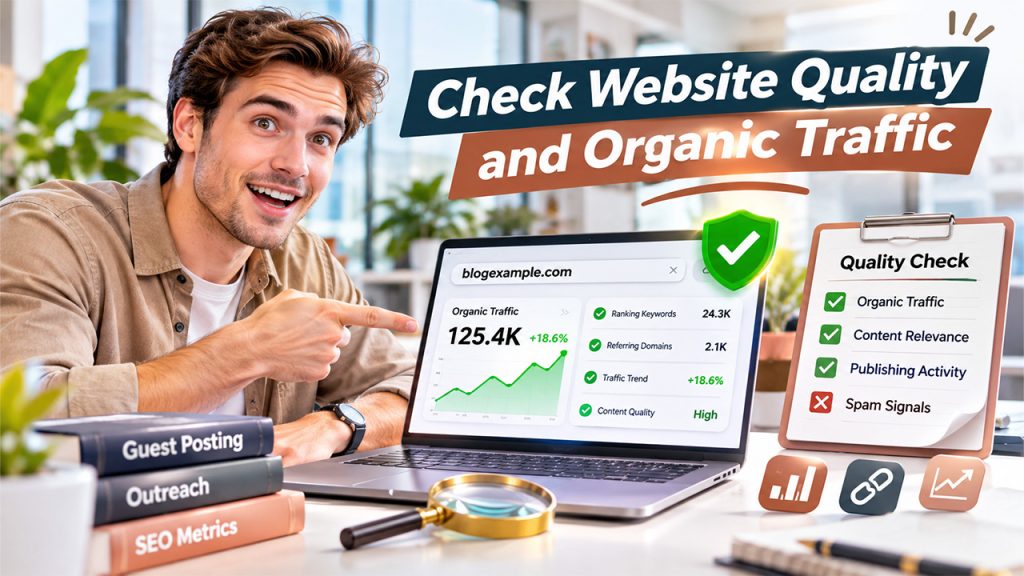
After collecting potential publishers, conduct a quality assessment before contacting them. This step helps reduce wasted outreach efforts and prevents your campaign from depending on questionable websites.
Use SEO tools to review estimated organic traffic, ranking keywords, referring domains, and historical traffic trends. Compare these indicators with the website's visible content and publishing activity.
Look for warning signs such as:
- A sudden, unexplained decline in organic visibility.
- Articles covering unrelated industries without a clear editorial purpose.
- Excessive outbound links to commercial websites.
- Repetitive, poorly written, or automatically generated content.
- Pages created mainly to accommodate paid guest posts.
- Suspicious backlink patterns or irrelevant anchor text.
Remember that third-party traffic estimates are not exact measurements. A low estimate does not automatically make a website unsuitable, especially if it serves a small specialist audience.
Combine SEO metrics with manual checks to make a more informed decision. Quality assessment should be a standard part of your Guest Posting & Outreach Strategy, not an optional step performed after publication.
7. Review Guest Post Guidelines and Editorial Policies
Before pitching an article, read the publisher's contribution guidelines carefully. These guidelines explain the topics accepted, preferred article length, formatting requirements, link policies, and submission process.
Some publishers accept completed articles, while others require a topic pitch first. Certain websites also restrict promotional language or limit the number of external links.
Check whether the publisher allows contextual links, author biographies, original research, expert quotations, or company mentions.
Avoid websites that promise guaranteed ranking improvements or sell followed links without meaningful editorial review. Google's spam policies identify links created primarily to manipulate search rankings as link spam, including certain paid guest-post links that pass ranking credit.
When compensation or another commercial arrangement is involved, ensure links are qualified appropriately, such as with rel="sponsored" where applicable.
Understanding these requirements helps you pitch suitable topics and avoid unnecessary rejections.
8. Personalize Your Guest Posting Outreach
Finding a suitable publisher is only half the work. Your outreach message must explain why your contribution would benefit its audience.
Avoid sending identical emails to hundreds of editors. Instead, mention a recent article, identify a content gap, and suggest a relevant topic that fits the publication.
A practical outreach email should include:
- A short, professional introduction.
- A specific reference to the publisher's content.
- One or two relevant article ideas.
- A brief explanation of the value for readers.
- Links to previous writing samples, if available.
- A polite question about the submission process.
For example, if a publisher regularly covers marketing automation, propose an article explaining how businesses can improve lead management through automation.
A thoughtful Guest Posting & Outreach Strategy treats outreach as relationship building rather than a request for a backlink. Follow up politely after a reasonable interval, respect editorial decisions, and avoid repeatedly contacting publishers who have declined.
9. Organize Prospects in a Tracking Spreadsheet
A structured spreadsheet makes it easier to manage opportunities, compare publishers, and track outreach progress.
Include columns for:
| Field | Purpose |
| Website URL | Identifies the potential publisher |
| Industry or niche | Records topical relevance |
| DA/DR | Provides a comparative authority metric |
| Organic traffic estimate | Helps assess potential visibility |
| Contact name and email | Supports personalized outreach |
| Guest post guidelines | Records submission requirements |
| Target article topic | Connects the prospect with your pitch |
| Outreach date | Tracks when the first email was sent |
| Follow-up date | Prevents missed follow-ups |
| Response status | Records replies and editorial decisions |
| Publication URL | Tracks successfully published articles |
| Backlink status | Confirms whether the expected link is present |
Assign priority levels based on relevance, content quality, audience fit, and editorial standards. Review the spreadsheet regularly to identify promising prospects and remove websites that no longer meet your criteria.
Conclusion
Finding the right guest posting opportunities requires more than collecting websites with high authority scores. You need to understand your goals, research competitors, evaluate topical relevance, inspect website quality, and communicate with publishers professionally.
A consistent Guest Posting & Outreach Strategy helps you focus on relevant opportunities, create useful content, and develop lasting relationships with editors. By combining targeted research with careful evaluation and personalized outreach, you can build a more sustainable approach to link acquisition and brand visibility.
Prioritize websites where your expertise genuinely benefits readers. Over time, that approach can support stronger industry relationships, qualified referral traffic, and a more credible online presence.