



Launching a new website is exciting, but getting it noticed by search engines and potential visitors can be challenging. Even with high-quality content, useful services, and a well-designed website, attracting organic traffic takes time. One effective way to build online visibility, earn relevant backlinks, and establish industry credibility is through guest posting.
However, publishing articles on random websites without a clear direction rarely delivers sustainable results. New websites need a structured guest posting strategy that focuses on relevant publishers, valuable content, natural link placements, and long-term relationship building.
A well-planned approach helps businesses introduce their websites to new audiences while gradually strengthening their backlink profiles. In this guide, we will explain how to develop an effective approach, find suitable publishing opportunities, and measure the results of your efforts.
1. Understand Your Website's Goals Before Starting
Before approaching publishers, understand what you want to achieve through guest posting. A new website may have several objectives, but trying to accomplish everything simultaneously can make your efforts less effective.
Start by identifying your primary goals:
- Improve search visibility: Earn relevant backlinks that support your website's authority and discoverability.
- Build brand awareness: Introduce your business to audiences who may not know about your website.
- Generate referral traffic: Attract visitors from websites that already have an established readership.
- Establish industry credibility: Share useful insights and demonstrate expertise within your niche.
- Build professional relationships: Connect with bloggers, editors, publishers, and industry professionals.
Your goals will influence which websites you approach, what topics you pitch, and how you evaluate campaign performance.
For example, a newly launched CRM software website should prioritize technology, business automation, SaaS, and digital marketing publications rather than unrelated lifestyle websites.
2. Identify Your Target Audience and Relevant Niches
The success of your outreach depends heavily on reaching the right audience. A backlink from a relevant website can provide more meaningful value than several links from unrelated publications.
Begin by understanding your ideal readers. Consider their industry, professional interests, challenges, and the information they regularly search for.
Next, identify niches that naturally connect with your website.
For example:
| Website niche | Relevant publishing opportunities |
| CRM and SaaS | Business technology, software, automation |
| Digital marketing | SEO, content marketing, advertising |
| Cybersecurity | Data protection, IT security, technology |
| Web development | Programming, software development, cloud computing |
| E-commerce | Online business, sales, customer experience |
A focused guest posting strategy makes it easier to identify publishers whose audiences are genuinely interested in your products, services, or content.
Avoid selecting websites simply because they have impressive domain authority or traffic figures. Relevance, editorial quality, audience engagement, and genuine publishing standards should also influence your decisions.
3. Create a Guest Posting Plan with Clear Priorities
Once you understand your goals and target audience, organize your activities into a practical publishing roadmap.
A structured Guest posting plan prevents unnecessary outreach and helps your team maintain consistency.
Your plan should include the following elements:
- Target website name and URL.
- Website niche and audience relevance.
- Domain authority or domain rating as supporting indicators.
- Estimated organic traffic.
- Spam score and backlink profile quality.
- Contact information or submission guidelines.
- Proposed article topics.
- Target landing pages and relevant anchor text.
- Outreach status and publication date.
You can organize this information in an Excel or Google Sheets document. Alternatively, Guest Posting Workflow Software can help centralize publisher details, track outreach activities, manage article submissions, and organize publishing schedules in one place.
It is also useful to divide prospects into priority groups:
Priority 1: Highly relevant websites with strong editorial standards and an established audience.
Priority 2: Relevant industry blogs with moderate authority and consistent publishing activity.
Priority 3: Emerging websites with genuine content and potential for long-term collaboration.
This prioritization helps new websites invest their time in meaningful publishing opportunities rather than chasing backlink numbers.
4. Find High-Quality Websites for Guest Posting
Finding suitable publishers is one of the most important steps. Your goal should be to identify websites that publish original, informative content and reach an audience relevant to your business.
You can discover opportunities using several methods.
Google search operators
Use targeted search queries such as:
- "Write for us" + technology
- "Guest post" + digital marketing
- "Contribute an article" + business
- "Submit a guest post" + SaaS
- "Become a contributor" + SEO
Competitor backlink research
Analyze websites that link to your competitors. SEO tools such as Ahrefs, Semrush, and Moz can help identify referring domains and potential publishing opportunities.
However, do not automatically approach every website linking to a competitor. Review its relevance, editorial quality, and publishing practices first.
Industry communities
Explore professional communities, niche blogs, online publications, and business websites. Some valuable publishers do not advertise guest posting opportunities publicly but may accept relevant editorial contributions.
A strong guest posting strategy prioritizes publishers that offer genuine audience value instead of websites created primarily to sell backlinks.
5. Evaluate Website Quality Before Outreach
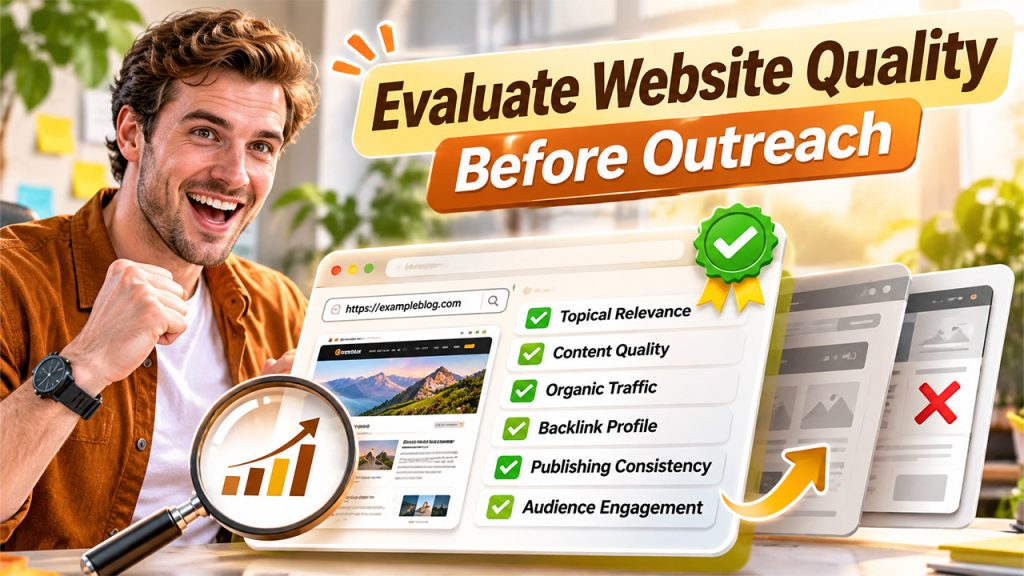
Not every website accepting guest contributions is worth approaching. Some publishers have outdated content, irrelevant backlinks, excessive sponsored articles, or questionable SEO practices.
Before adding a website to your outreach list, evaluate:
Topical relevance: Does the website regularly publish content related to your industry?
Content quality: Are its articles informative, original, and properly edited?
Organic traffic: Does it receive genuine search traffic, and are its important pages indexed?
Backlink profile: Does it have a natural link profile, or does it contain suspicious referring domains?
Publishing consistency: Has the website published useful content recently?
Audience engagement: Does its content attract meaningful comments, shares, or readership?
Do not rely exclusively on DA or DR. These are third-party metrics, not direct Google ranking factors. A website with moderate authority and strong niche relevance may offer a better opportunity than a high-metric website with unrelated content.
6. Develop a Guest Blogging Strategy Around Valuable Content
Once you have shortlisted publishers, the next step is creating content that matches their audience and editorial expectations.
A successful guest blogging strategy is not about writing promotional articles and inserting backlinks wherever possible. It is about providing information that readers genuinely find useful.
Start by researching each publisher's existing content. Identify topics they have covered, questions their audience may have, and areas where you can offer additional insights.
For example, if you are writing for a business technology website, consider topics such as:
- How Small Businesses Can Improve Customer Management.
- Common CRM Implementation Mistakes and How to Avoid Them.
- The Role of Automation in Modern Business Operations.
- How Data Security Improves Customer Trust.
- Practical Ways to Improve Sales Team Productivity.
Follow these content guidelines:
- Write original articles rather than rewriting existing online content.
- Use clear headings and short paragraphs.
- Include relevant examples and practical recommendations.
- Avoid unnecessary keyword repetition.
- Follow the publisher's preferred word count and formatting.
- Include authoritative references wherever appropriate.
- Add links only when they provide genuine value to readers.
Your article should be useful even if readers never click the backlink. That is a good indication that the content is providing real editorial value.
7. Build a Consistent Guest Post Campaign
Publishing one article occasionally is unlikely to create a strong presence for a completely new website. Consistency is important, but quality should always come before volume.
A structured guest post campaign helps you maintain a manageable publishing schedule. Effective Campaign Management also makes it easier to coordinate publishing deadlines, monitor outreach progress, and keep every activity aligned with your overall SEO goals.
For example, a new website could begin with the following three-month roadmap:
| Month | Activities | Target |
| Month 1 | Research publishers, evaluate websites, prepare content ideas | Build a list of 30–40 prospects |
| Month 2 | Start personalized outreach and publish approved articles | Secure 3–4 quality placements |
| Month 3 | Continue outreach, publish relevant articles, review performance | Secure another 3–4 placements |
These numbers are illustrative, not guaranteed targets. Actual publishing volume will depend on editorial approvals, available resources, and publisher quality.
Avoid publishing too many articles within a short period simply to increase backlink numbers. A natural, sustainable approach is more valuable than aggressive link acquisition.
Also, avoid paid links intended to manipulate search rankings. Google's spam policies identify link schemes, including paid links that pass ranking credit, as practices that can create search risks. Paid placements should use appropriate link attributes, such as rel="sponsored".
8. Personalize Your Outreach Emails
Even high-quality content may not get published if your outreach emails are generic.
Editors receive numerous requests, so your message should quickly explain who you are, why you are contacting them, and what value your proposed article offers.
A good outreach email should include:
- A personalized greeting.
- A brief introduction to your website or business.
- A reference to a relevant article on the publisher's website.
- Two or three original topic suggestions.
- A short explanation of the value for their readers.
- A polite request for editorial consideration.
Avoid sending identical emails to hundreds of publishers. Personalized communication improves the quality of conversations and helps build genuine professional relationships.
Follow up politely after a reasonable interval if you do not receive a response. Avoid repeatedly messaging editors who have declined or requested no further contact.
9. Track Results and Measure Performance
An effective guest posting strategy requires regular monitoring. Publishing an article is not the final step; you should evaluate whether the placement contributes to your website's broader marketing goals.
Track these important metrics:
| Metric | What it tells you |
| Published backlinks | Number of successfully published placements |
| Referring domains | Number of unique websites linking to you |
| Referral traffic | Visitors arriving through guest articles |
| Keyword visibility | Changes in organic keyword performance |
| Indexed pages | Whether important published pages are indexed |
| Conversions | Leads, sign-ups, or inquiries generated |
| Link status | Whether published backlinks remain live |
Google Search Console can help monitor search performance, while Google Analytics 4 can provide insights into referral traffic and conversions. SEO platforms can help track referring domains and keyword visibility.
Remember that backlinks do not guarantee higher rankings. Search performance depends on multiple factors, including content quality, technical SEO, competition, and overall website relevance.
10. Common Guest Posting Mistakes New Websites Should Avoid
New websites often make avoidable mistakes when starting their link-building activities.
Here are some practices to avoid:
- Choosing websites solely because of high DA or DR.
- Publishing content on unrelated websites.
- Using exact-match commercial anchor text excessively.
- Submitting duplicate or low-quality articles.
- Buying links that pass ranking credit.
- Ignoring website traffic and backlink quality.
- Sending automated, irrelevant outreach emails.
- Focusing on backlink quantity instead of editorial value.
- Failing to monitor published links.
A sustainable guest posting strategy should focus on relevance, useful content, natural link placement, and genuine relationships.
Conclusion
Building a strong backlink profile for a new website takes time, planning, and consistent effort. Guest posting can support this process by introducing your brand to relevant audiences, generating referral traffic, and helping establish industry credibility.
The key is to approach publishing strategically. Understand your goals, identify suitable websites, evaluate publishers carefully, create valuable content, and maintain a consistent outreach process.
Instead of chasing hundreds of backlinks, focus on earning meaningful placements from trusted and relevant websites. With continuous monitoring and improvements, your guest posting strategy can become a valuable part of your long-term SEO and brand-building efforts.