




Managing five guest posting publishers is relatively simple. Managing fifty or more is a different situation. Each publisher may have different pricing, payment deadlines, invoice formats, accepted currencies, and payment arrangements. When these details are scattered across emails and spreadsheets, even experienced SEO agencies can lose track of outstanding payments.
Effective guest post payment tracking helps agencies maintain accurate financial records, avoid duplicate transactions, and build reliable relationships with publishers.
The solution is not simply recording how much money was transferred. You need a structured process that connects every publisher payment to its corresponding order, invoice, placement, and payment confirmation.
Here is how to build that process.
Why Publisher Payment Management Becomes Complicated
Guest posting businesses rarely work with publishers under identical financial arrangements.
For example:
- Publisher A requests full payment before accepting content.
- Publisher B allows payment after publication.
- Publisher C requires a deposit before starting the placement.
- Publisher D accepts multiple orders under one monthly invoice.
Now imagine managing these arrangements across several clients and campaigns. A payment might be completed, but your team may not know which order it belongs to. Another invoice might remain unpaid simply because its email notification was overlooked.
Common problems include:
- Unorganized payment records: Transaction details are stored in different spreadsheets, emails, and accounting files.
- Unclear payment deadlines: Employees cannot easily identify which publishers need payment today or next week.
- Invoice mismatches: Payments are recorded without connecting them to the correct publisher or placement.
- Currency differences: International transactions introduce exchange-rate and conversion considerations.
- Duplicate payments: Multiple team members may unknowingly process the same invoice.
These problems make it difficult to understand actual outstanding liabilities and maintain predictable payment operations.
1. Create a Centralized Publisher Payment Database
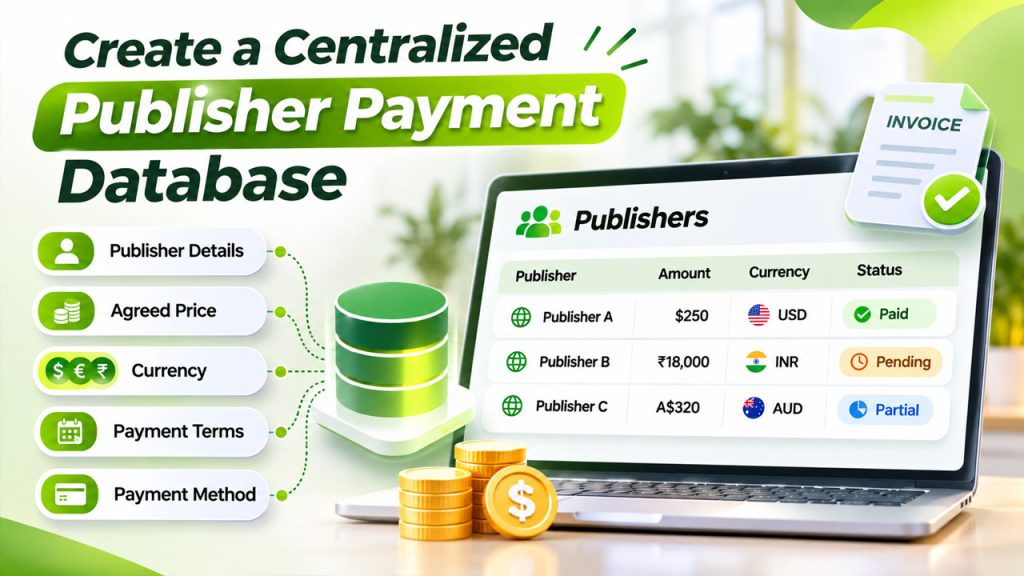
Start by creating one central location for all publisher-related financial information.
Instead of maintaining separate payment sheets for different publishers, use a single database with individual publisher records.
Your database should include:
| Field | Information to Record |
| Publisher Name | Website or publisher identification |
| Website URL | Publisher's domain |
| Contact Details | Email address or payment contact |
| Agreed Price | Negotiated placement cost |
| Currency | USD, INR, PKR, AUD, etc. |
| Payment Terms | Advance, partial, or post-publication |
| Payment Method | Bank transfer, PayPal, or other method |
| Invoice Reference | Unique invoice number |
| Outstanding Amount | Remaining payable balance |
| Payment Status | Pending, partial, paid, or overdue |
For example, if your agency works with publishers in the USA, India, Pakistan, and Australia, you should preserve the original transaction currency instead of combining every amount into one figure without conversion details.
A centralized publisher management system can help organize publisher information, pricing agreements, and communication history.
The objective is simple: anyone responsible for payments should be able to identify a publisher's financial position without searching through multiple conversations.
2. Connect Every Payment to a Specific Guest Post Order
A publisher name alone is not enough to identify a payment.
Consider this hypothetical situation:
Your agency purchases three guest post placements from the same publisher within one month. Each placement costs $120.
If your payment record simply says "$360 paid to Publisher A," you may struggle to determine whether all three placements were completed and paid for correctly.
Instead, assign a unique order reference to every placement.
For example:
| Order ID | Publisher | Placement Cost | Payment Status |
| GP-101 | Publisher A | $120 | Paid |
| GP-102 | Publisher A | $120 | Pending |
| GP-103 | Publisher A | $120 | Paid |
This approach creates a direct relationship between the publisher, placement, invoice, and payment.
It also makes reconciliation easier when publishers combine multiple placements into a single invoice.
A well-organized guest post order management workflow helps teams maintain visibility over orders, delivery stages, and related financial activities.
3. Standardize Guest Post Invoices
Different invoice formats can create unnecessary administrative work.
One publisher might send a PDF invoice, another might provide payment details through email, and someone else might share a simple spreadsheet.
Your finance team should maintain consistent invoice information regardless of the publisher's preferred format.
Every invoice record should contain:
- Unique invoice number.
- Publisher's business or contact details.
- Invoice issue date.
- Payment due date.
- Related guest post order IDs.
- Description of the placement or service.
- Total amount payable.
- Currency and applicable taxes, where relevant.
- Payment instructions.
- Current payment status.
Also establish a clear naming convention for saved invoices.
For example:
PublisherName_InvoiceNumber_2026.pdf
Keep the original invoice alongside its payment confirmation and related order information.
The IRS explains that business records should be supported by documents such as invoices, receipts, and payment records. Its business transaction recordkeeping guidance provides a useful reference for maintaining organized financial documentation.
Internal Revenue Service+1
4. Build a Payment Tracking Workflow
Once your publisher database and invoice records are ready, establish a consistent process for handling every payment.
A practical payment tracking workflow can follow these six stages:
- Order confirmation
Record the publisher, negotiated amount, placement requirements, and agreed payment terms.
- Invoice collection
Receive the publisher's invoice and connect it to the appropriate order reference.
- Invoice verification
Check the amount, currency, payment details, and agreed pricing before approving the transaction.
- Payment scheduling
Record the due date and assign responsibility for processing the payment.
- Payment execution
Process the transaction through the agreed payment method and save the confirmation.
- Reconciliation
Match the transaction against the invoice and update the outstanding balance and payment status.
This process creates an audit trail from the original publisher agreement to the completed transaction.
The same principle of capturing, validating, allocating, and reconciling payments is explained in Hyperbots' payment posting tracking reference. Although its primary focus is payment posting, the underlying record-matching principles are useful when designing publisher payment controls.
hyperbots.com
5. Handle International Publisher Payments Carefully
Working with publishers across multiple countries introduces additional considerations.
An agency purchasing placements from publishers in the USA, Pakistan, India, and Australia may need to manage USD, PKR, INR, and AUD transactions.
Simply converting every transaction into your local currency can make financial records confusing.
Follow these practices:
- Preserve the original invoice amount and currency.
- Record the actual amount transferred.
- Maintain the transaction date.
- Record the exchange rate used for accounting purposes.
- Separate bank charges and transfer fees from the publisher's agreed price.
- Save payment confirmations.
- Check applicable tax and documentation requirements with your accountant.
For instance, a publisher may invoice your agency for $200, while your bank account shows a different local-currency debit because of exchange rates and transaction fees.
Your records should explain both figures rather than treating them as identical.
Also, confirm the recipient's payment details independently before transferring funds, particularly when updated bank instructions arrive through email.
6. Use Payment Statuses and Automated Reminders
A payment database becomes much more useful when every invoice has a clearly defined status.
Use a consistent status system:
| Status | Meaning |
| Awaiting Invoice | Order confirmed, invoice not received |
| Pending Approval | Invoice received and under review |
| Scheduled | Payment approved for processing |
| Partially Paid | Only part of the invoice is paid |
| Paid | Full payment confirmed |
| Overdue | Due date has passed without full payment |
| Disputed | Amount or invoice details require clarification |
Set reminders before the payment deadline rather than waiting until an invoice becomes overdue.
For example:
- Three days before the due date: Internal reminder.
- On the due date: Payment processing notification.
- Two days after the due date: Outstanding payment review.
Do not automatically mark an invoice as paid just because a payment was initiated. Update the status only after confirming the transaction.
Benefits of a Structured Payment Tracking System
A reliable system provides several operational advantages.
Better financial visibility: Your team can identify outstanding publisher liabilities without reviewing individual email conversations.
Fewer administrative errors: Connecting invoices with order references reduces the likelihood of duplicate entries and incorrect payment allocation.
Improved publisher relationships: Timely payments and clear communication help establish professional working relationships.
Easier financial reporting: Managers can review publisher expenses, outstanding balances, and payment history.
More efficient team collaboration: Multiple employees can work with consistent payment information instead of maintaining separate records.
Common Payment Tracking Mistakes to Avoid
Even a well-organized database can become unreliable if employees do not follow consistent procedures.
Watch out for these mistakes:
- Recording a payment without an invoice reference.
- Using publisher names instead of unique order IDs.
- Mixing different currencies without conversion records.
- Forgetting to update partial payments.
- Treating scheduled payments as completed transactions.
- Keeping payment confirmations separate from invoice records.
- Allowing multiple employees to update the same records without clear responsibility.
One particularly important practice is assigning payment approval and reconciliation responsibilities clearly. For larger teams, consider separating transaction approval from payment execution and final review.
How GuestPostCRM Can Support Publisher Payment Management
When guest posting operations grow, maintaining publisher records, order details, invoices, and payment updates manually becomes increasingly difficult.
GuestPostCRM provides tools designed around guest posting operations, including publisher management, order organization, invoice creation, and payment status monitoring.
Its automated invoice and payment system allows teams to create invoices, associate invoice links with orders, and monitor payment statuses within a centralized workflow.
This can be particularly useful for agencies handling multiple publishers and client orders simultaneously.
The appropriate setup still depends on your accounting requirements and internal approval procedures. A guest posting management platform should complement, rather than replace, proper financial reconciliation and bookkeeping.
Conclusion
Tracking payments across multiple guest posting publishers requires more than maintaining a list of amounts and transaction dates. Every payment should be connected to a publisher, order, invoice, agreed payment terms, and supporting confirmation.
Start with a centralized publisher database, standardize invoice records, introduce unique order references, and establish a consistent payment tracking workflow. Add scheduled reminders and regular reconciliation to keep outstanding balances accurate.
As your publisher network expands, these practices help maintain financial visibility, reduce administrative confusion, and support stronger publisher relationships.
Looking to organize your guest posting operations? Explore GuestPostCRM to manage publisher relationships, guest post orders, invoices, and payment activities through a more structured workflow.