



.png)
.png)
Managing an agency is more complex than you think. It means that you have to juggle through project timelines, client requests, reporting, and team workloads, generally across five or six distinct tools that remain disconnected. Now, this gap can be closed by using something known as agency management software. Instead of transitioning between inboxes, spreadsheets, and individual apps for billing as well as scheduling, agencies get a single connected system to strategize, implement, and monitor their work.
In this detailed guide, let us break down what agency management software really does, the problem it fixes, and what agencies (including marketing and SEO teams) must look for before selecting a tool.
What Is Agency Management Software?
Agency management software refers to a category of business software specifically built for the way agencies work: project-based, client-facing, and reliant on getting the best out of a limited team. It integrates resource planning, project management, financial reporting, and client communication into one tool.
Contrary to generic project management tools, agency management software is built around realities specific to the agency such as client retainers, billable hours, campaign deadlines, and the need to keep track of profitability project-by-project. For agencies that handle content production, SEO campaigns, or link-building work, a specially built SEO agency software for guest posting and link building goes one step further by streamlining client orders, vendor or publisher communication, and content approvals in a single workflow instead of forcing that work into a platform built for something else.
Main Components of Agency Management Software
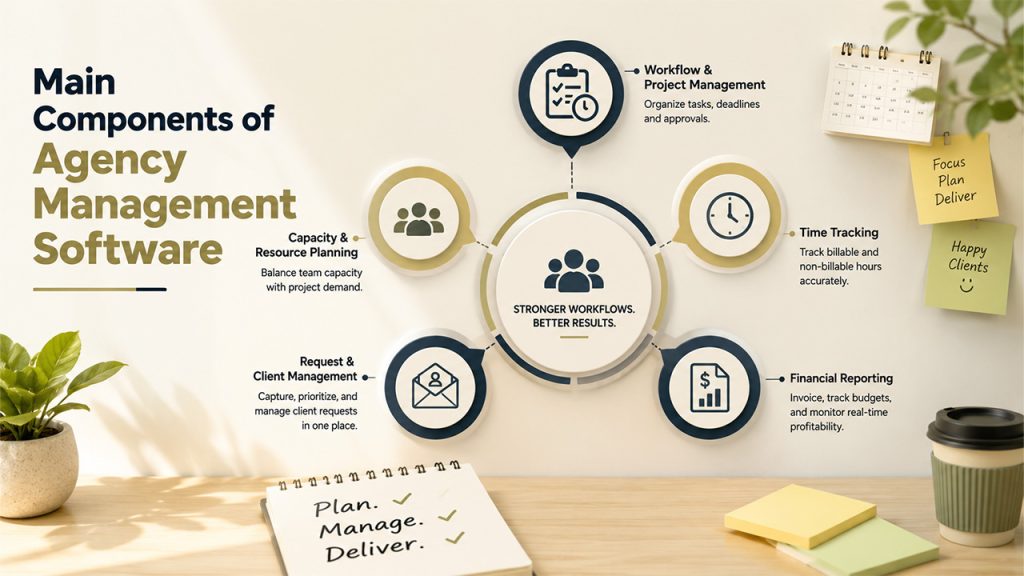
Most tools in this category are created around a few link modules instead of a single feature. Together, they provide agencies with good visibility in both profitability and delivery.
- Workflow and Project Management – Organizing deadlines, tasks, and approvals for engaging active clients.
- Capacity and Resource Planning– Aligning available team hours to project demand so no one is sitting idle or overbooked.
- Time tracking – Recording non-billable and billable hours against specific clients or projects.
- Request and Client Management – Capturing as well as scoring incoming client requests as per priority.
- Financial reporting – Invoicing, tracking budget, and real-time project profitability.
For agencies managing a top-volume of client requests, a specialized Client Request Management Software module is more important than it might appear. When requests come through chat, email, and calls, a simplified intake system makes sure that each inquiry is visible and keeps moving instead of stalled team members.
Why Agencies Need Purpose-Built Software?
Generic task management applications can work effectively for internal to-do lists. However, they are not developed to manage revenue-generating and client-facing work. This distinction is where agency management software has earned its place.
One of the main reasons agencies outgrow generic platforms are as follows:
- Generic tools keep track of tasks, but not margin, utilization, or client profitability.
- They do not connect time tracking to budgets or billing.
- They do not have agency-specific workflows for retainers, approvals, and repetitive client work.
- They provide no visibility into how a delivery decision impacts the bottom line.
This gap becomes particularly visible in content and SEO agencies. Handling guest post outreach, guest post orders, and link placements through inboxes and spreadsheets only works until the client volume is low. This is where specialized Guest Post Management Software for Agencies becomes valuable, since it is built around industry-specific tasks such as content approvals, publisher relationships, and order tracking instead of generic task lists. A dedicated Guest Post Order Management Software system, for example, keeps track of each order from inquiry through invoicing, so nothing gets ever lost between placement and payment.
Selecting the Right Planning Tool for Your Agency

Not every agency requires the same set of features. However, a few criteria become applicable widely when assessing planning software for agency processes:
- Right Option for the Type of Your Service: The requirements of creative agency change from the link-building or SEO requirements of the agency. Search for workflows created around your precise deliverables.
- Integration with Present Platforms – Accounting, email, and communication platforms must connect without manual entry of data.
- Scalability – The system must provide support to an evolving client roster without rebuilding the entire process.
- Depth of Reporting – You must be able to check out profitability by project or client, not just completion of task.
- Simple Adoption – A Platform that the entire team will use on a consistent basis.
Agencies that create robust internal processes centered around resourcing, client intake, and delivery often tend to describe this as successful Agency Workflow Management Software in practice, even when the core platform performs different functionalities at once. The objective is not sorting out the tasks; it is linking the delivery to visibility across the complete client's lifecycle.
Conclusion
Agency management software is built to solve a very particular issue: agencies work on tight timelines, client work, and generic tools rarely take all three into consideration at once. Irrespective of whether an agency requires a wide planning software for delivery and resourcing, or a more specialized SEO agency management software setup for content and outreach options, the best platform centralizes workflows, requests, and reporting into a single place. That visibility, more than a single feature, is what differentiates agencies that smoothly scale from the ones stuck juggling through email threads and spreadsheets.
Next Read: The Future Guest Post Management

.png)
.png)