


.png)
.png)
Most people “high ticket sales” and immediately think about numbers, big commissions, premium pricing, and five-figure offers. Yes, these things are part of the picture, but if that’s where your mind goes first, you’re already thinking about it wrong. High ticket sales aren’t a pricing strategy, a closing technique, or a niche. It's a philosophy that is built on the belief that some solutions are worth far more than market default, and the right buyers who approached it the right way already know this. Your job isn’t to convince them of the price; it is to make the value undeniable. This shift in thinking changes everything.
What Is High-Ticket Sales? Definition, Meaning & Examples
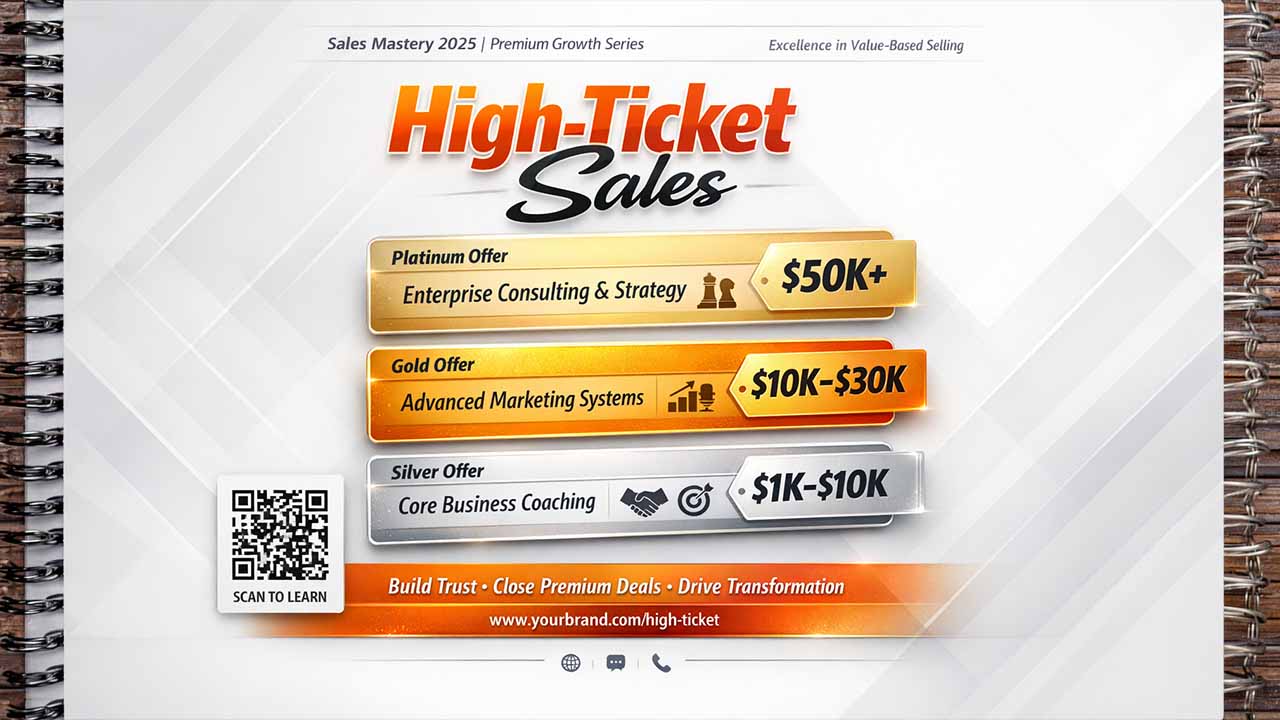
High-ticket sales refer to the selling of premium products or services that carry a significantly higher price point than standard market offerings, typically anything from $1,000 to six figures, depending on the industry.
Examples span a wide range of industries:
- The luxury goods industry includes designer bags, high-end watches, and rare collectibles.
- A business coach selling a 6-month private mentorship program
- A luxury real estate agent closing multi-million-dollar residential properties
- A SaaS company selling enterprise-level software with annual contracts worth
- A digital marketing agency offering full-scale brand strategy packages built on proven Digital Marketing Strategies at premium price points.
- A financial advisor managing high-net-worth portfolios with significant management fees
When someone is considering buying these, they are evaluating their value and the benefits that they will receive in exchange for their investment.
The Anatomy of High-Ticket Sales: Key Components Explained
Not every expensive product qualifies as a true high-ticket offer in the sales sense. A $5,000 is expensive, but you don’t need a high-ticket sales strategy to sell it. You need good retail merchandising.
A genuine high-ticket offer has three components:
- Significant perceived transformation: The buyer must believe that their life, business, or situation will look meaningfully different after the purchase. This isn’t about features; it’s about outcomes.
- A consultative sales process: High-ticket deals rarely close in a single touchpoint. They require discovery calls, follow-ups, proposal reviews, stakeholder conversations, and trust-building over time.
- A relationship-driven close: At this price level, people don’t buy from brands; they buy from people. The salesperson’s credibility, empathy, and communication style are as important as the offer itself.
If any one of these is missing, you’re not doing high-ticket sales; you’re just doing expensive sales.
High-Ticket vs Low-Ticket Sales: Key Differences & Comparison
Here's where most salespeople get confused. They assume high-ticket is just low-ticket with more zeroes. The entire model, the buyer psychology, the sales cycle, and the skill set required is different in kind, not just degree.
| Dimension | Low Ticket Sales | High Ticket Sales |
|---|---|---|
| Decision Type | Impulse/ transactional | Deliberate/commitment based |
| Sales Cycle | Minutes to hours | Days to weeks (sometimes months) |
| Primary Driver | Price, convenience, features | Trust, outcome, relationship |
| Volume Required | High volume to scale | Low volume, high margin |
| Buyer Mindset | “Is this worth the price?” | “Is this person worth my trust?” |
| Objection Type | Price resistance | Risk aversion, skepticism |
| Closing Technique | Urgency, discounts, FOMO | Deep listening, social proof, consistency |
| Relationship After Sale | Other transactional | Often ongoing and referral generating |
If you look at the table, you’ll notice that almost every dimension flips. This is why a great low-ticket salesperson doesn’t automatically become a great high-ticket closer.
Top Advantages of High-Ticket Sales for Businesses
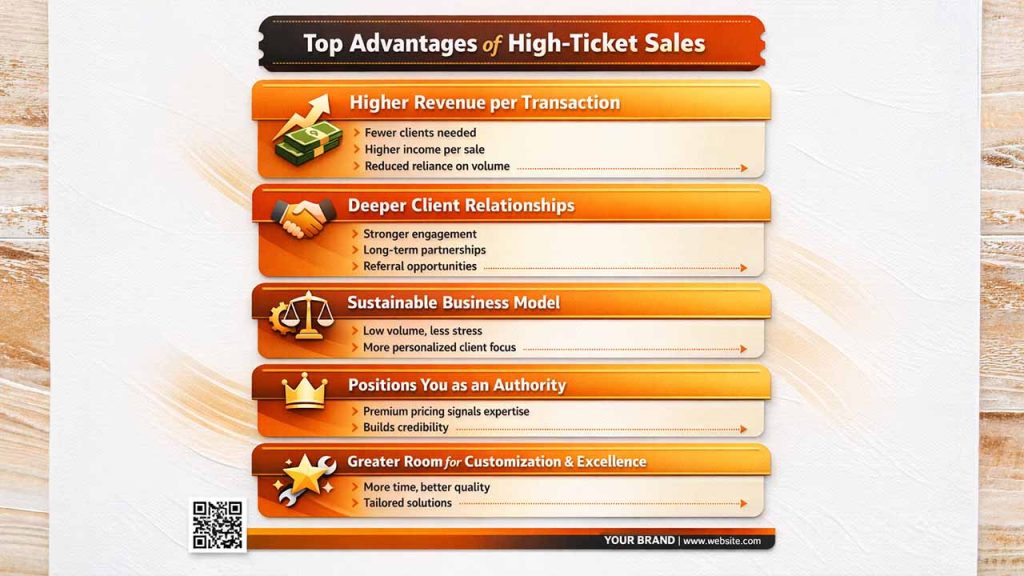
Let’s see the advantages of high-ticket sales and how they help businesses generate higher revenue with fewer clients. These benefits highlight why many businesses shift toward premium, value-driven selling:
Higher Revenue per Transaction
You need fewer clients to hit meaningful income targets. Selling high-priced services or products helps businesses achieve their revenue goals without having to make a dozen sales. This significantly reduces the need for a high-volume transaction. Businesses can further maximize returns by leveraging performance marketing and ROI optimization to ensure every marketing dollar is tied to measurable outcomes.
Deeper Client Relationships
When clients invest significantly, they remain actively involved. This results in higher engagement, stronger results, and deeper relationships that often turn into long-term partnerships or referrals. The right CRM Software Examples can help businesses manage and nurture these high-value client relationships effectively.
Sustainable Business Model
Low volume means low operational stress. You’re not constantly chasing new leads because each client relationship carries real weight and longevity. Sales reps can focus on individual clients and use a more personalized approach to understand their specific needs or preferences.
Positions You as an Authority
Premium pricing signals expertise. Buyers in the high-ticket space are actively looking for specialists, not regular salespersons. The price itself communicates the quality. Businesses can attract their target audience and establish their credibility in the market.
Greater Room for Customization and Excellence
With higher margins, you can actually pay attention to each client and deliver extraordinary work without taking shortcuts or rushing. You have ample time, resources, and motivation to go above and beyond.
Disadvantages of High-Ticket Sales You Should Know
High-ticket sales also have their downsides that businesses need to consider before adopting this approach. Let’s take a look at the challenges that come with selling high-value offers:
Long Sales Cycle
In the high-ticket sales process, deals can take weeks or months to close due to long, thorough discussions and increased complexity. Potential buyers also take time to evaluate the value and benefits of a product or service. If you fail to manage your pipeline carefully, cash flow can become unpredictable.
Higher Buyer Security
Premium buyers come prepared. They’ll compare you with other competitors, research your track record, and ask difficult questions. They’ll be able to identify if your offer has any gaps.
Emotional Weight of Each Deal
It becomes essential to invest emotionally when the single sale represents significant revenue, as losing it will inflict a huge loss and sting more. Emotional resilience is a real requirement in this space.
Smaller Addressable Market
Not everyone can or will make a substantial investment at premium levels. Premium pricing naturally narrows the pool of potential buyers. Therefore, it demands more precise targeting to increase the chances of success.
Advanced Sales Skills
To convert leads successfully, you cannot rely on scripts or pressure tactics. High-ticket selling demands patience, emotional intelligence, deep listening, and the ability to have real consultative conversations.
Real-World Examples of High-Ticket Sales Across Industries
Understanding high ticket sales becomes far more tangible when you look at how it actually plays out across industries. The following examples span diverse sectors, each one demonstrating how premium value, consultative selling, and relationship-driven approaches come together to close significant deals.
Renewable Energy Solutions
Consider a startup that has developed groundbreaking technology for renewable energy solutions, selling large-scale solar power systems to commercial establishments. Since these systems require a significant upfront investment and have the potential to generate substantial cost savings in the long run, they fall under the high-ticket sales category. The startup sales team engages in targeted marketing campaigns to focus on organizations with high energy consumption and a commitment to sustainability. They utilize a consultative selling approach, educating potential clients about the benefits of their systems and providing comprehensive proposals tailored to each organization's specific needs and energy requirements.
This is high ticket sales where the price is large, but so is the transformation. The buyer isn't purchasing hardware; they're purchasing long-term cost reduction and environmental accountability.
Enterprise SaaS and Software
Some SaaS startups stop focusing on subscriptions and go after enterprise deals that are worth $10,000 to $50,000 per year. In these cases, companies are not just selling software; they are selling long-term growth and peace of mind. The client gets dedicated support and advanced features, and the business secures a high-value contract.
This example illustrates how software as a product, when positioned correctly, can move far beyond commodity pricing and into premium territory. The key shift is how the offer is framed; not as a tool but as a business outcome.
High-End Consulting Retainers
Instead of charging for one-off sessions, consultants often lock in long-term retainers where they handle strategy, accountability, and ongoing problem-solving. At this level, the client sees them as a partner, not just someone who’s giving advice.
This is one of the clearest illustrations of what high-ticket sales look like in the service industry. The value isn't measured in hours; it's measured in outcomes, access, and strategic clarity that the client simply cannot find elsewhere.
Conclusion: Mastering High-Ticket Sales for Long-Term Growth
In conclusion, high-ticket sales revolve around offering premium products or services that justify their significant price through exceptional value. While businesses benefit from high revenue margins and stronger customer relationships, they must strategically navigate a narrower audience and a more complex sales process.
High-ticket sales are a long game. It rewards those who invest in relationships, sharpen their understanding of buyer psychology, and commit to delivering outcomes that genuinely transform. It demands more than a polished pitch or persuasive script. It demands integrity, patience, and a deep belief in the value you bring to the table. Examining diverse industries reveals how tailored high-ticket strategies drive meaningful business growth. Ultimately, mastering high-ticket sales empowers businesses to boost profitability, differentiate their brand, and position themselves as authoritative leaders, transforming not just their revenue but their entire market reputation.


.png)
.png)