



.png)
.png)
Each business reaches a point where sticky notes, spreadsheets, and scattered email threads are no longer sufficient to handle customers. Deals get lost, follow-ups get missed regularly, and teams consistently lose track of who said what and to which client. This is the precise gap that CRM management software is created to fill.
A CRM platform is advanced software that helps marketing, sales, and support teams with a real-time and shared view of relationships with every customer, from the first point of contact to the final sale and beyond. Instead of juggling through disconnected platforms, teams get a one system that collects conversations, monitors progress in deals and automates the routine work that eats into selling time. For businesses who are serious about scaling in an organized and predictable way, selecting the best CRM software is not an optional choice anymore. It is foundationally important.
What Is CRM Management Software?
CRM management software stands for Customer Relationship Management software. This is a technology platform that powers businesses to handle all their interactions with the current clientele as well as potential prospects. At the heart of it, it works as a single source of truth across the business where deal stages, contact details, communication logs, and customer history are made accessible and stored across teams.
Advanced CRM platforms do a lot more than store contact data. They automate routine tasks, create sales reports, monitor follow-ups, and incorporate distinct tools like marketing automation tools, email clients, and customer support tools. The objective is to provide each member of the team a comprehensive and accurate view of the customer, removing silos, and allowing more data-driven decisions at each stage of the service and sales cycle.
CRM software is utilized across industries and business sizes. It is beneficial for the following teams:
- Sales teams that have to monitor leads and efficiently handle pipelines.
- Marketing teams that depend on customer segmentation and tracking of campaigns.
- Customer support teams handling resolution timelines and service tickets.
- Business owners who require a holistic view of their revenue channels and customer engagement
- Operations teams aiming to minimize process gaps and enhance coordination across the departments.
Modern CRM platforms are becoming even more advanced as they are evolving into learning-based systems using AI to understand client motive, automate communication, and make sound decisions.
Signs Your Business Is Ready for CRM Management Software
Not every business requires a CRM platform from day one. However, specific signals make that case unmistakable. Identifying such signs early on aids in avoiding the operational strain of waiting too long to adjust to the right solution.
- Leads Keep on Getting Lost: If you keep on noticing your leads going cold since no one followed up in time, it is an indication that your sales pipeline needs a modification or a restructure.
- Customer data Exists in Too Many Places: Notes in email threads, contact details in spreadsheets, and deal updates in Slack messages make it almost impossible to get a full picture of any customer.
- Reporting takes a lot of Time: When creating a straightforward sales report needs manually extracting data from numerous sources, decision-making substantially slows down.
- Your team Keep on Evolving: As headcount improves, informal methods of tracking that worked for a five-person team break down quickly for fifty-person team.
- Customer Handoffs are Messy: If sales, support, and marketing teams cannot see the interactions of each other with a customer, the experience feels slightly disjointed from the side of the customer.
If two or more of the above issues sound familiar, it is a great indication that a dedicated CRM system would meaningfully enhance how your business works.
Main Characteristics of CRM Management Software
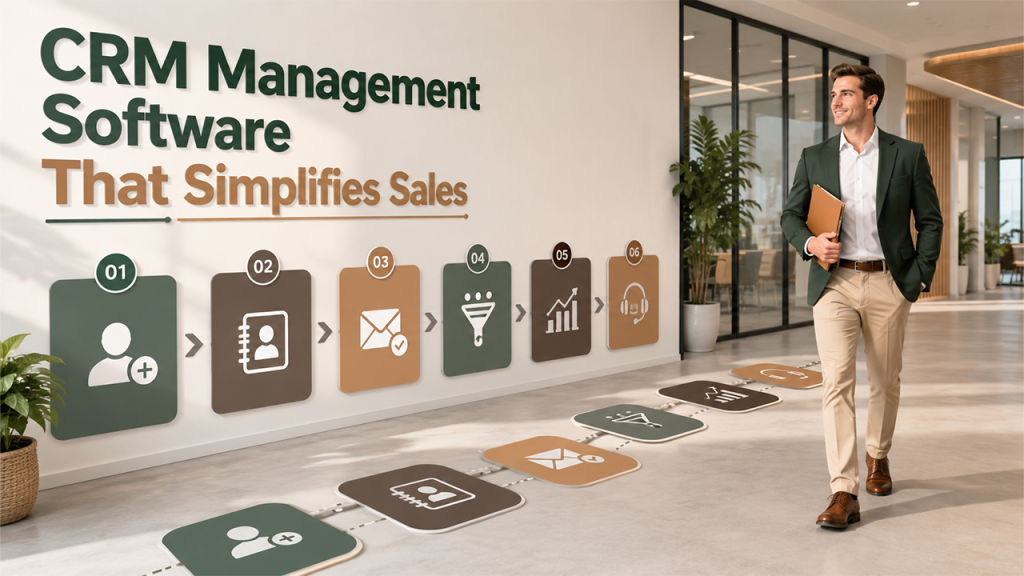
Not all CRM platforms are engineered in the same way. However, the most efficient solutions share a key set of capabilities that drive results across marketing, sales, and support functions consistently.
Lead and Contact Management
A robust CRM platform sorts all contact records in a centralized place including demographic details, interaction history, and deal status. This makes it simple for sales reps to continue conversations without losing context, irrespective of the assignee who previously managed the account. When a new member of the team gets assigned a client, they can instantly see the history of the conversations across different touchpoints, minimizing onboarding friction and saves continuity.
Sales Pipeline Monitoring
CRM management software ensures a visual representation of the complete sales pipeline, enabling teams to see where every deal stands, which leads need follow-ups, and which opportunities are at risk of putting deals on hold. This high visibility enables managers to effectively allocate resources and predict revenue with higher accuracy. Instead of depending on fragmented spreadsheets or instinct, sales leaders can make good decisions based on pipeline data in real-time.
Task Automation
Routine tasks like sending follow-up emails, assigning leads to specific representatives, scheduling reminders, and updating deal stages can be automated via CRM platforms. This minimizes manual workload greatly and makes sure that no lead ever falls through the crack because of lack of oversight or human errors. Automation also ensures a higher level of consistency where each prospect gets an organized and timely experience irrespective of which team member is managing the account.
Reporting and Analytics

In-built reporting tools enable teams to track key performance indicators (KPIs) like average deal size, conversion rates, sales cycle length, and customer acquisition costs. Updated and accurate data enables businesses to identify bottlenecks, recognize patterns, and fine-tune their marketing and sales strategies over time. Leadership teams leverage benefits from dashboards that display a real-time display of business performance without needing manual compilation of data.
Email and Communication Tracking
A lot of CRM solutions involve in-built email integrations that store all inbound and outbound communications directly against a contact record. This removes the need to update records manually after each interaction and provides the entire team with deep visibility into where a conversation is currently. Combined with meeting notes and call logging, this ensures a comprehensive communication timeline for every customer.
Third-Party Integrations
The majority of CRM software incorporates tools that are in use already including accounting software, email platforms, marketing automation tools, e-commerce platforms, and communications applications. This connectivity makes sure that data seamlessly flows across the business without manual entry or duplication. This ensures that CRM database is a genuine source of truth for customer data.
Advantages of Leveraging a CRM Management Tool
Executing a CRM solution ensures a measurable benefit that goes beyond the sales departments. When CRM is adopted across the organization, the impact on collaboration, efficiency, and customer satisfaction can be important.
Enhanced Customer Relationships
With comprehensive interaction history readily available, teams can tailor their outreach and more effectively respond to customer requirements. Instead of considering each interaction as an individual event, CRM management software allows for a contextually aware and continuous relationship. This enables customers to feel valued and known instead of automatically processed.
Higher Team Productivity
Centralized data and automation minimize the time teams spend on administrative processes, enabling them to emphasize activities that generate most revenue. Sales representatives spend significantly less time updating records and relatively more time strengthening relationships. Support agents fix issues quickly since customer history is accessible instantly. Marketing teams run more personalized campaigns since customer data is segmented and categorized within the platform.
Higher Cross-team Collaboration
When marketing, sales, and support teams get access to the same CRM platform and customer data. This makes sure that handoffs become more streamlined and communication enhances greatly. A sales representative working on a deal can leave detailed notes for the onboarding team. A support agent can identify upsell opportunities for the sales team. This leads to more organized collaboration, minimizing effort duplication, and making sure that customer experience is consistent across different departments.
More Confident and Faster Decision-Making

Real-time analytics and dashboard ensure that the leaderships have the insights required to quickly act on emerging challenges or trends. Whether it is recognizing a drop in pipeline velocity, identifying a high-performing sales region, or comprehending which marketing channel creates the most qualified leads, CRM reporting tools gives you the data that is most important and when it is most important.
Smooth Scalability
As the business evolves, a customer relationship management system scales with it, enabling more users to get more complex workflows and more data without any disruption. A lot of CRM platforms provide feature sets and module pricing, ensuring that businesses can begin with core functionality and scale with their requirements. This makes sure that the CRM software becomes a long-term investment instead of a short-term fix.
Minimized Leakage of Revenue
One of the benefits of CRM management software that is most underappreciated is its capability to avoid revenue loss caused by overlooked leads, missed follow-ups, or unstructured pipelines. Task reminders, automated alerts, and pipeline health indicators ensure that the teams remain accountable and make sure that each opportunity is pursued with the attention it deserves.
How to Select the Best CRM Management Software?
Choosing the best CRM platform needs close assessment of the industry, business size, existing tools, and lasting objectives. Here are the important factors you need to consider:
- Simplicity: A platform that needs detailed technical knowledge will see poor rates of adoption. Emphasize on intuitive interfaces that teams can go through without substantial training.
- Customization: Your CRM solution must adjust to your sales process, and not the other way around. Look for the software that enables pipeline stages, custom fields, and workflow configurations.
- Integration capability: Make sure that the CRM software aligns with your present platforms, including marketing platforms, email providers, and any applications specific to the industry.
- Mobile accessibility: Support and sales teams generally work on the go. A CRM platform having an excellent mobile application makes sure that the data remains accessible and actionable from anywhere.
- Customer Onboarding and Support: The vendor support quality during initial execution can considerably influence how fast your team starts to see results from the platform.
- Pricing structure: Assess total ownership cost, which includes per-user pricing, onboarding fees, and costs related to add-ins to make sure that the platform aligns with your budget as the team size increases.
Common Challenges Businesses Experience When Integrating CRM Management Software
Even if you purchase the most suitable and feature-packed CRM management software, it can fall short of expectations if the rollout is not carefully managed. Understanding such common pitfalls in advance is important to make sure that the transition is smooth and secures the ROI.
- Low Adoption Among Users: If the platform feels disconnected or complex from routine workflows, sales representatives often go back to old habits such as personal notes or spreadsheets, which affects the entire system.
- Poor Quality of Data: Outdated records, duplicate contacts, and inconsistent data entry can reduce the reliability of reports and predictions created by the CRM.
- Inadequate Training: Teams that are not properly onboardeded often use only a fraction of the capabilities of the platform; losing out on the key capabilities that would have given them more value.
- Misaligned Processes: A CRM set up without the input from the support or sales teams who leverage it on a daily basis can end up working against the available workflows instead of assisting them.
- Underestimating Migration Effort: Exporting historical customer information from legacy platforms or spreadsheets into a CRM solution generally takes more time and needs more cleanup than businesses plan for initially.
For businesses moving between CRM platforms, understanding the common migration issues in advance can help ensure a smoother transition. See our guide on Zoho to Odoo migration challenges.
Addressing such challenges early on through clear ownership, phased rollouts, and consistent training defines whether a CRM offers long-term value or becomes another underused platform.
Conclusion
Handling relationships with customers without an organized system eventually turns out to be a liability instead of a workaround. As businesses evolve, the overall volume of deals, conversations, and data points must remain organized and accessible to the best people at the time.
CRM management software can solve this by simplifying customer data, automating repetitive tasks, and providing each team, marketing, sales, and support, a shared SOT (Source of Truth). The businesses that get the best value are not always the ones with the costliest platforms. However, they are the ones that prefer a system aligned with their precise workflows and focusing on using it properly from the first day itself.
Irrespective of whether you are looking to integrate your first CRM platform or want to replace the one you are already using, the objective is always the same: More informed, faster, and accurate decisions, fewer missed opportunities, and more robust and long-term customer relationships.


.png)
.png)