





.png)
.png)
The guide explores some of the most common guest post management mistakes, explains why these errors occur, and offers practical solutions to help streamline the complete outreach process.
Guest Posting is considered among the most effective strategies for website owners and agencies in building authority, improving search visibility, and earning high-quality backlinks. However, the success of any guest posting campaign mainly depends on how well it is managed. Businesses generally invest a significant amount of time and money into outreach and content creation but can witness disappointing results caused by various avoidable management issues.
There are various key guest post management mistakes reducing the effectiveness of the link-building efforts, such as poor communication with the publisher or targeting the wrong website. Understanding each of these pitfalls is considered essential to achieve long-term SEO success.
What is Guest Post Management?
Guest post management is the process of carefully planning, organizing, executing, and monitoring guest posting campaigns to achieve specific goals. The process generally involves every stage of the guest posting workflow, right from identifying a relevant website and reaching out to the publisher to creating high-quality content, securing backlinks, and tracking campaign performance. An effective guest post management strategy ensures that the guest post is published on a reputable and niche-relevant website that can offer value to the readers and search engines.
A well-managed guest posting campaign generally involves the following steps:
- Authoritative and relevant website research.
- Building targeted outreach lists.
- Sending personalized outreach emails.
- Pitch unique and valuable content ideas. Creating original, high-quality articles.
- Following editorial guidelines of each publisher.
- Managing backlinks and anchor text strategically.
- Tracking published posts and campaign performance.
- Maintaining relationships for future collaboration.
Successful Guest Post Campaign Management combines outreach planning, content quality, relationship building, and campaign tracking into a repeatable process that improves both SEO performance and publisher relationships.
Why is Guest Post Management Important?
Guest post management ensures that the guest post efforts of the users are organized, strategic, and aligned with the overall SEO and content marketing goals. A well-managed guest posting strategy helps users identify authoritative, niche-relevant websites, create valuable content, maintain consistent communication, and monitor the performance of every published post.
Regular Performance Analytics helps identify which guest posts generate the highest referral traffic, strongest backlinks, and greatest SEO impact, allowing businesses to continuously improve their campaigns.
Some of the key reasons why guest post management is essential are as follows:
- Improves Backlink Quality: High-quality backlinks help carry more SEO value and contribute to better search engine rankings.
- Increases Outreach Success: High-quality guest post management avoids common outreach mistakes, making it easier to build relationships with the website owners.
- Enhances Content Quality: It helps improve the content quality, ensuring every article is well-researched, original, and tailored to the targeted audience.
- Supports Long-Term SEO Growth: It helps in avoiding common guest posting errors, along with improving search engine ranking, domain authority, and organic traffic.
Common Guest Post Management Mistakes
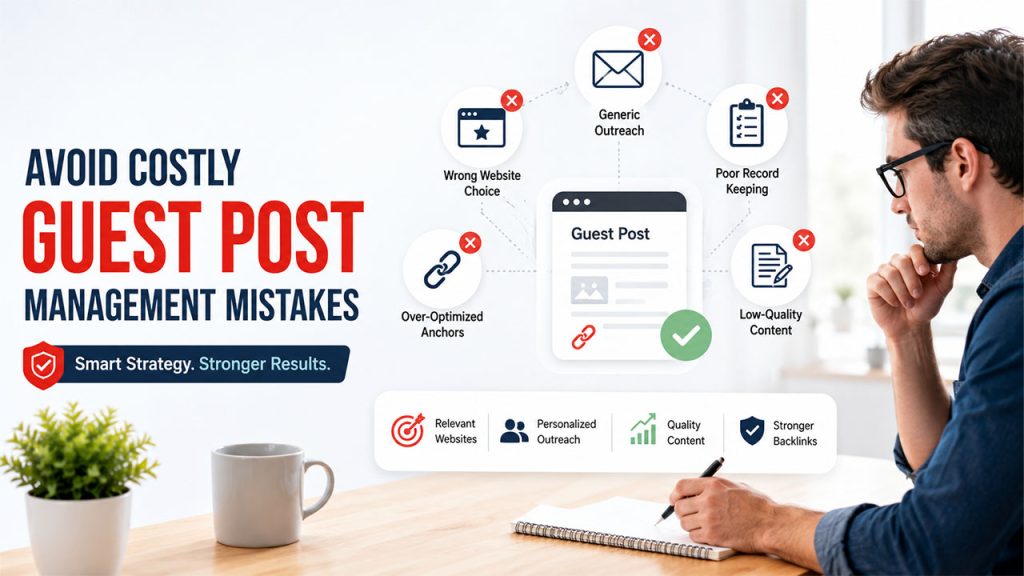
There are various guest post management mistakes that can lead to low-quality backlinks, poor outreach results, and wasted marketing resources.
Some of the most common guest post management mistakes are as follows:
1. Choosing Websites Based on Domain Authority Only
One of the biggest guest post management mistakes is selecting the website solely based on its high domain authority (DA) or domain rating (DR). Many high-DA websites generally have little topical relevance, receive minimal organic traffic, sell links excessively, and have poor editorial standards.
How to Avoid It
Evaluate websites using multiple factors:
- Organic traffic
- Niche relevance
- Content quality
- Engagement levels
- Editorial guidelines
2. Ignoring Website Relevance
Publishing on an unrelated or irrelevant website is considered the most damaging guest posting error. Posting on unrelated websites makes the backlinks appear unnatural and offers limited value.
How to Avoid It
- Create a list of niche-specific websites, and ask before outreach:
- Does this audience match my target audience?
- Does the website regularly publish content in my niche?
- Would readers genuinely benefit from my article?
3. Sending Generic Outreach Emails
One of the most common outreach mistakes is using identical email templates for every publisher. Generic emails receives lower replies, whereas a personalized email attracts attentions instantly.
How to Avoid It
Include:
- The recipient's name
- Mention of a recent article
- Why their audience is relevant
- Unique topic ideas
- Value you'll provide
4. Poor Record Keeping
Marketers generally lose track of the contacted websites, follow-up emails, published posts, and payment status. This creates confusion and duplicate outreach.
How to Avoid It
Maintain a centralized guest posting tracker and track information such as:
- Website URL
- Contact name
- Email address
- Outreach date
- Follow-up schedule
5. Using Over-Optimized Anchor Text
A major guest post management mistake is stuffing backlinks of the article with exact-matching keywords. Users should use more natural variations, such as learn more here, partial-match keywords, and contextual phrases.
How to Avoid It
Maintain a healthy anchor text distribution:
- Branded anchors
- Naked URLs
- Generic anchors
- Partial-match keywords
6. Publishing Thin or Low-Quality Content
Organizations generally consider guest posts just as a link-building tool rather than valuable content. This leads to creating AI-generated articles with little editing.
How to Avoid It
- Every guest post should:
- Solve a real problem
- Include original insights
- Offer actionable advice
- Be well-researched
7. Failing to Follow Up
Various opportunities generally disappear simply because the marketers never share follow-up emails.
How to Avoid It
Users should create a structured follow-up schedule, such as:
- Initial email
- Follow-up after 5 days
- Second reminder after another week
- Final follow-up before closing the opportunity
8. Prioritizing Quantity Over Quality
Publishing low-quality guest posts rarely delivers sustainable SEO results. Users should focus on acquiring fewer and stronger placements that offer a better ranking, more relevant traffic, higher trust, and greater brand visibility.
How to Avoid It
Evaluate each opportunity based on:
- Traffic
- Relevance
- Editorial quality
- Audience engagement
- Organic keyword rankings
9. Focusing Only on Backlinks
Guest posting offers key benefits that are beyond SEO. Businesses often overlook these opportunities for brand awareness, referral traffic, lead generation, and industry networking.
How to Avoid It
Create content that genuinely helps readers and measure success through:
- Traffic
- Engagement
- Brand mentions
- Leads
- Newsletter signups
10. Not Diversifying Outreach
A major outreach mistake is targeting the same type of website repeatedly. Diversification strengthens the backlink profiles.
How to Avoid It
Users should consider targeting:
- Industry blogs
- News websites
- Educational websites
- Resource pages
- Professional communities
- Business publications
Best Practices to Avoid Guest Post Management Mistakes
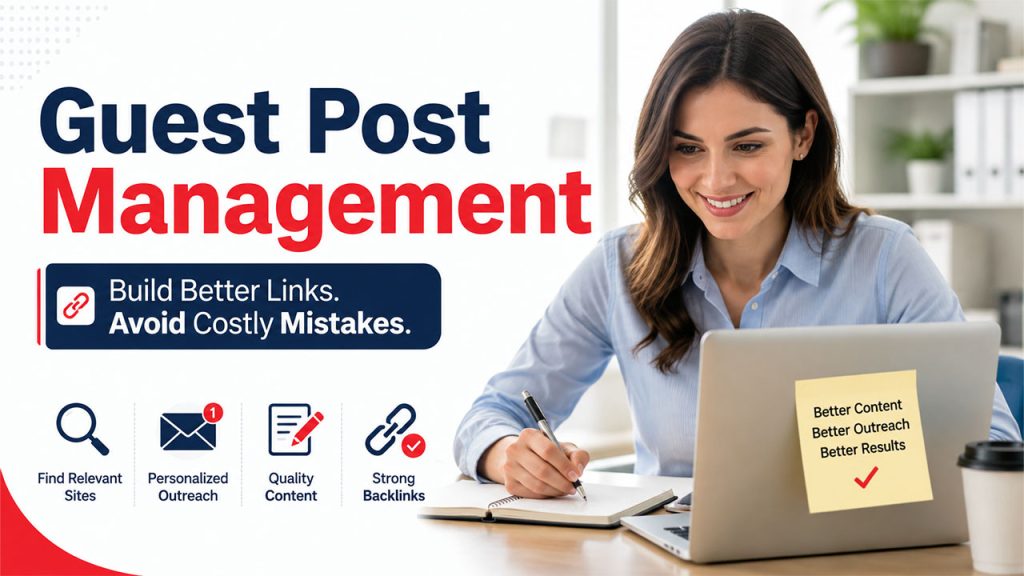
A successful guest posting strategy is generally built on careful planning, consistent execution, and ongoing performance evaluation. By following proven best practices, users can improve the quality of their backlinks, strengthen relationships, and maximize the return on their outreach efforts.
An effective Guest Post Campaign Management workflow should include website research, personalized outreach, editorial coordination, backlink monitoring, and regular campaign reviews to ensure consistent results.
Some of the proven best practices to avoid guest post management mistakes are as follows:
- Focus on a Relevant and High-quality Website: Users should choose a website that is closely related to the niche and has a strong reputation. Users should also consider the organic traffic, content quality, audience engagement, and editorial standards of the site.
- Personalized Outreach: Instead of using generic email to every publisher, users should send personalized messages, as customized outreach is far more likely to receive a positive response.
- Original and Valuable Content: Publishers generally prefer articles that educate, inform, or solve a problem for their readers. Original and well-researched content aligns with the target audience of the website.
- Follow Editorial Guidelines: Respecting the editorial standards of the publisher demonstrates professionalism and also increases the likelihood of publication.
Conclusion
Guest posting continues to become one of the most valuable methods used by agencies and individuals to earn authoritative backlinks and expand their online presence. However, successful guest post management does not depend on just publishing articles. It requires thorough planning, organized execution, and continuous optimization.
Businesses can build stronger relationships with the publishers, secure higher-quality placements, and create sustainable SEO growth by avoiding some common guest post management mistakes. A strategic and well-managed guest posting campaign is not just about acquiring links, but is more about building credibility, increasing visibility, and creating meaningful connections within the industry.


.png)
.png)