





.png)
.png)
The guide explores what SERP insight text links are, how they work, why they matter, and how one can incorporate them into a broader SEO strategy.
Search engine optimization is not limited to adding keywords to web pages and waiting for rankings to improve. Modern SEO requires a clear understanding of search results, competitor strategies, user intent, content quality, and link relationships. One area that offers valuable insights is SERP analysis, especially when it is combined with a well-planned text link strategy.
SERP insights can help SEO professionals understand how pages are connected. They can also reveal common anchor-text patterns, content types, and potential link-building opportunities.
What are SERP Insight Text Links?
SERP, or Search Engine Results Page, is the page displayed by a search engine after a user enters a query. Search intent analysis generally involves examining the pages that rank specific keywords and identifying patterns across those results. SEO professionals can also use a Google SERP API to collect and analyze search-result data more efficiently when evaluating ranking pages, keywords, and SERP patterns.
These patterns include content formats, keyword usage, backlinks, anchor text, page structure, search intent, and other ranking-related signals.
The concept of SERP insight text links refers to using information gathered from search-result analysis to develop, evaluate, or improve text-based internal and external linking strategies. Using this, marketers can use SERP tracking to understand what appears to work within a particular search landscape, rather than building links randomly.
Types of Links in SEO
In SEO, there are two types of text links, which include internal text links and external text links. Text links serve several purposes within a website or broader SEO campaign.
Internal Text Links
Internal text links, or internal links, connect one page to another page on the same domain. It helps guide visitors to related content, establish relationships between pages, and helps search engines discover pages. It also distributes internal authority throughout a website and provides additional context around important topics.
External Text Links
External text links, or external links, are links from one website to another. Earning relevant editorial links through publisher outreach can potentially contribute to a website's authority and visibility, especially when links come from trustworthy and topically relevant sources.
Benefits of Text Links in SEO
Text links offer key benefits in SEO, as these are clickable words or phrases that connect one webpage to another. When used naturally and with context, they can help improve user experience and the way search engines understand a website.
Some of the key benefits of text links in SEO are as follows:
- Help Search Engines Discover Pages: Internal links offer pathways for search engine crawlers to discover other pages on a website.
- Strengthen Website Structure: Text links can also help create relationships between related pages. This creates a more organized website structure.
- Provide Context Through Anchor Text: The clickable words, or anchor text, offer users and search engines context about the linked pages.
- Improves User Navigation: Text links offer visitors an easy way to explore additional information without having to return to the main menu or search for another page.
Benefits of SERP Insight Text Links

SERP analysis offers useful information on several target keywords, especially at several stages of link planning. Some of the key benefits of SERP insight text link strategies are listed below:
- Identify Relevant Topics
Analyzing search results for target keywords helps SEO professionals discover relevant topics, pages, and resources that are closely connected to the subject. These insights also help identify pages that should be linked together within the website.
- Support Better Anchor Text Selection
SERP research can also show how related topics and concepts are described across ranking pages. It helps in creating natural and descriptive anchor text.
- Improves Internal Linking Strategy
SERP insights can also help uncover relationships between informational, commercial, and supporting pages. Users can create internal links that connect all these pages logically.
- Help Discover Content Gaps
By comparing the content with pages that appear in relevant SERPs, users can identify topics or subtopics that the website has not covered adequately.
These insights can also help SEO professionals identify relevant websites and potential prospects for SEO outreach, making it easier to approach websites that are closely aligned with the target topic.
Practical SERP Text Link Workflow
To improve the SERP text link strategy, users can incorporate SERP insights into their regular SEO process with a simple workflow.
- Step 1: Choose a Target Keyword
Select a primary keyword or topic that is relevant to the website.
- Step 2: Analyze the SERP
Review the top-ranking pages and identify common content themes, formats, and related queries.
- Step 3: Study Linking Patterns
Identify useful information about internal links, external references, anchor text, and related content.
- Step 4: Identify Opportunities
Determine which pages you should create, update, connect, or promote.
- Step 5: Build Natural Links
Add internal links where they genuinely help readers. For external link building, focus on earning relevant editorial mentions rather than pursuing links solely for quantity.
Explore our guide to link building strategies for a deeper look at the process.
- Step 6: Monitor Performance
Track changes in rankings, organic traffic, engagement, indexed pages, and other relevant SEO metrics.
Best Practices for SERP Insight Text Links
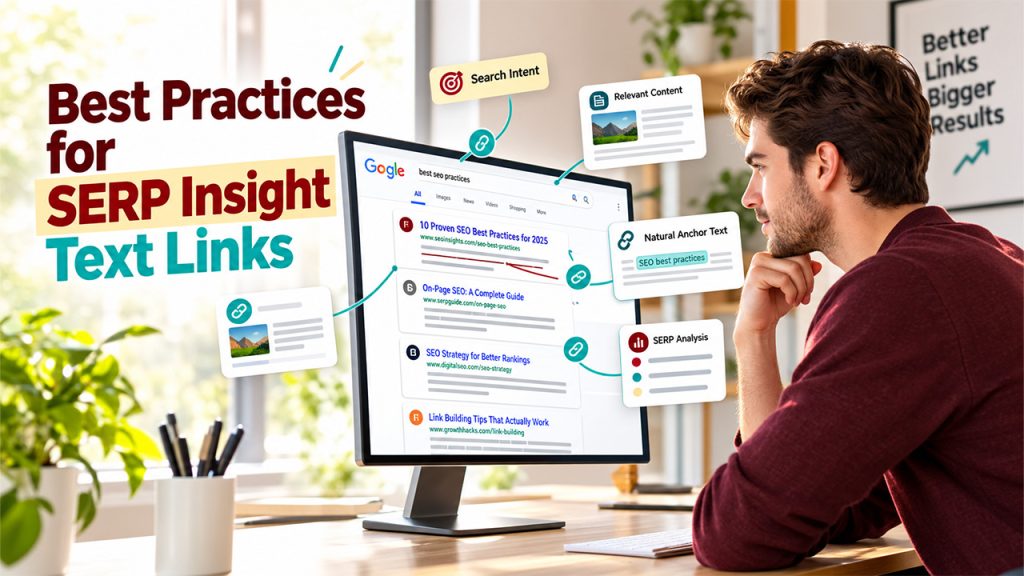
Using SERP insight effectively requires more than just identifying keywords and adding hyperlinks. A successful strategy focuses on relevance, context, natural anchor text, and user experience. Follow the given best practices to develop an effective SERP insight text link strategy:
- Keep Links Contextually Relevant
Every text link should have a clear connection to the surrounding content. Before adding a link, users can consider whether the destination provides useful additional information to the reader.
- Use Natural Anchor Text
Ensure that anchor text clearly describes the linked page without sounding forced. Users should avoid inserting exact-match keywords repeatedly just for SEO purposes.
- Analyze SERPs Before Choosing Link Opportunities
Before creating a linking strategy around a keyword, examine the current search results. They should look for common topics, content formats, related terms, and pages that constantly appear.
- Match Link with Search Intent
Users should consider what the reader is trying to accomplish with their search. If the reader is looking for educational information, link to a useful guide or tutorial.
Common Mistakes to Avoid
While practicing the SERP insight text link strategy, avoid the following common mistakes:
- Copying Competitor Anchor Text
Analyze competitors for insights, but don't copy their linking strategy. Users can use competitor data to understand patterns while developing their own natural strategy.
- Overusing Exact-Match Anchors
Repeatedly using the same keyword-rich anchor can make the linking strategy look unnatural. Use varied and descriptive languages.
- Focusing on High-Volume Keywords
A keyword with a large search volume is not necessarily the best opportunity for linking. Long-tail and highly specific queries can attract users with stronger intent.
Conclusion
SERP insight text links help businesses build a more informed and effective SEO strategy, simply by connecting SERP analysis with relevant and contextual linking. Marketers can create stronger content connections and improve the overall user experience simply by understanding search intent, choosing natural anchor text, identifying relevant linking opportunities, and using strategies such as SEO outreach and publisher outreach. Mainly focus on maintaining relevance, quality, and genuine value, rather than simply increasing the number of lists.


.png)
.png)