





.png)
.png)
2026 broke every record venture capital had. AI alone absorbed $242 billion, about 80% of all global startup funding, and four of the five largest private rounds in history closed within the same three months. The numbers are genuinely staggering.
But Capital isn't the story anymore. Back in 2024, "hottest AI startups" essentially meant any company that wrapped a foundation model around something, raised a seed round at an inflated valuation, and called it a product. That era is over. The question being asked in 2026 is sharper: which startups are growing revenue at category-defining speed, locking in real distribution, and embedding themselves into industries before the frontier labs absorb everything? There's more money than ever chasing fewer genuine winners, and the market knows exactly who they are.
Here's an honest look at seven of them.
What Are AI Startups?
AI startups are companies that are built from the ground up to develop, deploy, or commercialize artificial intelligence as their core product; not as an add-on feature.
That distinction matters. Why? Because a traditional software company adding an AI chatbot to its dashboard isn't an AI startup. These are businesses where AI is the infrastructure, the product, and the competitive advantage all at once.
In 2026, they generally fall into four broad categories:
- Foundation Model Companies: Building the large language models and general-purpose AI platforms that power everything else. Examples include Anthropic, OpenAI, and Mistral.
- Vertical AI Companies: Applying AI deeply to specific regulated industries like legal, healthcare, or defense.
- Developer Tools and AI Infrastructure: Providing the APIs, compute, and coding environments that the wider ecosystem runs on.
- Autonomous AI Agent Platforms: Newer players building systems that can take multi-step actions with minimal human input.
They're not just attracting capital. They're actively reshaping how industries operate, how software gets written, and how enterprises make decisions.
Top 7 Hottest AI Startups of 2026 at a Glance
| Startup | Category | 2026 Valuation | Why It's Defensible |
| OpenAI | Foundation Models | ~$852B | 700M+ weekly users; $24B+ ARR |
| Anthropic | Foundation Models | ~$380B | Enterprise trust; embedded in agent stacks |
| Anysphere (Cursor) | AI Developer Tools | ~$50B | Fastest B2B SaaS to $2B ARR |
| Perplexity | AI Search | ~$22.6B | Survived OpenAI search; publisher revenue-share |
| Harvey | Legal AI | ~$11B | Half of Am Law 100; embedded engineering model |
| Sierra | Customer Support AI | ~$15B | Fortune 500 depth; $150M+ ARR |
| Shield AI | Defense AI | ~$12.7B | US Air Force contract; mission-critical deployment |
The 7 Hottest AI Startups Leading the Market Right Now
These AI startups are not just raising massive funding rounds, they are actively shaping the future of software, enterprise operations, defense, search, and autonomous AI systems in 202
1. OpenAI — The Dominant Force

At this point, OpenAI doesn't just lead the AI space. It largely defines it. In March 2026, the company closed the single largest private funding round in history that is $122 billion, taking its post-money valuation to approximately $852 billion. Revenue is running at around $2 billion per month, which puts annualized figures north of $24 billion.
Key highlights:
- 700+ million active weekly users across its product suite
- Products span ChatGPT, Codex, Sora, an enterprise agent platform, and Stargate-scale infrastructure
- Over one million enterprise customers as of early 2026
- Actively preparing for a potential IPO targeting a $1 trillion valuation
OpenAI's scale has positioned it as one of the leading players in the AI industry. However, as the market continues to evolve, users and businesses are exploring alternative AI platforms that offer different features, pricing models, and specialized capabilities. OpenAI faces increasing competition from organizations that are driving innovation across the AI landscape.
2. Anthropic — The Safety-First Challenger

Anthropic closed a $30 billion Series G in February 2026, led by GIC and Coatue, at a $380 billion post-money valuation. Annualized revenue sits around $14 billion and is still climbing and has become the steepest absolute revenue ramp in the industry right now.
What makes it genuinely interesting isn't just the valuation. It's where the growth is coming from:
- Claude powers agent stacks at Cursor, Cognition, and a large share of the latest Y Combinator batch
- Reportedly outpacing OpenAI in net-new enterprise logos across regulated industries
- Claude Code has become the fastest-growing AI coding tool behind Cursor itself
Anthropic isn't trying to be OpenAI. It's carving out something different — safety-oriented, deeply trusted in enterprise, and quietly embedded in the tools developers already depend on every day.
3. Anysphere (Cursor) — The AI Coding Phenomenon
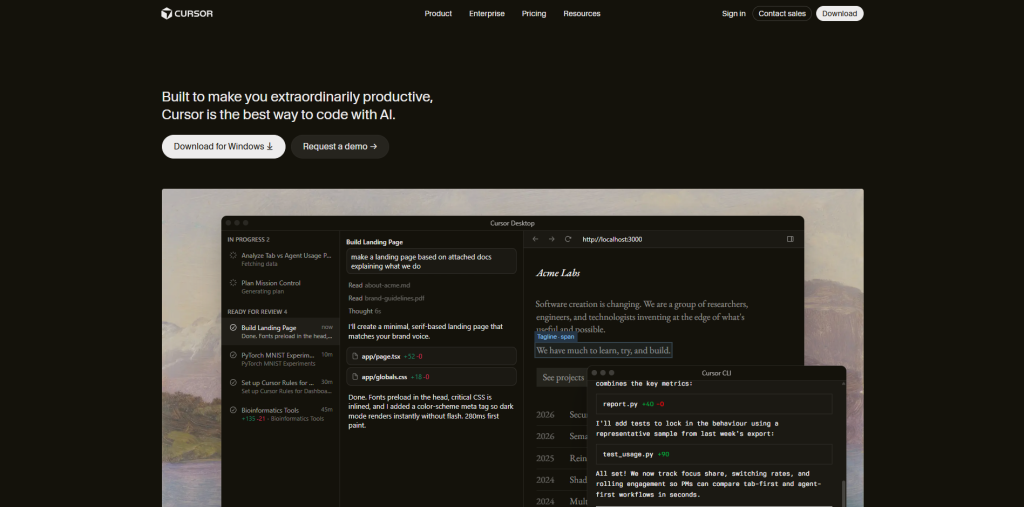
No startup in 2026 has a more striking growth arc than Cursor. Built by Anysphere, the AI code editor has posted numbers that genuinely don't have a precedent in B2B software history.
- January 2025: $100M ARR
- June 2025: $500M ARR
- November 2025: $1B ARR
- February 2026: $2B+ ARR
That's zero to $2 billion faster than any B2B software company ever. As of mid-April 2026, Cursor is reportedly in talks to raise over $2 billion at a $50 billion valuation, with Thrive Capital and Andreessen Horowitz leading. Internal forecasts reportedly target $6 billion-plus ARR by end of year.
What separates it from a well-funded tool is that it's become the daily workflow for a significant share of professional software engineers globally. Net dollar retention is reportedly above 90%. It has built real proprietary infrastructure around code retrieval and multi-file editing. It's what engineers actually use to do their jobs.
4. Perplexity — The AI Search Startup
A lot of people assumed Perplexity would fade once OpenAI launched its own search capabilities. That assumption was proven wrong:
- Raised $200M at a $20B valuation in September 2025
- Climbed to a reported $22.6B post-money valuation by December 2025
- Committed $750 million over three years to Microsoft Azure in January 2026 to power Deep Research and Model Council features
The Comet browser launch and a publisher revenue-sharing program gave Perplexity something genuinely hard to replicate; a defensible position in AI-driven web traffic. Perplexity is the only one that is seriously trying to answer the question of how publishers get real value back in a world where AI answers replace clicks? There are many companies that are not even asking this question. But Perplexity is and it’s gaining real ground around it.
5. Harvey — The AI Legal Startup Transforming Law Firms

Legal AI has been promised for a long time. Harvey is the company actually delivering it at scale.
- Hit an $11 billion valuation in March 2026 after a $200 million raise; up from $8 billion just three months earlier
- Embedded in roughly half of the Am Law 100
- Growing rapidly among in-house corporate legal teams worldwide
The strategic shift worth watching is Harvey's move away from pure SaaS toward what it calls embedded legal engineering where Harvey staff work directly alongside client legal teams to build and maintain custom agents. It's high-touch, high-retention, and structurally resistant to churn. Legal workflows are slow to change and deeply compliance sensitive. Once you're embedded at that level, you're not easy to remove. Harvey understands this. Everything about its current strategy reflects that understanding.
6. Sierra — The Enterprise AI Customer Support Startup

Sierra doesn't get the headlines it probably deserves. Founded by Bret Taylor, former Salesforce co-CEO and current OpenAI board chair; it's built one of the cleanest vertical AI agent businesses in the market today.
Key highlights:
- ARR hit $150 million in January 2026; up from just $26 million at end of 2024
- Total funding of $635 million from Greenoaks, Sequoia, Benchmark, Iconiq, and Thrive
- Deployed deep inside Fortune 500 customer support stacks
What Sierra sells isn't a chatbot. It's an operating layer. Once a company has rebuilt its customer support infrastructure around Sierra's platform; integrating it with their CRM, knowledge base, and escalation flows and the cost of switching becomes enormous. That depth is a competitive advantage. The revenue curve reflects exactly that.
7. Shield AI — The Defense AI Startup Powering Autonomous Military Systems
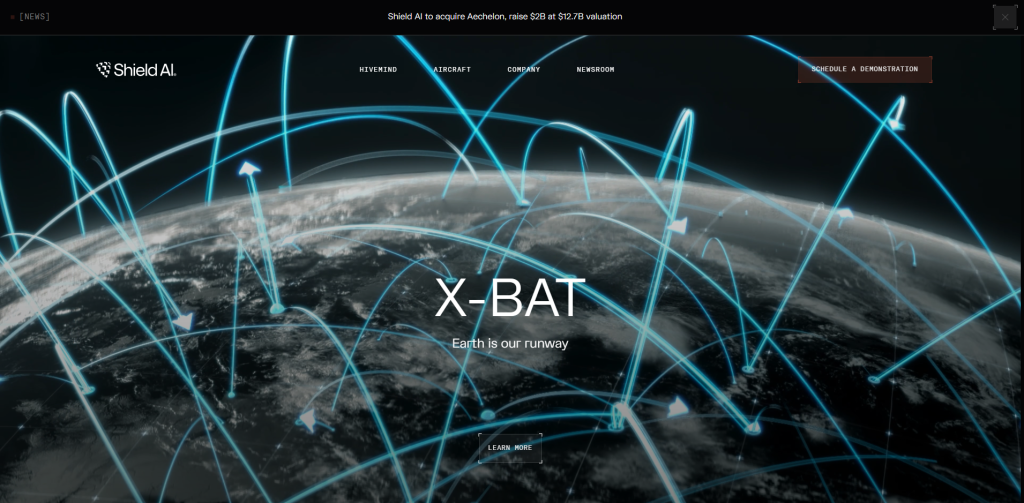
Three years ago, defense AI wasn't a real category. In 2026, it's one of the most consistently funded verticals in the startup world and Shield AI is its most visible face.
- Closed a $1.5 billion Series G in March 2026 at a $12.7 billion valuation; a 140% jump in twelve months
- Projecting $540 million-plus in 2026 revenue, representing 80%+ year-over-year growth
- V-BAT autonomous aircraft software selected to integrate with Anduril's Fury fighter jet program
- Win secured on the back of a significant US Air Force contract
Defense contracts are long, sticky, and nearly impossible to exit once embedded in mission-critical operations. The same logic that makes regulated verticals attractive for Harvey or Anthropic applies here, only with higher stakes, longer timelines, and virtually no commercial replacement risk.
Key AI Startup Trends Shaping the Industry in 2026
Look across all seven companies, and a few clear patterns emerge. These aren't coincidences; they're the forces actively determining which AI startups win and which ones stall.
- Vertical Depth Beats General Purpose: The companies gaining the most ground aren't trying to do everything. They've gone deep into one industry such as legal, defense, customer support and made themselves genuinely hard to displace.
- Agentic AI is Moving from Demo to Deployment: Cursor, Sierra, Cognition, and Harvey aren't showing what agents could do. They're shipping them into real workflows where outcomes are measured, and contracts are signed.
- Revenue Retention is the New Valuation Signal: Net dollar retention above 90%, ARR doubling every few months, enterprise contracts with embedded switching costs. This is what investors are actually looking at now. Funding rounds follow revenue, not the other way around.
- Defense AI has Matured into a Serious Category: Shield AI's Air Force win and Anduril's continued expansion signal that autonomous defense technology has crossed from experimental to operational. That's a structural shift, not a trend.
- Europe is Building Real Infrastructure: Mistral's €722M raise and $830M debt facility for a Paris data center, Black Forest Labs hitting $3.25B, and Wayve raising $1.2B for autonomous driving, the "European AI is falling behind" narrative is simply outdated.
Conclusion
The hottest AI startups of 2026 aren't the loudest ones. They're the ones that have made themselves structurally irreplaceable in the workflows, engineers depend on daily such as in legal teams that can't afford errors or in defense operations where failure isn't an option. Funding follows that kind of depth, so does longevity. The companies that figured this out early aren't just winning the quarter. They're building the infrastructure that the next decade of AI runs on.



.png)
.png)