



.png)
.png)
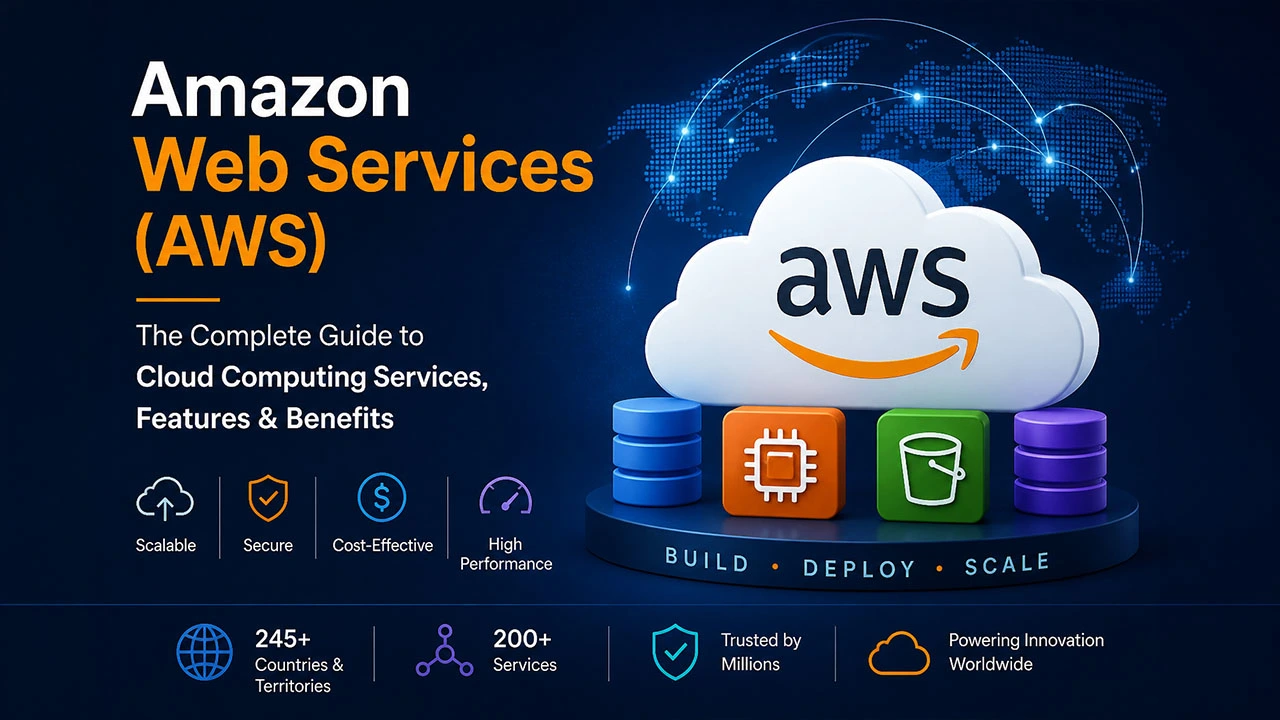
AWS (Amazon Web Services) is an evolving and complete cloud computing platform offered by Amazon. It involves a mix of IaaS (Infrastructure-as-a-Service), Packaged SaaS (Platform-as-a-Service), and SaaS (Software-as-a-Service) offerings. AWS provides you with powerful tools like database storage, compute power, and content delivery services.
Amazon.com launched its first web services in 2002 from the company’s internal infrastructure, purpose-built to manage its internal operations. In 2006, it started its flagship IaaS services. AWS is widely believed to be the first company to introduce a pay-as-you-go cloud computing model that scales to render users with computation, storage, and throughput as required.
AWS provides a wide range of products and tools for software developers and enterprises in 245 territories and countries. Educational institutions, government agencies, private organizations, and non-profits utilize AWS services.
Why Is AWS Significant?
With a total of 200 services, Amazon Web Services provides a broad range of offerings for individuals, as well as private and public sector businesses, to develop applications and data services of all kinds. The services are based on the cloud and are expected to be cost-efficient. They connect with numerous programming languages and interact over distinct networks and interface with competitive cloud service providers (CSPs).
AWS was the first developer to build cloud services. Thus, it caters to a wide customer base and provides a broad range of offerings. It is utilized by businesses all around the world through a global network of data centers.
Businesses utilizing AWS for scalable cloud infrastructure and digital operations can further enhance productivity by adopting modern workflow automation, cloud collaboration, and business management solutions that streamline daily operations.
What Is the History of AWS?
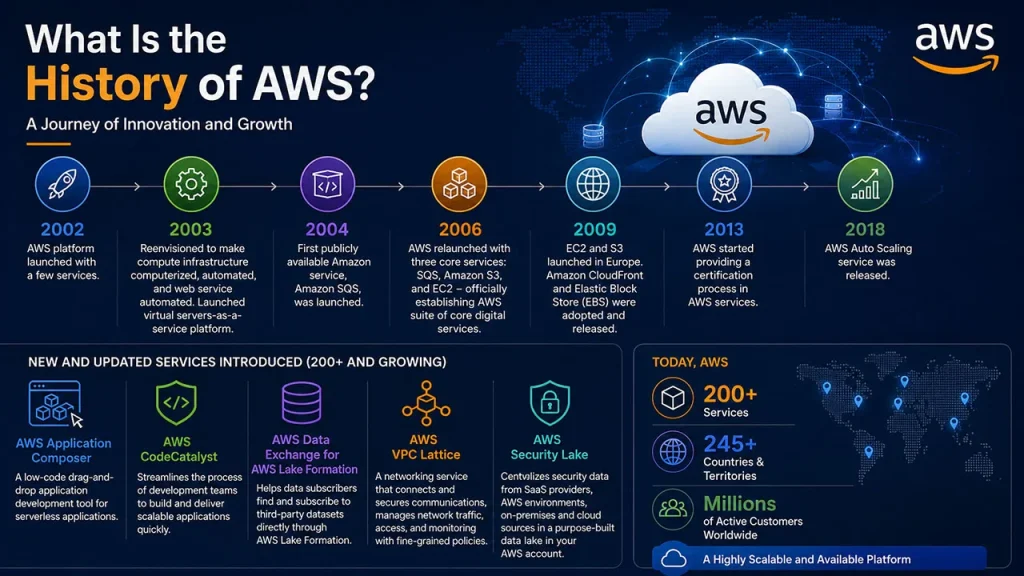
The AWS platform was launched in 2002 with a few services. In 2003, it was reenvisioned to make AWS compute infrastructure computerized, automated, and web services automated. This change involved selling accessibility to a virtual servers-as-a-service platform. In 2004, the first publicly available Amazon service, Amazon SQS, was launched.
In 2006, the Amazon Web Service was relaunched to include three services, i.e., SQS, Amazon S3, and EC2, officially making AWS a suite of core digital services. In 2009, EC2 and S3 were launched in Europe, and Amazon CloudFront and the Elastic Block Store were adopted and released to AWS. In 2013, AWS started providing a certification process for AWS services, and 2018 saw the release of an autoscaling service.
In 2002, Amazon introduced more than 110+ new and updated services and features at its 2002 invent conference. A few of these offerings are as follows:
- AWS Application Composer: It is a low-code drag-and-drop application development tool for serverless applications.
- AWS CodeCatalyst: It streamlines the process for development teams to build and deliver scalable applications quickly.
- AWS Data Exchange for AWS Lake Formation: It helps data subscribers find and subscribe to third-party datasets that are directly handled through AWS Lake Formation.
- AWS VPC Lattice: It is a networking service that tracks, connects, and secures communications among users to enhance productivity. It also determines policies for management of network traffic, access, and monitoring.
- AWS Security Lake: It centralizes security data automatically from SaaS providers, AWS environments, on-premises and cloud sources in a specially built data store that is stored in the AWS account of the user.
Today, AWS provides 200+ services and has data centers all around the world that make it a highly scalable and available platform.
How Does AWS Operate?
AWS is separated into distinct services where each one can be configured in distinct ways as per the requirements of users. Users can look at configuration options and separate server maps for an AWS service.
The AWS portfolio involves the below-mentioned service categories:
- Storage
- Compute
- Infrastructure Management
- Databases
- Data Management
- Application Development
- Migration
- Data Management
- Networking
- Hybrid Cloud
- Management
- Development Tools
- Monitoring
- Security
- Big Data Management
- Governance
- Artificial Intelligence
- Analytics
- Mobile Development
- Messages and Notification
- Game development
- Augmented Reality and Virtual Reality
- Internet of Things
Many modern enterprise platforms depend on scalable cloud environments like AWS to manage databases, business applications, and operational workflows efficiently.
Core AWS Services You Should Know
Although AWS offers more than 200 services, a few products form the backbone of most cloud environments. Understanding these services helps businesses and developers make better decisions when building applications.
Amazon EC2 (Elastic Compute Cloud)
Amazon EC2 provides virtual servers in the cloud, allowing users to deploy applications without purchasing physical hardware. It supports different operating systems, instance sizes, and pricing models to meet various business requirements.
Amazon S3 (Simple Storage Service)
Amazon S3 is one of the most popular cloud storage solutions in the world. It enables organizations to store files, backups, media assets, and application data with high durability and scalability.
Amazon RDS (Relational Database Service)
Amazon RDS simplifies database management by handling backups, maintenance, patching, and scaling automatically. It supports several database engines, including MySQL, PostgreSQL, MariaDB, Oracle, and SQL Server.
AWS Lambda
AWS Lambda allows developers to run code without managing servers. Businesses only pay for the compute time consumed, making serverless computing highly cost-effective for many workloads.
Amazon CloudFront
CloudFront is AWS's content delivery network (CDN) service. It distributes content through edge locations worldwide to reduce latency and improve website performance for global users.
Amazon VPC
Amazon Virtual Private Cloud (VPC) enables organizations to create isolated cloud networks with custom security rules, subnets, and access controls, helping maintain secure enterprise environments.
AWS Advantages and Demerits
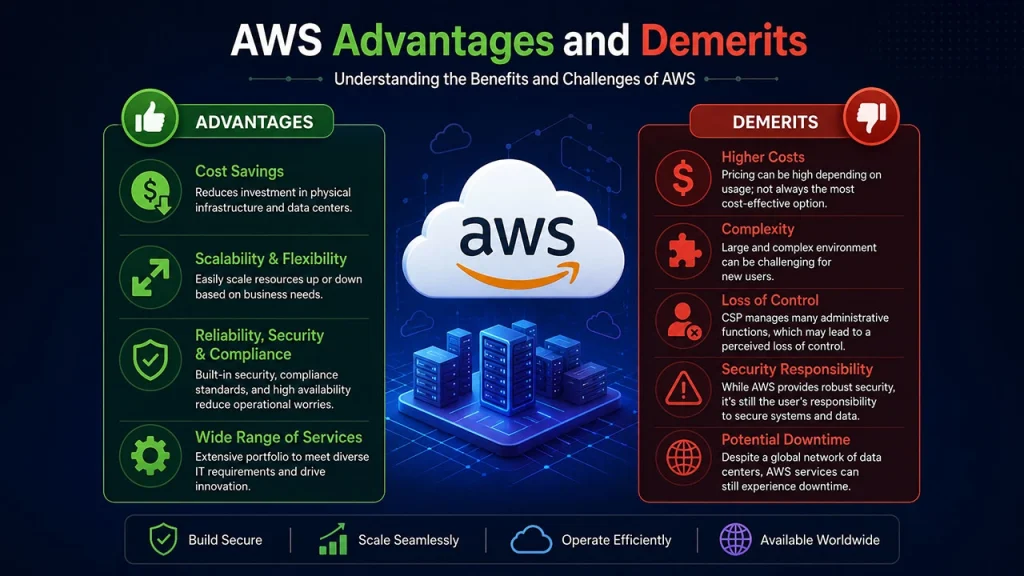
With a wide range of service offerings, AWS can address numerous IT requirements and issues. The major advantage of switching to a cloud environment is that it can save businesses money on related investments and physical data centers. AWS ensures extensive flexibility and scalability of services. It also relieves customers from having to worry about reliability, security, and compliance problems.
Businesses that rely on cloud environments often prioritize uptime, scalability, and performance. AWS provides a globally distributed infrastructure with multiple availability zones and regions that help applications remain available even during unexpected failures. Companies looking for Reliable Hosting solutions often compare enterprise cloud providers like AWS with traditional web hosting platforms to determine the best fit for their long-term growth and technical requirements.
Despite its versatile pricing models, AWS pricing is in the higher range, depending on how much a specific service is utilized. Users must determine their requirements before launching an AWS product to check whether cloud services are the most cost-effective option.
The AWS environment is also complex and large, which can pose challenges to new users. Loss of control is a common problem for cloud service customers, since the CSP manages administrative functions, unless otherwise arranged by the user. Security of AWS is a primary focus for Amazon. However, it is still the responsibility of the users to make sure that the systems and data are secure. And, despite the international network of data centers, AWS can also face downtime.
Who Uses Amazon Web Services?
The list of companies that host their IT environments in AWS is long and comprises different enterprises:
- Adobe: Adobe utilizes AWS to render multi-terabyte operating ecosystems for its environments by incorporating its system with AWS cloud. Adobe can emphasize operating and deploying its own software instead of trying to implement and handle the infrastructure.
- Airbnb: Airbnb, which is a digital vacation rental marketplace for travelers and property owners to maintain and connect to a large infrastructure in AWS, utilizes nearly all of the available services.
- Autodesk: Autodesk creates software for the design, engineering, and entertainment industries. Utilizing services such as Amazon S3 and Amazon RDS, Autodesk can emphasize creating its machine learning tools instead of spending a lot of time handling the infrastructure.
- America Online (AOL): America Online (AOL) has utilized AWS to economize, decommission 14,000 in-house, and close data centers. They have transferred mission-critical workloads to the cloud, widened its global reach, and saved millions of resources on energy.
- BitDefender is a network security software organization, and its portfolio of software includes anti-spyware products and antivirus. Utilizing Amazon EC2, they are running numerous instances that manage 5 terabytes of data. BitDefender also utilizes the features of Elastic Load Balancer to load balance the connections coming into these instances across different availability zones, ensuring smooth global delivery of service.
- BMW: BMW utilizes AWS for its new connected-car application, collecting sensor data from BMW 7-series cars to provide drivers with updated information dynamically.
- Imaging products division of Canon benefits from quicker deployment times, minimum cost, and global reach by utilizing AWS to ensure cloud-based services like office imaging products and mobile printing.
The largest cable company of the world and leading provider of internet service in United States, Comcast, utilizes AWS in a hybrid environment. Out of all the remaining cloud providers, Comcast chooses AWS for its scalable hybrid infrastructure and flexibility.
Docker is a company that empowers the way developers create, ship, and execute applications, making full use of containers. The Amazon EC2 container service enables them to do it.
Although the bulk of the work of the European Space Agency is completed by satellites, little data storage and computing infrastructure is developed on Amazon Web Services.
The Guardian newspaper also utilizes a broad range of AWS services to boost their analytics dashboard that is used by editors to see how stories are trending in real-time.
Why Is AWS So Successful?
Companies report a broad range of reasons for not only choosing Amazon Web Services but also depend on it for vital facets of their IT infrastructure:
- Durability and Security: AWS can encrypt the data, providing end-to-end storage and privacy.
- Flexibility: In AWS, flexibility is immense, enabling developers to choose the OS, database and language.
- Experience: Developers can depend on Amazon's established processes of Amazon. Their techniques, tools, and suggested best practices are created upon years of experience.
- Simplicity: AWS is quite simple to use, enabling developers to choose the OS, database and language.
- Scalability: Applications can be easily scaled down or up as per the user's needs.
- Cost Savings: Companies only need to pay for storage, computing power, and resources utilized, with no long-term commitments.
AWS vs Other Cloud Providers
While AWS is the market leader in cloud computing, it isn’t the only option. Microsoft Azure and Google Cloud Platform (GCP) are its two closest competitors, and each has its own strengths worth understanding before committing to a platform.
AWS vs Microsoft Azure
Azure is a cloud computing platform by Microsoft, being the second most popular in the industry. Its strength lies in the seamless integration between Azure and other Microsoft technologies such as Windows Server, Active Directory, and Office 365. However, AWS is ahead in the number and variety of services and geographic reach. Therefore, it is a better option for businesses that do not have a lot of applications based on Microsoft’s tools.
AWS vs Google Cloud Platform
The main advantages of Google Cloud Platform are its strengths in the spheres of data analytics, machine learning, and Kubernetes for container orchestration, since most of these technologies have been created by Google. AWS offers comparable services in all of these areas but tends to have the edge in overall service breadth, enterprise adoption, and community support.
Which one should you choose?
For most companies, AWS remains the best choice due to its maturity, wide range of offered services, and global availability. If your business uses lots of products from the Microsoft stack, Azure is the best choice, while GCP is perfect for those focusing on data science, AI workloads, or Kubernetes.
Understanding AWS Pricing Models
One reason behind AWS's popularity is its flexible pricing structure. Businesses can select payment options according to their workloads and budget requirements.
Pay-As-You-Go Pricing
The standard AWS model allows users to pay only for the resources they consume. There are no long-term commitments, making it ideal for startups and small businesses.
Reserved Instances
Organizations with predictable workloads can purchase Reserved Instances to receive significant discounts compared to on-demand pricing by committing to longer usage periods.
Spot Instances
Spot Instances enable businesses to utilize unused AWS capacity at substantially lower prices. They are particularly useful for testing, batch processing, and non-critical applications.
Free Tier Services
AWS provides a Free Tier that allows new users to explore many services without immediate costs. This helps developers and businesses experiment before investing in larger deployments.
When evaluating cloud expenses, many website owners also compare traditional hosting providers through resources such as Hostinger vs Bluehost to determine whether managed hosting or enterprise cloud infrastructure better aligns with their business goals.
How to Get Started with AWS
Getting started with AWS is more straightforward than most people expect, and the free tier makes it easy to explore services without any upfront cost.
Step1: Create an AWS Account
Go to aws.amazon.com and create a free AWS account. For creating the account, a valid e-mail ID, phone number, and credit card will be required for verification; however, one won’t have to pay anything for free-tier usage.
Step 2: Explore the AWS Free Tier
AWS offers a Free tier, which enables new customers to avail certain services provided by AWS for free during the period of one year. The list of these free services includes Amazon EC2, Amazon S3, and experience using the services.
Step 3: Choose Your First Service
One doesn't need to learn all the services at once; rather, one should pick the most appropriate service according to the purpose and start using it. If the purpose is to host a website, then begin with Amazon EC2 or S3; while building an application, use Amazon RDS and so forth.
Step 4: Use AWS Documentation and Training
The company offers very detailed information about its different services along with free training on AWS Skill Builder, which is a learning platform by AWS. This platform teaches about AWS basics for certification.
Step 5: Monitor Your Usage
As you start using services, keep an eye on the AWS Cost Explorer and Billing Dashboard to track usage and avoid unexpected charges, especially once free tier limits are reached.
Conclusion
Amazon Web Services continues to transform how businesses work in the digital age. With more than 200 services encompassing storage, computing, AI, and security across 245 countries, AWS provides flexibility, unmatched scalability, and cost efficiency. Ranging from startups to global companies such as BMW and Adobe, businesses trust AWS to enable mission-critical workloads. While challenges such as pricing complexity and security responsibilities are present, AWS remains the primary standard in cloud computing, evolving constantly to align with the demands of a greatly connected world.

.png)
.png)