




.png)
.png)
If you’ve ever connected to a work network from home or set up a private tunnel between two office locations, there’s a good chance IPsec was doing the heavy lifting behind the scenes, even if you never saw its name. It’s one of those technologies that quietly runs a huge chunk of the internet’s private traffic without most people ever needing to think about it.
In brief, IPsec is a suite of protocols that allows encrypting and authenticating all the traffic moving from point A to B over an IP network. IPsec doesn’t bother with the type of data; it just wraps the traffic in its encryption for safe passage through the network regardless of whether anybody tries to read or alter the data while it is transferred.
This technology usually goes hand in hand with virtual private networks because IPsec VPNs are one of the most used technologies for connecting a company's remote branches and allowing employees to safely use corporate resources remotely. Today, we will talk about IPsec in general: what it is, how it works, why it is needed, and in which cases IPsec is used.
What Is an IPsec?
IPsec, short for Internet Protocol Security, is a framework of protocols that work together to secure data as it moves across a network. Rather than being one single tool, it’s more like a toolkit, made up of different pieces that handle encryption, authentication, and key exchange, all working together to keep traffic private and verified.
It works on the network layer, which provides for its versatility as an instrument of securing communications. Unlike other solutions that could be applied to specific applications or types of communications only, it can be used for any IP traffic, from browsers and file transfers to enterprise networks communicating with each other.
IPsec was developed in the 1990s initially for use with IPv6, although later the protocol was modified so that it could be applied to IPv4. Nowadays, after dozens of years, IPsec is still one of the most reliable instruments for establishing secure communications over the public network.
How IPsec VPN Works
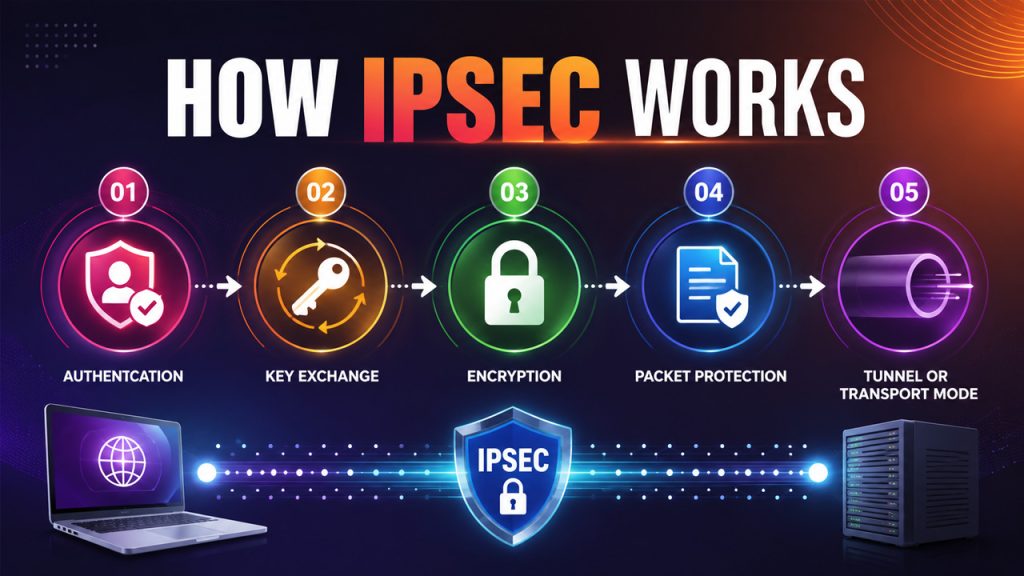
IPsec doesn’t rely on just one mechanism to keep data safe; it’s really a combination of a few different processes working together behind the scenes:
Authentication:
Both devices that communicate authenticate their identities before any data transfer occurs; therefore, you can be sure that a secure tunnel is created only between genuine devices, not imposters.
Key exchange:
To exchange encryption keys used by both devices, the IKE (Internet Key Exchange) protocol is used.
Encryption:
The data is being encrypted after establishing trust and becomes unreadable to anyone who attempts to eavesdrop on the communication.
Protection of the packet:
IPsec employs two major protocols for providing security services for the packets: Authentication Header and Encapsulating Security Payload. Each of the protocols may perform the functions of authenticating data, encrypting data, or performing both functions, depending on the configuration of the packet.
Tunnel or transport mode:
IPsec allows protecting either by encapsulating the entire packet with a new packet (tunneling mode) or just the payload of the packet (transport mode).
All these things make IPsec-based VPN services reliable for personal use as well as for whole corporate networks. The above-described process takes place automatically, and therefore, the users usually do not know anything about it.
Benefits of IPsec
Once it’s set up, IPsec quietly does a lot of work to keep network traffic safe, and the advantages go beyond just “it’s encrypted”:
- Strong security by default: Both authentication and encryption are built into the protocol, so you’re not bolting security on as an afterthought.
- Works at the network layer: Because it operates below individual applications, it protects everything running over the connection without needing each app to support it separately. While IPsec secures network traffic, technologies such as CDNs focus on improving website speed and reducing latency by distributing content across geographically distributed servers.
- Flexible deployment: It works for site-to-site connections between offices, remote access for individual employees, or even device-to-device communication, depending on the setup.
- Wide compatibility: Being an established, well-supported standard, it works across most operating systems, routers, and firewalls without much hassle.
- Reliable for business use: It’s been battle-tested for decades, which matters a lot when you’re depending on it to protect sensitive company data every single day.
For most businesses, the biggest win is that IPsec doesn’t ask you to trust the public internet at all. It builds its own protected layer on top of it, so what happens inside that tunnel stays private regardless of what network it’s traveling through.
Use Cases: Where IPsec Shows Up
IPsec is not a hypothetical security protocol anymore; rather, it is at work everywhere:
- Site-to-site VPN: Establishing a secure connection between two office locations using the Internet, so that the two networks operate as a single local network.
- Remote access VPN: Providing employees access to corporate resources from their personal computers, without having to expose their sensitive information to the public Internet.
- Cloud networking: Securing traffic between your local infrastructure and AWS cloud computing environments to meet increasing hybrid-cloud demands.
- Voice and video streams: Providing reliable encryption of voice over IP calls where both security and performance are needed.
- Governments and defense networks: Extensively used wherever high security and data integrity demand mandatory encrypted and authenticated traffic.
The vast majority of IPsec virtual private networks encountered in the commercial environment will belong to either of these categories, namely, site-to-site or remote access.
Challenges and Limitations of IPsec
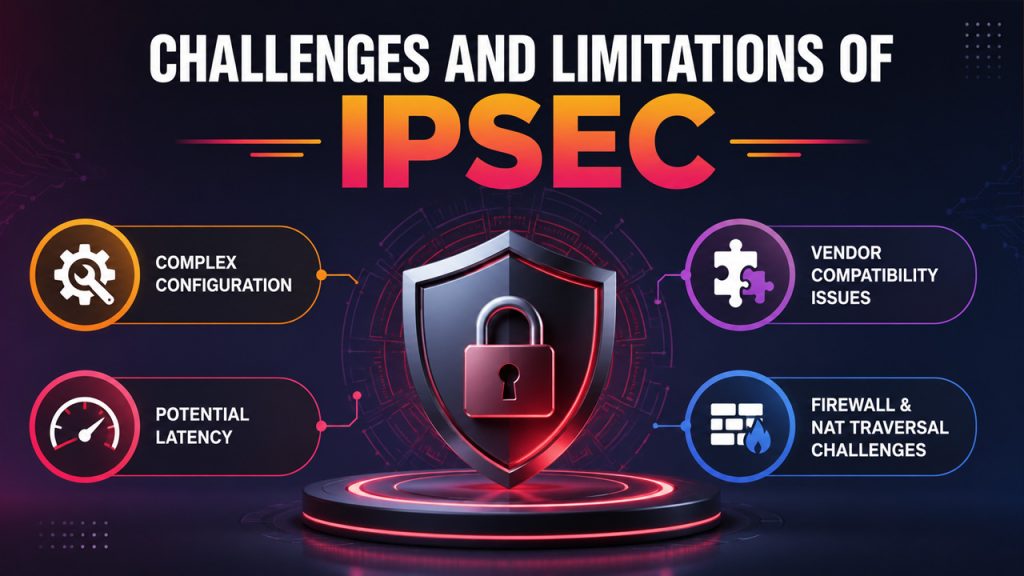
IPsec is solid, but it’s not without friction, and it’s worth knowing where that shows up before you build a whole security setup around it.
Configuring is perhaps the biggest problem. It may not be easy to get the correct configuration for authentication, encryption, and the key exchange process for both of the devices or networks involved, and a slight configuration error might silently sabotage the whole process of communication.
IPsec may also increase latency in some cases. Encryption and decryption processes require some computing resources to be done, and therefore may make communication slower compared to an unencrypted connection, especially for old devices or networks with many users.
Compatibility with different vendors is also another issue. Even though IPsec is one of the established standards, there are some differences in how different vendors implement this standard that may cause some difficulties with the connection process.
Last but not least, the fact that IPsec works on the network level may pose some problems with firewalls and NAT, making some additional configuration, such as NAT traversal, necessary.
It does not mean that IPsec is bad technology; it just means that it requires realistic time expectations during the setup process.
Conclusion
At the end, IPsec isn’t flashy, but it’s one of those technologies quietly doing the heavy lifting behind a huge portion of secure internet traffic. It doesn’t ask you to trust the network it’s running on; it builds its own protected space on top of it, which is exactly why it’s remained a go-to standard for decades.
Setting it up correctly does take some effort, and there’s a real learning curve if you’re new to configuring authentication, encryption, and key exchange from scratch. But once it’s running, it works quietly in the background, protecting everything from office-to-office connections to remote employees logging in from halfway across the world. In some cases, organizations also use IPsec VPNs to securely access internal resources or unblock website browser restrictions that are enforced within private or corporate networks.
Whether you’re securing a small business network or connecting multiple offices, IPsec VPNs remain one of the most trusted ways to keep that traffic private without reinventing the wheel.
Also Read: VPN Age Verification Law Utah



.png)
.png)