



.png)
.png)
If you’ve ever wondered why some brands seem to land the right creator partnerships while others get ignored entirely, the answer usually comes down to how well they handle influencer outreach. It’s not just about sending a message and hoping for the best; it’s a genuine skill, one that involves finding the right people, reaching out in a way that actually gets noticed, and building a relationship that goes beyond a single sponsored post.
If you do your research properly and reach out to the right influencers, it can be a great way for a brand to connect with people who are simply not available to it through other means. When done poorly, though, it just becomes another spam message that an influencer will have to sift through each day.
In this blog, we’ll break down what influencer outreach actually involves, the strategies that consistently work, and the tools and practices that separate a scattershot approach from one that actually converts.
What Is Influencer Outreach?
So, what is influencer outreach in the simplest terms possible? It’s the process of identifying, contacting, and building relationships with content creators or influencers to collaborate, whether that’s a sponsored post, an affiliate partnership, a product review, or more long-term brand ambassadorship.
One might easily mistake this for influencer marketing in general, yet it should be noted that outreach pertains to the very first stage: researching and contacting the influencer to establish a collaboration. Everything else- negotiations, tracking of deliverables, payment management- can happen only after outreach has succeeded in its goals.
The difference between effective outreach and spam is the intention. The message that says, “Hey, we’d love to work with you!” message sent to hundreds of creators rarely gets a response. On the other hand, effective outreach entails understanding the person being reached and why they’re a genuine fit, and framing the message around what’s in it for them, not just what the brand wants out of the deal.
What Influencer Outreach Matters
Brands invest in influencer outreach because it works in ways traditional advertising simply doesn’t anymore.
- Built-in trust: Consumers trust suggestions from content creators whom they already follow much more than they already follow much more than they trust a regular ad, since the latter is advice coming from a person they know.
- Access to targeted audiences: No need to conduct broad and expensive campaigns as with traditional advertising; brands will be able to address a particular niche audience who are interested in the product.
- Better ROI than traditional ads: Particularly when it comes to micro or mid-level influencers, whose rates of engagement are higher, as well as the costs.
- Content that keeps working: A single collaboration often produces content that keeps generating views, clicks, and conversions long after the original post goes live.
- Stronger brand credibility: Consistent partnerships with the right creators build a brand’s reputation in a space far more authentically than paid ads ever could.
None of this happens by accident, though; it’s the result of outreach done with actual strategy behind it, not just mass messaging and hoping something sticks.
Influencer Outreach Strategies that Work
1. Research Before You Reach Out
Before sending a single message, take the time to actually understand who you’re contacting. Analyze their content, engagement rates, and even the demographics of their following before you get in touch. Someone with 20,000 followers who isn’t in any way related to your product.
2. Personalize Every Message
Generic templates get ignored, and the creators will know right away that your message is something copied and pasted. Refer to a particular post, state how their writing style matches the brand, and show that you are not sending them an email to fifty other people simultaneously.
3. Lead With Value, Not Just the Ask
Influencers are always being asked, so the emails that work are those that highlight the value in it for them from the very beginning, whether that means fair payment, free product, access to a new audience, or anything that truly adds value, not just starting with the ask.
4. Keep the First Message Short
Nobody wants to read a wall of text from a brand they’ve never worked with before. A concise and interesting message will serve you well rather than an information-packed message. Leave the details for the second conversation.
5. Follow Up Without Being Pushy
Most replies are not gotten by the first communication but by follow-ups that are made at the right time. It is okay to send one or two courteous follow-up communications after a few days. Any more is simply coming across as pushy.
6. Build Relationships, Not Just Transactions
Successful influencer marketing isn’t a one-time interaction. Brands that approach the process of reaching out to influencers not as making a deal but as forming a relationship will generally experience greater success and produce more genuine content.
7. Track Everything in One Place
When you start reaching out beyond the first few creators, managing the whole process and knowing who you’ve contacted, who has answered, and how each conversation is going becomes extremely challenging. That is when an outreach management software comes into play, because it keeps all of the conversations nicely organized.
Automated Influencer Outreach Tools vs Manual Outreach
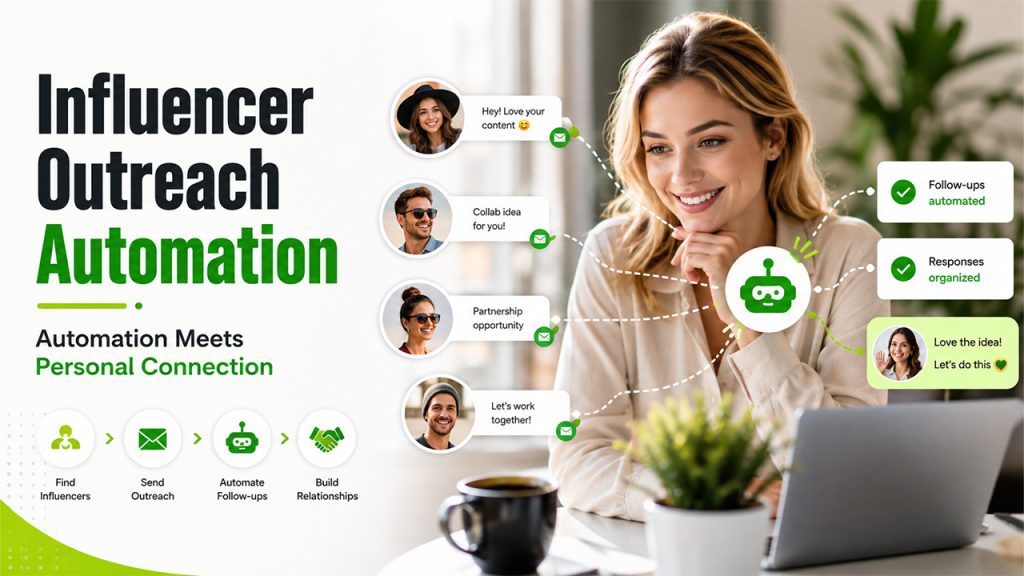
Manually reaching out to a few influencers might be very effective. You could find each influencer, send them a personal message, and monitor their reaction to it. Manual outreach is great from the point of view of the control you have, but it will soon become hard to organize and maintain.
This is where the role of influencer outreach automation software comes in handy. It could assist in carrying out repetitive tasks such as contact organization, follow-up scheduling, response tracking, and communication consolidation. Instead of wasting many hours looking through different spreadsheets and emails, you could concentrate more on selecting the right influencers and developing relationships with them. Similar workflows are also useful for teams managing creator and blogger relationships, where blogger outreach software can help organize contacts, follow-ups, and communication in one place.
However, just because the process of writing has been automated doesn’t mean that the same message should be sent to everybody. Most people can tell when someone is just using a generic pitch, and generic messages will probably not yield the result you are looking for.
For smaller campaigns, manual promotion is sufficient. However, for large-scale campaigns, it will be effective to combine automated marketing with a more personalized style of marketing.
Best Practices and Common Mistakes
Successful influencer marketing is not about the number of emails you send but rather the relevance of the emails you send. Adopting these best practices doesn't take much effort.
Set clear campaign goals first.
Identify the purpose you want to achieve from the campaign prior to reaching out to influencers. This can be increasing awareness, driving traffic to your website, making sales, promoting a product, and developing partnerships, among others.
Choose relevance over follower count.
Just because someone has many followers does not necessarily mean that he is the right person for your company. Look at the content, audience, how engaged the audience is, and the kind of products they usually promote. The bigger your campaign, the more disappointing its outcomes may be if the audience is not interested in what you offer.
Give creators a reason to care:
Do not let the whole dialogue revolve around what you need from them. Let them know why the offer is worth their attention, whether it involves money, product, creativity, or working with an intriguing brand.
Treat the first contact as a conversation.
Whether you are contacting a creator through email, social media, or another channel, avoid making the message sound like a sales pitch. This is especially important with Cold Outreach, where the influencer may have never heard of your brand before. A short introduction, a genuine reason for contacting them, and a clear opportunity are usually enough to start the conversation.
There are also a few mistakes worth of avoiding.
Sending out your message to several hundred influencers is another very common one. The next would be reaching out to creators without verifying that their followers belong to your target demographic. Being overly aggressive while following up could ruin the relationship before it even starts.
Also, do not forget to stay in contact after the influencer agrees to work with you. Effective communication is as important in the process as in the beginning. Answer questions and give them the necessary information.
How GuestPostCRM Supports Influencer Outreach
Influencer outreach efforts tend to get complicated fast once the number of conversations grows. Contact details, email threads, follow-ups, negotiations, and partnership records end up scattered across inboxes and spreadsheets, and that’s exactly the kind of chaos a proper CRM is built to solve.
It’s worth being upfront here: GuestPostCRM is purpose-built for guest posting, publisher management software, and SEO outreach, not influencer marketing specifically. But several of its core features translate well to managing creator relationships, since the underlying problem, too many conversations and not enough organization, is essentially the same.
AI-based e-mail filtering is done automatically according to intent and priority levels; thus, responses from interested creators don’t get buried under spam or irrelevant emails. Clever automation sends automatic reminders regarding follow-ups without the need for someone to manually monitor who has not responded yet. AI-powered communication tools generate context-aware first responses and follow-ups, thereby reducing typing that is often required when doing mass outreach.
In cases where the teams have to manage the outreach through several contacts or partner databases, the concept behind it is to ensure that all conversations, deals, and updates are kept in one place rather than being scattered around; this is precisely influencer outreach with GuestPostCRM, even if it was not originally built for influencer marketing.
However, CRM may not be essential for all campaigns. Should you be reaching out to only a few creators, a spreadsheet along with an email account could do just fine. For larger outreach campaigns, CRM software can help teams organize influencer connections, outreach activity, and follow-ups in one place.
A CRM tool is required when there are scores of creators who need to be reached out to through the process of outreach.
Conclusion
After all, the key to success in influencer outreach is to focus on building relationships, not to see how many emails one can send in a week. Brands that always have successful collaboration deals do not necessarily send the largest number of emails; what they do is send emails to the right people based on research and a proper strategy.
While the process can be managed either manually or automatically in order to deal with the repetitive aspects, there are certain universal principles: personalization, value proposition, and follow-up after receiving positive feedback. It is through this consistency that one sponsored post can become a collaboration worth having.
One does not need to start with grand scale right away. Just a few well-researched and personalized outreach emails can outperform a mass mailing done without much effort.

.png)
.png)