




.png)
.png)
This article explores how CRM is based on its modelling, playbook of client involvement, examining the main training that feeds the community, valuing insidiousness, and offering a practical guide for organizations before taking the leap.
In the current digital landscape, businesses struggle to deliver personalized customer experiences while also managing increasing customer data, communication channels, and sales activities. The traditional CRM platform often requires manual follow-ups, along with repetitive tasks, and time-consuming reporting, making it difficult for teams to engage with customers effectively.
This is where AI CRM offers its enhanced capabilities to solve these challenges, simply by utilizing advanced technologies to automate workflows, analyze customer behavior, predict sales opportunities, and improve customer interactions. The AI-powered Customer Relationship Management system combines CRM automation with AI-powered insights, enabling businesses to create more personalized experiences and increase customer retention.
What is AI CRM?
AI CRM (or AI-Powered Customer Relationship Management) is an advanced form of CRM Software that helps organizations transform customer relationship management simply by combining machine learning, predictive analytics, natural language processing, and intelligent automation. The platform analyzes customer data, identifies patterns, and provides actionable insights, improving decision-making processes of the organization.
The platform leverages CRM automation to streamline repetitive tasks, such as lead scoring, email follow-ups, customer segmentation, and data entry. It allows sales, marketing, and customer support teams to focus on building stronger relationships instead of spending valuable time on manual administrative tasks. Many AI CRM platforms also include built-in AI chatbots that offer instant support, along with answering frequently asked questions and offering 24/7 customer service.
What Does AI CRM Effectively Perform?
The platform automates repetitive processes, understands customer behavior, and helps businesses deliver a better customer experience. AI CRM also learns continuously from multiple customer touchpoints, such as emails, live chats, sales conversations, support tickets, website interactions, and social media activities. By analyzing these interactions, the platform improves AI customer engagement, creating personalized campaigns, and building a stronger relationship.
Key Functions of AI CRM
- Predictive Customer Analytics
AI CRM utilizes predictive analytics to study historical customer data and forecast future behaviors. It can also analyze purchase intent and sales opportunities, helping businesses make data-driven decisions, and improving customer targeting strategies.
- Automated Lead Scoring
The platform evaluates leads based on various factors, such as customer behavior, engagement levels, and conversion probability. It also allows sales teams to focus on high-value prospects, while also improving sales efficiency.
- CRM Automation
One of the major advantages of AI CRM is that it enables CRM automation. Similar automation capabilities can be applied across different business workflows, including Guest Posting Automation, follow-up emails, customer segmentation, lead qualification, and workflow management.
- Personalized Customer Engagement
The AI CRM analyzes customer preferences, previous interactions, and buying patterns to deliver personalized recommendations and improve communication strategies such as Email Outreach and targeted customer campaigns. It helps improve AI customer engagement by ensuring customers receive relevant messages at the right time.
How Does AI CRM Work?
AI CRM works by collecting customer data, analyzing it with AI, and automating actions that improve customer relationships. The platform uses advanced technologies, such as machine learning, predictive analytics, and natural language processing, to deliver personalized experiences, streamline workflows, and enhance business decisions.
The working of AI CRM is as follows:
- Step 1: Collects Customer Data
The platform gathers customer information from multiple touchpoints, creating centralized customer profiles.
- Step 2: Analyzes Customer Behavior
Once the data is collected, it uses artificial intelligence to identify trends, buying patterns, and customer intent.
- Step 3: Automate Routine Tasks
The platform utilizes CRM automation to reduce manual effort and improve operational efficiency.
- Step 4: Personalizes Customer Interactions
AI CRM uses customer insight to deliver personalized experiences throughout the customer journey.
- Step 5: Provides AI-Powered Customer Support
The platform integrates an AI Chatbot that offers instant assistance to the customer.
- Step 6: Predict Customer Needs and Retention
AI CRM utilizes predictive analytics to identify customers who may stop engaging or are likely to leave.
- Step 7: Deliver Real-Time Insights
AI CRM continuously analyzes customer data and presents actional insight through interactive dashboards and reports.
AI CRM vs Traditional CRM
A quick comparison between AI CRM and traditional CRM is as follows:
| Features | Traditional CRM | AI CRM |
| Customer Data Management | Stores information for manual use. | Collects, analyzes, and updates data automatically. |
| Lead Scoring | Manual lead qualifications. | AI-powered lead scoring. |
| Reporting | Static reports are generated manually. | Real-time dashboards with predictive analytics and insights. |
| Customer Support | Requires human support. | 24/7 support through AI Chatbots. |
| Customer Insights | Historical data analysis. | Predictive customer behavior, churn analysis, and buying trends. |
Benefits of AI CRM
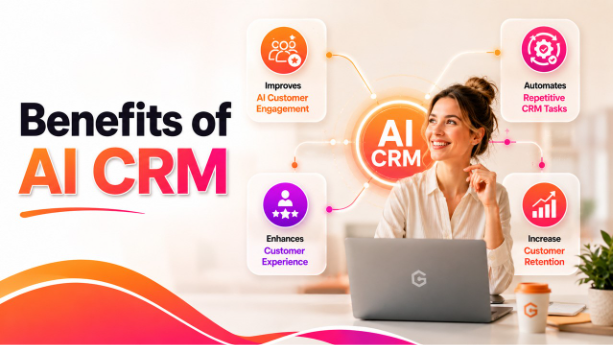
AI CRM offers key benefits to users, moving beyond traditional relationship management. The solution uses artificial intelligence to automate tasks, analyze customer data, and deliver personalized experiences. It also combines CRM automation with predictive analytics and intelligent insights to help businesses strengthen AI customer engagement and improve customer experiences.
Some of the key benefits of AI CRM are as follows:
- Improves AI Customer Engagement
The platform helps businesses deliver personalized email campaigns and recommend products based on customer interests and improve outreach strategies such as AI Guest Posting through intelligent automation and data-driven targeting. It can also send timely follow-ups and create targeted marketing campaigns.
- Automates Repetitive CRM Tasks
The platform simplifies daily operations through CRM automation. It can automate various tasks, such as lead scoring, email follow-ups, appointment scheduling, and customer segmentation, among others.
- Enhances Customer Experience
The platform helps businesses adopt a customer-centric approach by offering personalized recommendations, faster response times, and consistent communication across channels.
- Increase Customer Retention
With AI CRM, businesses can improve customer retention by detecting churn risks early and offering targeted promotions or discounts. It can also send personalized retention campaigns and monitor customer satisfaction.
Key Features of AI CRM
AI CRM combines artificial intelligence with customer relationship management to help businesses automate processes, improve customer interactions, and make smarter decisions. Some of the key features of AI CRM are as follows:
- AI-Powered Lead Scoring: AI CRM automatically evaluates and prioritizes leads based on customer behavior, purchase intent, and engagement.
- CRM Automation: The platform streamlines repetitive tasks, improving overall productivity.
- Personalized Customer Engagement: The platform analyzes customer preferences and interaction history to deliver personalized recommendations and improve AI customer engagement.
Customer Segmentation: The platform allows businesses to create highly targeted marketing campaigns and improve the overall customer experience.
Challenges of AI CRM
While AI CRM offers key advantages to businesses, especially in improving AI customer engagement, CRM automation, customer experience, and customer retention, it also includes various challenges. Some of the key challenges of the platform are as follows:
- High Implementation Costs: Deploying AI CRM generally requires substantial initial investment, especially in software, infrastructure, system integration, and employee training.
- Data Quality and Accuracy: The effectiveness of AI CRM depends on the quality of customer data. Outdated, incomplete, or inaccurate data can lead to ineffective CRM automation and less personalized customer interactions.
Data Privacy and Security: The platform processes large volumes of customer data, making data privacy and security a key priority. Businesses must implement strong security measures and control user access.
Conclusion
As the expectations of the customer continue to evolve, businesses need smarter and more advanced solutions to manage relationships, personalize interactions, and improve engagement. AI CRM is among such platforms that transform traditional customer relationship management, simply by combining artificial intelligence with CRM automation and predictive insights, helping organizations make data-driven decisions.
The platform offers key benefits to businesses, such as enhancing AI customer engagement, improving customer experience, and supporting customer retention strategies. Businesses can effectively integrate AI CRM to achieve key benefits, such as enhanced efficiency, personalized communication, and sustainable growth.
Frequently Asked Questions
- How does AI CRM work?
AI CRM works by gathering customer data from different touchpoints, analyzing customer behaviors, and automating actions, like follow-ups, lead scoring, customer support, and personalized communication.
- Can AI CRM improve customer engagement?
Yes, AI CRM can improve AI customer engagement as it analyzes customer preferences, purchase behavior, and communication history.
- How does AI CRM improve customer retention?
AI CRM helps improve customer retention by identifying customer behavior patterns, predicting churn risks, and enabling businesses to build personalized retention campaigns.
- Can AI CRM improve customer experience?
Yes, AI CRM can improve customer experiences by offering faster responses, personalized recommendations, consistent communication, and proactive support, based on customer behavior.


.png)
.png)