




.png)
.png)
Suppose you spend three days writing a guest post. You pitch it to a relevant publisher, it gets accepted and goes live on a good enough website. Now, you are waiting for it to show up on SERPs. After three months, you check your rankings but find nothing. Your post isn’t ranking higher, and you aren’t getting more visitors from that link. The content you worked hard on is just sitting on someone else’s site, ignored by both readers and Google.
If this sounds familiar, you’re not alone. It's one of the most common complaints about guest posting today. And the problem isn't guest posting itself; it's that most guest posts are written the wrong way. Instead of doing research, writers start directly with the article. That's exactly the problem a SERP Insight guest post was built to solve.
What Is a SERP Insight Guest Post?
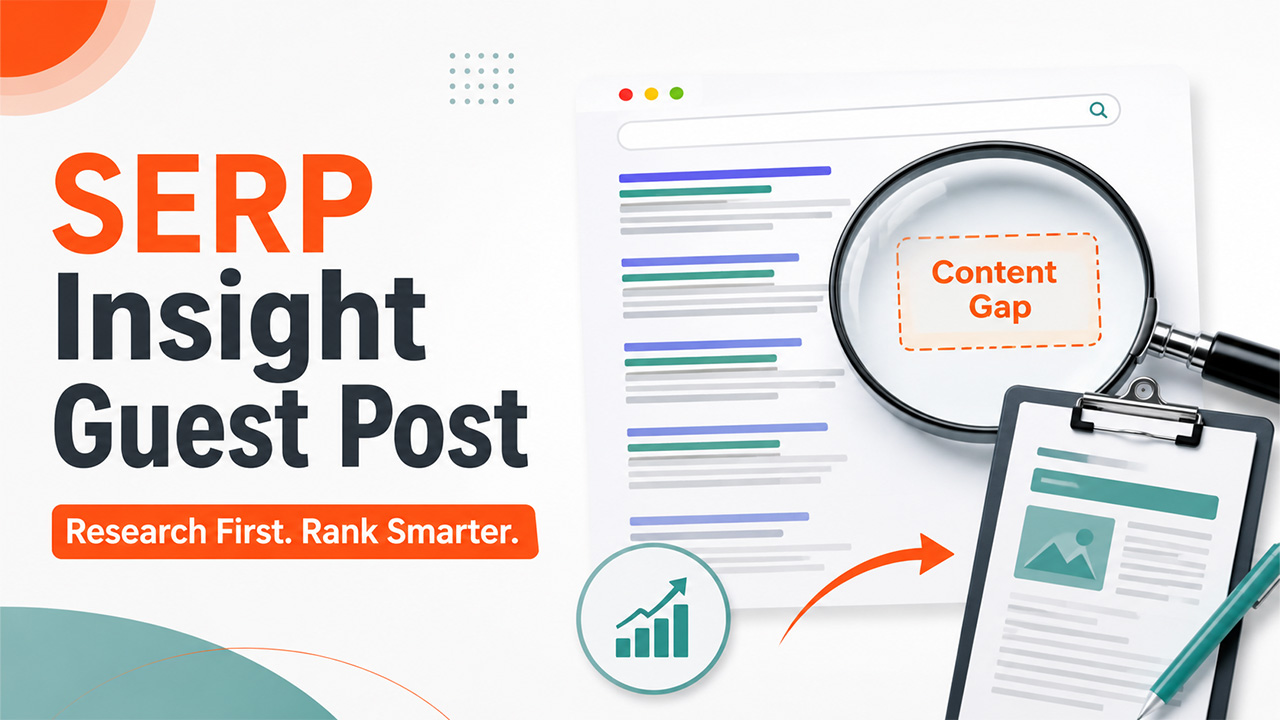
A SERP Insight guest post is a guest article that you plan by doing research first, not by starting with a random idea. Before you start writing anything, you search your target keyword on Google and see what articles are already ranking on page one. You study what topics they cover, in which format, what questions they answer, and what questions they didn’t cover. Once you find that gap, write your guest post to fill it by using information that other articles don’t have or explain poorly. This research-first approach becomes even more effective when combined with a structured guest posting strategy that focuses on relevance, content quality, and useful publisher relationships. This research-first approach is often called SERP Insight SEO, because the strategy behind the content comes directly from analyzing what's already ranking.
This way your article doesn’t repeat what’s already out there; rather it adds something new. The backlink you get from this guest post is still important, but it's not the main reason the article exists anymore. It becomes a natural result of writing something genuinely helpful that both readers and Google want to see.
Traditional Guest Post vs SERP Insight Guest Post
See how a SERP-driven approach changes the purpose, process, and potential results of a traditional guest post.
| Aspect | Traditional Guest Post | SERP Insight Guest Post |
| Starting point | An idea you already have | What's actually ranking on the SERP |
| Main goal | Get the link placed | Fill a real gap, let the link follow |
| Research done | Little; write first, tweak later | SERP and gap analysis before writing |
| Chance of ranking | Low; often repeats what's out there | Higher; built around a genuine gap |
| Long-term payoff | Link sits quietly, rarely earns traffic | Can rank on its own and keep sending traffic |
The comparison makes one thing clear: guest posting works harder when search insights guide the content before the backlink is added.
Why Guest Posting Still Matters for SEO

Yes. However, the version that works isn’t the version most people picture when they hear “guest post.” Google has never considered guest posting a problem. However, it does take issue with how guest posting is being used purely as a link-distribution machine. People publish some articles in different ways on unrelated sites and stuff them with the same exact-match anchor text. This is the pattern that’s considered problematic, not the practice itself. This distinction is part of what's known as the White Hat Link Building, earning links through genuinely useful content rather than manipulative placement tactics.
If used properly, guest posting still puts your name, brand, and your expertise in front of an audience that already trusts the site they are reading. A guest post that is well-written and well-placed doesn’t just deliver a link; it signals to search engines that other reputable sites in your niche think you’re worth mentioning. And that trust is hard to fake, which is exactly why it still carries weight.
Benefits of Publishing a SERP Insight Guest Post
This is where SERP Insight guest posting separates itself clearly from the traditional approach. Compared to a standard guest post, here's what you actually get:
- Earn High-Quality, Relevant Backlinks: A link from a respected and relevant site vouches for your content and improves your rankings far better than a dozen links from low-quality, irrelevant sites ever could.
- Drive Targeted Referral Traffic: Readers on the host side are already interested in your niche. This makes them far more likely to click through to your content, stick around, and actually convert. This way, your website will earn referral traffic.
- Improve Search Rankings Over Time: Pages backed by strong, relevant backlink profiles tend to climb SERP rankings and hold their position more reliably than pages without them.
- Build Long-Term Brand Authority: If you keep showing up consistently on reputable industry sites, people will start recognizing your brand name and keep coming back. Using GuestPostCRM can help teams organize guest-post outreach and manage publisher relationships more efficiently. Your content won’t be just a link that they click once and forget about it.
- Generate Long-Term Traffic and SEO Value: Unlike a paid ad that stops the moment your budget runs dry, a well-placed guest post can earn traffic and pass authority for years without spending money.
- Create Guest Posts That Can Rank on Their Own: Because it's built around a real content gap, it has a legitimate shot at ranking for its own keywords, not just sitting there as a link vehicle.
Traditional guest posting can deliver a few of these. However, SERP Insight guest posting is really the only version that reliably delivers all of them together.
How to Plan a SERP Insight Guest Post

Planning is where most guest posts either earn their spot or quietly waste everyone's time. Here's a practical sequence to follow:
Research Your Target Keyword and Analyze Top SERP Results: Type your keyword on Google and look at the first five to ten pages that rank. Study what format they use: how-to guides, listicles, comparison or opinion pieces. Then write to match what’s already working; don’t fight against it. Using Google Search Operators like site: or intitle: can help you narrow down exactly which competing pages to study first.
Identify and Fill Content Gaps: Read the articles that rank closely. What they cover, what’s outdated, and what questions they raise but never answer. Find the gap and then fill that gap with your content. Add something that they genuinely lack, such as a clearer explanation, a fresh real-world example, or an updated statistic.
Evaluate the Host Site for Relevance and Authority: Look at its authority and its traffic. This matters more than people think. By checking out the host site, you can find out whether its audience would actually care about your topic. Once you identify suitable publishers, a structured link building outreach process can help you manage prospecting, communication, and placement opportunities more efficiently.
Create a Strong Guest Post Outline Before Pitching: Create a short, specific outline of what you wish to publish and why. This shows the editor that you've done your homework, and it makes the pitch far easier to say yes to.
Write for the Reader Before the Backlink: If the article would still be worth reading with the link removed, you've done it right.
If you skip step two, you’re just left guessing what could work. And guessing is expensive. It costs you the writing, time, outreach effort, and often the placement itself.
Types of Content That Perform Well in SERP Insight Guest Posts
Not every format works equally well for every keyword, but a few patterns show up again and again in guest posts that actually rank:
| Content Type | Why It Performs |
| How-to guides with clear steps | Match informational search intent directly; easy for readers and search engines to follow |
| Data-backed analysis | Original numbers or findings give other writers a reason to cite and link back to you |
| Case studies with real results | Concrete outcomes build credibility and give readers something they can actually replicate |
| Comparison posts | Serve commercial intent well, especially for readers close to a decision |
| Updated or corrected guides | Fill gaps left by outdated top-ranking content, which search engines tend to reward |
Opinion pieces and broad thought-leadership essays can perform well, but they are harder to sell than guest posts. They tend to rank far better on your own blog, where the audience already knows and trusts your voice.
Getting this right also comes down to understanding Search Engine Basics: how intent, format, and relevance shape what actually earns a ranking.
Conclusion
The difference between a guest post that gets lost in a blog archive and one that keeps sending traffic for years usually comes down to a single decision made before any writing happens: did you study the SERP first, or did you just write and hope?
A SERP Insight guest post isn't a trick or a shortcut. It's simply a more honest way of doing something guest posting was always supposed to do. It adds real value to a conversation that’s already happening and lets the backlink follow naturally from that. When you approach it that way, it stops being a one-off tactic and starts becoming a dependent part of your long-term SEO strategy.



.png)
.png)