


.png)
.png)
Most businesses lose customers not because their product is weak, but because there’s no clear path guiding a stranger toward becoming a buyer. That’s exactly what a sales funnel is built to fix: a structured way to move someone from first hearing about you to actually handing over their money.
The idea is simple even if the execution isn’t: the number of people at the top is large, and it naturally narrows as fewer move forward at each stage, until only the genuinely interested and ready-to-buy prospects remain at the bottom. Without one, businesses tend to treat every lead the same way, which wastes time on people who were never going to buy and under-serves the ones who actually were.
In this blog, we’ll break down what a sales funnel actually looks like, the stages it moves through, real examples of how it plays out, and how to build a strategy around it that actually converts.
What Is a Sales Funnel?
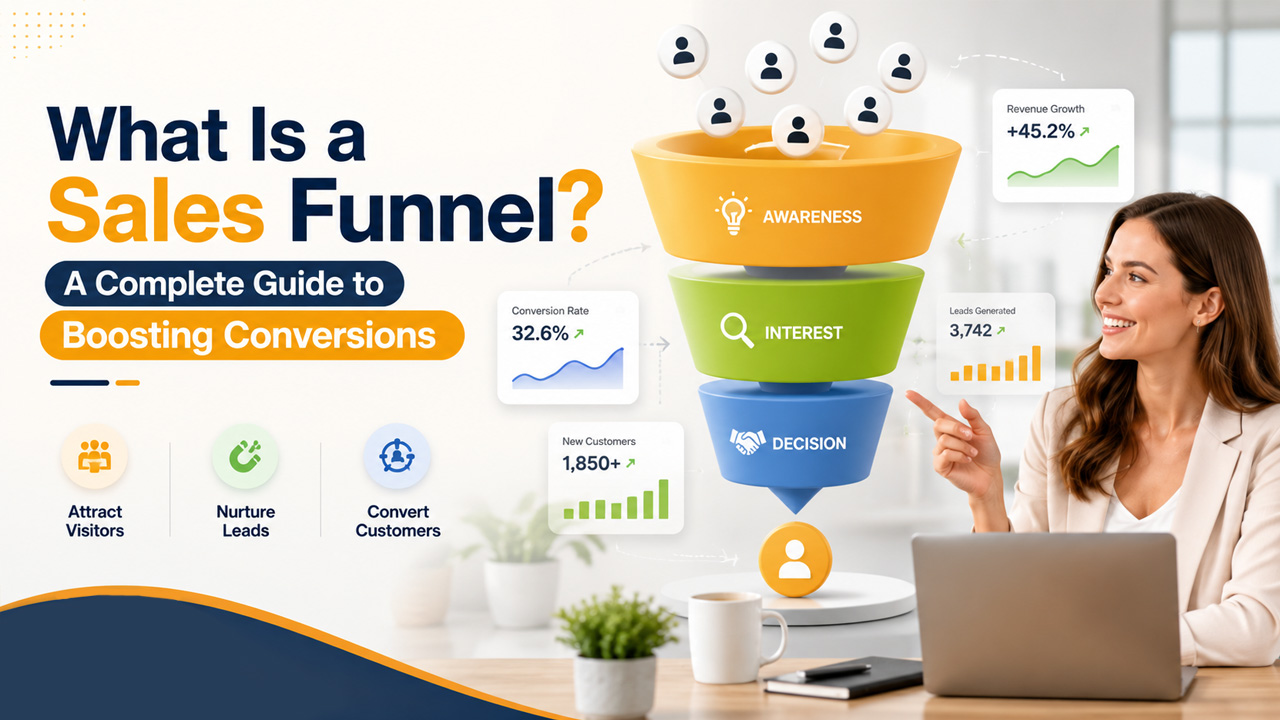
A sales funnel is the step-by-step journey a potential customer moves through, from the moment they first notice your business to the moment they actually buy. Just like its name implies, it is designed as a funnel, meaning that it starts very wide, accommodating plenty of visitors, and narrows down, retaining those who really need your services.
This concept can easily be confused with the marketing funnel, but there is one significant difference between the two. Namely, marketing funnels deal with gaining awareness and drawing in potential leads, whereas sales funnels deal with all other aspects.
Using such a structure allows businesses to systematize the processes that can be otherwise chaotic, giving companies an opportunity to pinpoint problems and address them right away.
Sales Funnel Stages
Every sales funnel breaks down into three core sales funnel stages, each with its own goal and mindset on the buyer’s side:
- Top of Funnel (Awareness): The prospect has a problem and is just starting to research it. They don’t know your brand yet; they’re mostly Googling symptoms, not solutions. Content like blog posts and guides works best here.
- Middle of Funnel (Interest): Now they understand the problem better and are comparing types of solutions, not specific companies yet. This is where tools like AI Sales Automation start to matter, since prospects are warm enough to actually convert into tracked, qualified leads.
- Bottom of Funnel (Decision): The prospect knows what they need and is now comparing specific providers, including you. This is where demos, case studies, and direct conversations close the gap between interest and an actual purchase.
At each stage of the sales funnel, different approaches should be used. Using automated follow-ups can also help businesses keep prospects engaged as they move from one funnel stage to the next. Trying to treat the visitor at the Top of Funnel stage as the customer who will buy something right away is a bad idea; they’re not ready for a hard pitch yet, and pushing too early tends to push them away instead.
Sales Funnel Examples
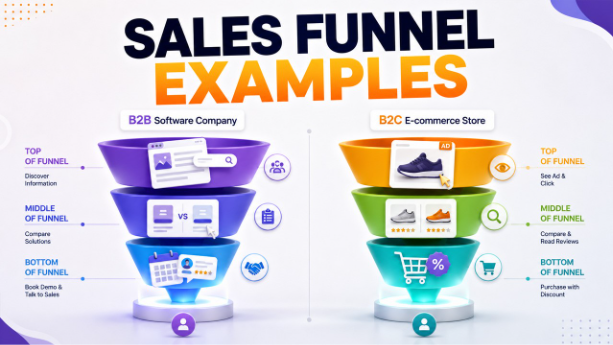
It helps to see how it works in practice. Let’s take a couple of fast examples of sales funnels in action for different business models:
B2B software company: A user is looking for “how to improve X” information and comes across an article (Top of Funnel). The user goes to a comparison guide and decides to try a free trial version (Middle of Funnel). Then, he sets up a demo and talks about prices with a sales representative before buying (Bottom of Funnel).
B2C ecommerce store: A customer sees an advertisement about a product and clicks on it (Top of Funnel). He compares the item with competitors’ products and finds some reviews about it (Middle of Funnel). Then, he decides to purchase it because of a discount (Bottom of Funnel).
In all these cases, the funnel looks the same, wide on top with broad interest and narrowed down to committed customers on the bottom.
Benefits and How to Build a Sales Funnel Strategy
A clear sales funnel strategy does more than organize your pipeline; it actively improves the rate at which leads become paying customers. CRM automation can make this process easier by helping teams organize leads, manage follow-ups, and track prospects throughout the funnel.
The benefits show up fast once it’s in place:
- Better lead prioritization: You stop spending equal time on cold and hot prospects, focusing your effort where it actually pays off.
- Predictable revenue: Knowing how many leads sit in each stage makes forecasting far less of a guessing game.
- Faster deal closing: Spotting where prospects usually hesitate lets you address objections before they even come up.
Building the strategy itself comes down to a few practical steps:
- Understand your buyer’s true journey: Identify what the buyer is actually asking themselves or questioning at every step, rather than what you think they might be asking or thinking.
- Create the appropriate content at every step: At the very top of the funnel, this means educational materials; in the middle, comparative content, and towards the bottom, case studies and demos.
- Measure the right metrics: The metrics that matter include conversion rate per step, average deal size, and sales cycle time. These help you identify where your funnel is really leaking.
- Periodic review and adjustment: A funnel is not something that you create and forget about. You need to go back over it every few months to make sure it still makes sense.
- Use the right tools: Solid sales techniques paired with a CRM to track it all makes the difference between a funnel that exists on paper and one that actually drives revenue.
Conclusion
All in all, sales funnels do not only exist in theory; instead, they are a tool that helps to figure out whether there are some problems with the current process and what causes them. When you have learned about the stages of a funnel and have created yours by taking into account your customers’ journey, everything becomes easier to manage and much more predictable.
It is important to remember that one does not need to start with an ideal funnel. Instead, one may try to begin with simple stages such as awareness and decision. This alone will place one ahead of other companies.



.png)
.png)