





.png)
.png)
Whether you’ve been in sales for ten years or ten days, one thing stays true: the right sales techniques can be the difference between a prospect who ghosts you and one who signs. Sales isn’t about having the perfect pitch memorized, it’s about knowing which approach fits which moment and adjusting as you go.
The good news for salespeople is that many of the techniques that were successful in the past remain relevant, despite the advent of newer technology and marketing channels. Techniques such as genuine rapport building, active listening skills, and effective, not aggressive closings continue to outshine gimmicky tactics in most situations. The only difference is the amount of information salespeople have at their disposal these days.
This blog will guide you through some of the timeless sales techniques that have proved effective throughout the years and how they differ based on your sales job and industry.
Classic Sales Techniques That Still Work
Some sales techniques earn their reputation the old-fashioned way, by working, year after year, no matter how much the industry shifts around them.
Make a strong first impression: A steady handshake and genuine eye contact still set the tone before you’ve said a single word about your product.
Be specific, not grandiose: Explain exactly what you do and get to the point. Vague pitches lose people fast.
Be genuine: Sharing a bit of yourself, even something as small as how your weekend went, builds real rapport instead of a transactional vibe.
Treat trust as something earned, not assumed: Get to know your prospects the way you’d get to know anyone else. Trust follows naturally from there.
Stay positive: Nobody wants to hear you trash a competitor. Lead with what makes you different instead.
Speak directly to pain points: Connect what you offer to the actual problem sitting in front of your prospect.
Keep your word: If you promised a follow-up call on Monday, make that call Monday. Reliability builds trust faster than almost anything else.
Lean on your network: Referrals convert at a far higher rate than cold outreach ever will.
None of this is flashy, and that’s kind of the point. These techniques work because they focus on the other person instead of your own agenda.
Why do these work? The importance of active listening

The classic method is more about listening than talking. This is because good listening makes a customer feel understood, and this is perhaps the most underrated sales technique.
Pay attention to your own body language: Keep your arms uncrossed, nod occasionally, use open body language. Small things like that show the prospect you are actually listening and interested in what he says.
Observe the prospect’s body language: Hesitation and uncertainty are usually signs that you have to probe a bit more, not push.
Repeat what he has said: A brief summarization shows that you listen and allows you to remember the information he gives you.
Do not interrupt: Let the customer complete his thought fully before you reply. Half-answers to half-said questions do not work well in sales.
People who learn to do that automatically become better at selling just like that. When you listen to understand something, prospects tell you more, and the conversation goes in a helpful direction.
Sales Techniques by Role
Not every sales technique fits every job. What works for a phone-based inside rep looks pretty different from what works for someone closing deals face-to-face.
- Inside sales: Build around phone and online outreach rather than in-person meetings. Calls need to be practiced and tracked carefully so you’re not overwhelming the same prospect.
- Direct sales: Face-to-face selling outside a physical store, where in-person rapport and body language carry more weight than any script.
- Outbound sales: Focused on reaching leads who’ve shown interest or straightforward cold outreach, often the starting point of the whole pipeline.
- Referral sales: Built entirely around a network that keeps sending you qualified leads. It tends to have the highest conversion of any of these, simply because trust is already halfway established.
Each of these leans on different tools, phone calls, social selling, email, in-person meetings, and increasingly, content that draws leads in organically through SEO and blogging. Most sales teams don’t rely on just one; they blend a few and track performance through their CRM software to see which combination is actually converting.
B2B vs B2C: Why the Techniques Differ
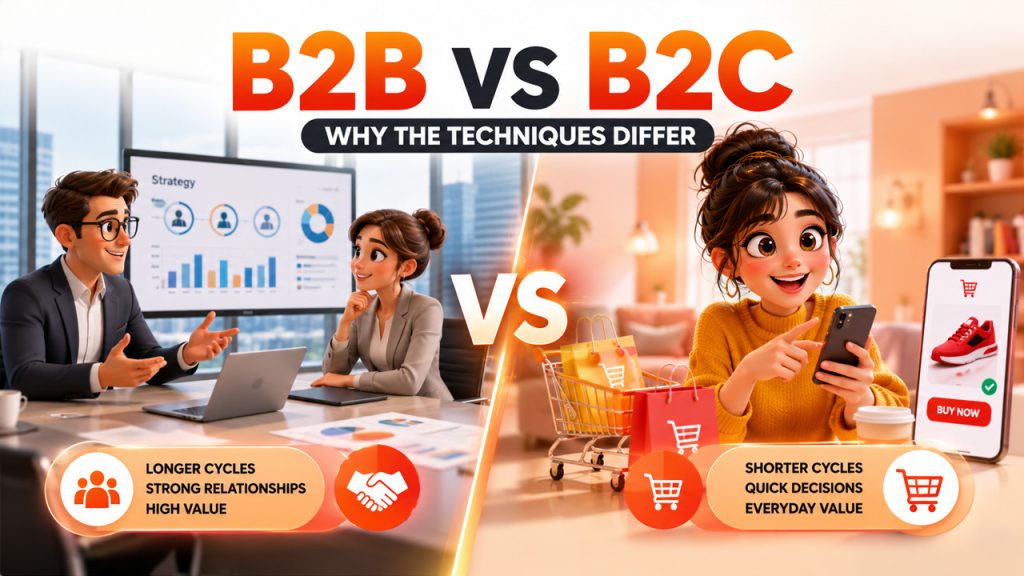
Sales in retail and e-commerce fall somewhere in between, but B2B and B2C sales are really worlds apart, despite similarities in underlying sales techniques.
First of all, B2B deals are generally harder to close. They include larger orders and often involve complicated products and multiple decision-makers who will listen to your pitch. While a B2C purchase can be made in just one session, closing a B2B deal may take several weeks or even months.
It greatly affects sales techniques. Relationship marketing plays an essential part in B2B sales because the sales are supposed to bring a steady income. Meanwhile, occasional sales in B2C can work without the need for strong relationship building.
If you’re selling high-value B2B deals specifically, this is where techniques like high-ticket sales strategies come into play, since larger deals usually demand more trust-building, more patience, and a much more consultative approach than a quick B2C transaction ever would.
Effective Closing Techniques
No matter which industry you’re in, some closing sales techniques hold up consistently across the board.
Don’t fear the phone: Some people are simply auditory, and a call can close what an unanswered email never will.
FOMO still works: Real testimonials and data showing how others benefited create genuine urgency, without needing to manufacture anything artificial.
Speak with action, not vague questions: Instead of “When can I bring the contract by?”, try “I’ll be by Thursday after 2 PM; does that work?” Specifics remove decision fatigue and keep momentum moving forward.
Focus on the end result: Prospects care about outcomes. Show them exactly how your product or service improves their bottom line, not just what it does.
Ask specific questions: When someone mentions a pain point, ask for concrete examples. Vague problems get vague solutions; specific problems get real ones.
Here’s the part that’s easy to forget: closing the deal isn’t really the finish line. It’s the start of the relationship. The best salespeople keep following up long after the contract is signed, because repeat business and referrals almost always outperform chasing brand-new leads.
Conclusion
Ultimately, the best sales practices do not involve any tricks, but are simply good habits performed with consistency. Listening more often than talking, being accountable to your word, and looking at each lead as an actual person rather than a figure to meet your quota, those are the practices that actually get things done.
Channels and tools used for sales will continue changing, as well as the places and ways you will be able to get in touch with your customers. However, the basics that have been described above, which involve building trust, reading the situation, and closing confidently instead of putting pressure on the other party, remain relatively unchanged.
Whether you are a beginner in sales or have years of experience, your task will always be to convert less transactions into more relationships.



.png)
.png)