



.png)
.png)
A CRM is primarily developed to store and organize customer data. CRM to LCRM represents a different approach: GuestPostCRM is designed not only to capture customer information, but to learn from it.
A CRM is primarily developed to store data. GuestPostCRM is designed to learn from it. This article explains the architecture of GuestPostCRM and why it represents LCRM – Learned Customer Relationship Management. This blog is not marketing material. This is a product philosophy based on almost 20 years of CRM development expertise.
Why GuestPostCRM Started as "Just a CRM"?
We intentionally began the development of GuestPostCRM as a simple CRM system. A successful and advanced system always begins with a stable foundation. The foundation must be sound before adding automation.
GuestPostCRM emerged from understanding which modules users genuinely need. Unnecessary or distracting UI/UX elements were intentionally excluded. This ensured a simple interface while still supporting advanced functionalities. Security was built into the system right from the very beginning, not added later as an afterthought.
Before diving into how LCRM differs, it’s important to understand why many CRMs fail:
Typically, most CRMs go down not because of poor programming but because of poor starting points. This is due to the fact that AI is frequently integrated into systems that lack appropriate data models, sufficient process automation, or a thorough comprehension of the organization's workflows.
CRM to LCRM: From Beginning to the Destination

A traditional CRM solution keeps track of contact data, closing deals, and activities. That is important, but not enough.
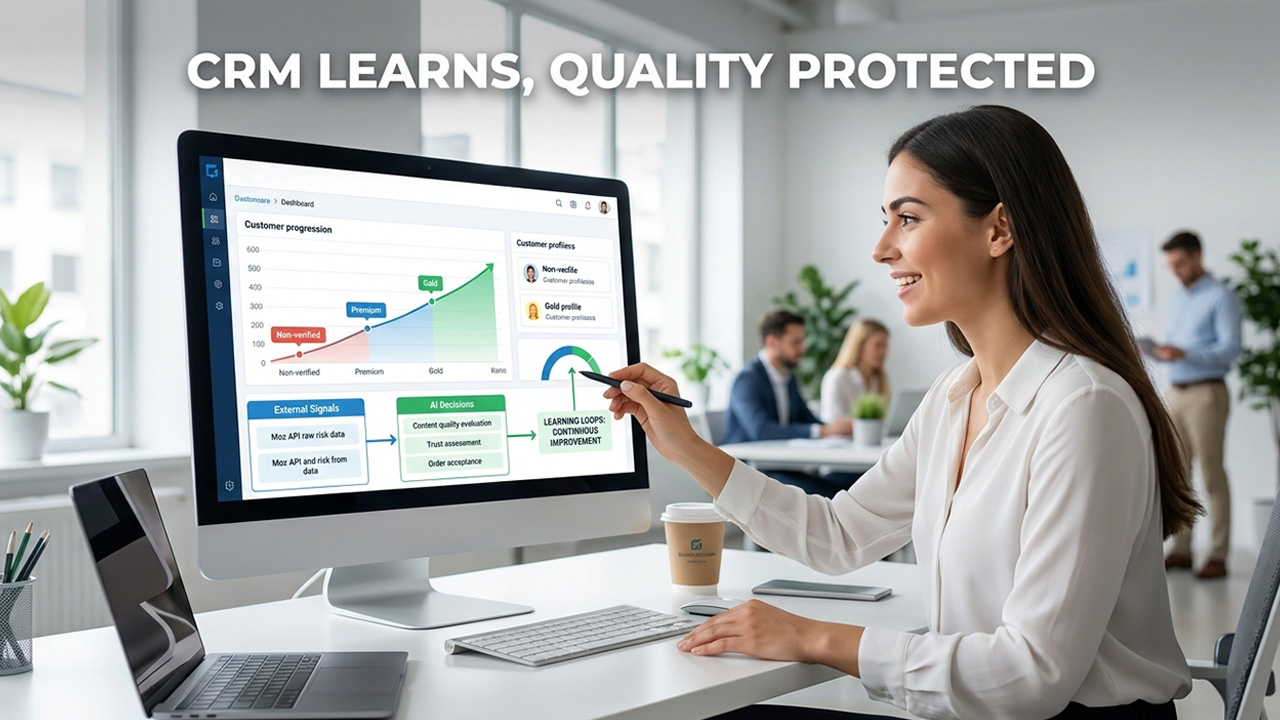
LCRM (Learned Customer Relationship Management) continually learns from customer interactions. It tracks customer experience progression paths, such as transitions from Non-verified to Premium and then to Gold. It also analyzes additional data, including payment habits, negotiation patterns, and content acceptance patterns, using predictive analytics in CRM to identify patterns and support more proactive decisions.
Instead of static records accumulating data, customers become evolving profiles shaped by outcomes. The CRM layer records facts: conversations, transactions, deliverables, etc. The LCRM layer understands behavior: reliability indicators, quality standards, and response predictions.
The move from CRM to LCRM is absolutely essential. If you only look at facts, you end up reacting to problems instead of preventing them. While knowing the facts is useful, using AI to gain insights about your customers is even more important because it lets you act ahead of time and build stronger relationships.
CRM to LCRM: Separating Signals from Decisions
One crucial architectural element in GuestPostCRM is separating signals from decisions. This prevents a common AI failure: letting data sources control business logic.
External tools provide signals—observations about the world. AI provides judgment—weighing signals, considering context, and making holistic decisions.
This architecture prevents fragile logic and blind trust in third-party data. When external APIs change methodology, the decision system adapts rather than breaks. No single data source hijacks decision-making.
Moz API: Intentionally Limited
Moz is respected in SEO, but in GuestPostCRM, it serves one purpose: Spam Score.
Spam Scores help in recognizing websites that use manipulative SEO tactics or have poor backlink profiles. SPAM Score is a valuable indicator but is just one piece of the puzzle. Moz doesn't decide content quality, niche relevance, or order acceptance.
This limitation prevents SEO metric misuse. Some systems make poor decisions treating Domain Authority as a universal quality metric. In GuestPostCRM, Moz provides a raw risk signal that enters the AI decision layer alongside dozens of other signals, weighted appropriately by context.
The AI Decision Layer: Where Intelligence Lives
All meaningful decisions happen in the AI layer, which handles content quality evaluation, niche identification, order acceptance, relationship trust assessment, and outcome-based learning.
The AI will assess website content and structure, acceptance history, and CRM interactions. It will also evaluate Moz spam scores (treated as weights), communication style, and PayPal financial information. These considerations encompass aspects that standard rules do not account for.
For example, a high spam score is a warning that a site might have low trust or could be risky, but it doesn’t automatically prevent a new site from gradually building credibility or authority. On the other hand, a low spam score doesn’t guarantee that content will be accepted or valued—if the site or content doesn’t meet quality and relevance standards, it can still be rejected.
Decisions improve over time. The AI notices patterns—certain industries consistently become premium partners; specific content types underperform—and adjusts criteria automatically rather than waiting for manual rule updates.
Automatic Quality Protection
Quality protection is automatic, not manual. GuestPostCRM's AI checks in filtering spam and improving deal quality by rejecting content related to casinos/gambling, adult content, CBD, grey-area niches, and non-relevant industries without human intervention.
The move from CRM to LCRM ensures that genuine relationships are prioritized over automated noise. Without the possibility of two-way communication, there's no relationship to manage.
Financial Behavior as Learning Data

Payments indicate behavior and personality. The integration of PayPal services for payment enables learning from late payments, refunds, payment patterns, and overall dependability. PayPal invoice creation within GuestPostCRM streamlines billing while capturing transaction data that feeds into customer trust profiles.
Financial history drives customer trust profiles, impacting credit limit extensions, terms of payment, service priorities, and premium eligibility. Early payment of bills by a customer shows respect for the partnership.
Prompt Management: Engineering AI Reasoning
AI is structured for reasoning, not magic. GuestPostCRM, as a modern Link Building CRM, treats prompt management as a first-class system component with versioned prompts, auditable logic, iterative improvement, and explainable outcomes.
Every decision involves metadata about prompt versions used, inputs considered, and reasoning processes. This transparency builds trust and enables refinement. Teams confidently delegate decisions to AI because they understand how decisions are made.
Effective prompts require clear objectives, explicit criteria, reasoning examples, edge case handling, and consistency checks. This engineering discipline ensures reliable, scalable AI decisions.
Learning Loops: Continuous Improvement
Every outcome gives important feedback—whether content is accepted or rejected, how trustworthy publishers are, how satisfied customers feel, how they handle payments, and how they respond to messages.
AI enables the enhancement of acceptance trust scores, the threshold of risk, accuracy in niche classification, and trust models based on actual outcomes. Starting choices can lead to accuracy of up to 70% compared to human experts' accuracy.
Following evaluations involving thousands of outcomes, accuracy can touch or exceed 85%. Ultimately, computers could perform better than human beings by analyzing more variables and having access to more examples than human experiences allow.
The system doesn't simply automate; it learns and creates a compounding advantage over time.
Also Read: A Complete Guide to How GuestPostCRM Filters Your Inbox Before Anyone Replies
API-First Architecture: Built for Evolution
GuestPostCRM is designed as API-first and not API-later. This enables Moz to remain a clean and isolated signal source, allowing AI models to operate independently. This approach enables decision logic to evolve without breaking core functionality and ensures future integrations can connect safely.
This architecture makes CRM evolution into LCRM possible. The learning layer accesses CRM data, returns decisions, and interacts with external signals without tangled dependencies. When AI improves, the CRM doesn't require changes. Components evolve independently.
Speed and Financial Discipline
Not everything builds at once. The priorities are to ship stable CRM foundations early, add intelligence where it creates real value, avoid over-engineering, learn fast, and do it with financial discipline. It's not about perfection; it's about the velocity of learning.
A Platform for Continuous Learning
GuestPostCRM isn't a final product. It's a system asking one continuous question: "What can we learn from this interaction?"
When that question guides every module, workflow, and integration, the system naturally evolves into LCRM. Every feature faces evaluation: Does it create learning data? Does it apply learned insights? Does it improve outcomes?
This philosophy extends beyond code to organizational culture. Teams using GuestPostCRM should ask the same question. The platform provides tools, frameworks, and automation supporting learning—but learning remains fundamentally human. Success comes from helping humans learn faster, decide better, and build stronger relationships.
The Path Forward
Most CRMs help you remember customers. LCRM helps you understand them.
Memory is storage—understanding is insight. Memory records what happened—understanding explains why and predicts what's next.
GuestPostCRM begins this shift with foundations enabling learning, signal infrastructure making intelligence practical, and architectural frameworks making continuous improvement sustainable.
This represents where CRM evolution heads: not bigger databases or more automation, but genuine intelligence growing with use. From passive data storage to active learning. From recording history to understanding patterns. From managing relationships to truly knowing customers.
That is the vision. And this is just the beginning.

.png)
.png)