





.png)
.png)
Choosing between manual vs automated outreach is not just a tactical decision; it is a turning point that can define success and failure of a revenue-making organization. For many years, digital marketing agencies, sales teams, and solopreneurs have toyed with a dilemma, whether to go for personalized and authentic manual outreach or choose between scale, speed, and data-based power of automated outreach. Manual methods create genuine connections but quickly reach a threshold, limiting your growth and exhausting your team.
Automation promises better efficiency but often leads to robotic and impersonal communications that buyers generally disregard, ultimately damaging your ROI and brand. This conflict of automated vs manual is a regular hot topic in GTM discussions. Let us learn further about it in this blog.
Why You Should Learn About Manual Vs Automated Outreach Comparison?
What is important to know is that the market has seen paradigm shifts. Buyers get overwhelmed with generic messages, and the old “spray and pray” mindset does not lead to results anymore. The question is not whether you must automate, but how and when. When does the manual outreach expenses stop making sense, and when does investment in an advanced sales engagement platform become important? How do you ensure a successful transition without compromising personalization? For any agency as well as its clients, this is a strategic viewpoint. The manual outreach ROI must be weighed carefully against the possible automated outreach ROI. This comparison of ROI is greatly important.
This is exactly when AI-powered tools become significant. Such solutions do not automate tasks simply; they amplify the capability of humans. They combine the authenticity that comes with manual outreach with the smartness and scalability of automation. GuestPostCRM, a reputed solution in the guest posting industry, offers an intelligent response and offer system where you can smoothly communicate and negotiate with clients without any manual effort. Despite automating responses, it makes sure that the responses always remain contextually aware and personalized.
Are you ready to learn how smart automation can fine tune your outreach and grow your meeting bookings?
What Is the Difference Between Automated and Manual Outreach?
Understanding the basic difference between automated outreach and manual outreach is the basic starting point for developing best outreach strategies for SEO agencies and other companies. These two approaches basically reflect distinct philosophies and operational frameworks for interacting with clients and prospects. The manual vs automated debate works on a trade-off between scale and customization, a trade-off that the next-generation solutions are resolving actively.
How Does Manual Outreach Work in Conventional Sales Process?

Manual outreach is a conventional approach to sales. It is a human-driven and hands-on approach that factors in how each touchpoint is designed and skill of an account executive and sales representative. The conventional approach emphasizes quality over quantity-
- Personalized Research: Before sending an email or placing a call, the representative invests a considerable amount of time researching their prospects and their business. This involves going through LinkedIn profiles, exploring company announcements, and recognizing personal hooks that make the message more relevant.
- Customized Messaging: Every messaging is crafted from absolute zero. The representative personalizes the content to refer to the respective role of the prospect, organizational challenges, or recent milestones. This high degree in manual outreach focuses on nurturing and strengthening the connection. In the Guest Posting industry, looking for the right guest post template is also a part of customized messaging.
- One-to-one Execution: The representative sends every email manually, connects with the prospect on LinkedIn, and logs each activity in the CRM. Follow up are monitored through task lists or calendar reminders. This process is repeated individually for every prospect.
- Direct Loop of Feedback: A notable advantage in manual outreach is its mechanism of instant feedback. Representatives can quickly determine which messaging resonates well and which one is not working, enabling them to fine-tune their approach in real-time. This is specifically valuable for any agency working to further tailor the messaging for each client.
- Great Focus on Top-value Targets: Since it requires so much time, manual outreach is generally reserved for strategic prospects, high-ticket sales, or top-level accounts where the possible Return on Investment demands substantial investment upfront. The manual outreach ROI can be strong on a per-conversion basis but is actually low in overall volume.
What Is the Significance of Automated Outreach in Modern Sales Strategies?
Automated outreach utilizes technology to implement sales communication at a scale. It is related to creating systems and workflows that manage routine tasks, enabling teams to engage with a considerably large number of prospects with better efficiency.
- Candences and Sequencing: Automated outreach is streamlined around cadences or sequences. They are a series of pre-built emails, and other touchpoints that are automatically delivered to a prospective list over a designated timeframe.
- Templates with Customization Tokens: Instead of creating every email from scratch, representatives leverage templates filled with customization tokens such as {{company name}}, {{first name}}, and {{Job Title}} to generate a degree of customization at a considerable scale.
- Trigger-driven Actions: Modern automated outreach can dynamically react to behavior of prospect. If a prospect clicks on a link present in the email, they can be shifted automatically into a distinct sequence specially built for targeted built-up. This is an adaptive approach that improves automated outreach ROI meaningfully.
- Large-scale Deployment: The most considerable advantage is scalability. An SDR can sign up hundreds, if not thousands of prospects in an automated sequence, ensuring consistent communication without manual outreach at every touchpoint. This capacity is vital for evolving an agency beyond a fixed number of clients.
- Data and Analytics: Automated outreach platforms ensure in-depth analytics encompassing click-through rates, open rates, and reply to rates. This data is valuable for teams to carry out a precise ROI comparison across different campaigns and consistently fine-tune their strategies over time.
When it comes to boosting your digital presence or SaaS SEO strategy, automated outreach is more effective.
What Challenges Do Sales Teams Face When They Depend on Manual Outreach?

Businesses that remain adamant on manual outreach for too long face a growing number of challenges that suppress growth eventually and even the most capable people. After a complete cycle of year outreach, such problems become undeniable.
- The Scalability Limitations: There is a limit to sales representatives to how many prospects it can research and contact in a single day. This creates a hard cap on pipeline creation. Irrespective of effectiveness in individuals, no representative can scale their output manually to align with aggressive growth targets.
- Inconsistent Performance and Implementation: Manual outreach is influenced heavily by individual discipline and motivation. Output levels can dramatically vary from one day to the next and from one representative to another. One representative can send 50 customized emails while another one manages only 15.
- Tremendous Time Investment in Routine Tasks: Research regularly shows that SDRs can spend almost 80% of their working day on non-selling activities such as data logging, prospecting research, and follow-up scheduling. This causes considerable wastage of talent and direct ROI drain. The manual outreach ROI sharply deteriorates when representatives are not selling actively.
- Increased Burnout Risk: The grinding and repetitive nature of manual outreach creates tremendous campaign fatigue. As one of the digital agencies has noted after a comprehensive full year of manual outreach, manual outreach created a plateaued ROI and left the team feeling exhausted, underscoring the urgent requirement of automation.
- Absence of Actionable Insights: Without having a centralized platform, it becomes greatly difficult to recognize what is working. Managers do not have visibility into which value propositions, subject lines, or calls to action are creating results across the team, converting coaching and process refinement into educated guesswork.
How Do Automation Trends Enhance Engagement and Customization?
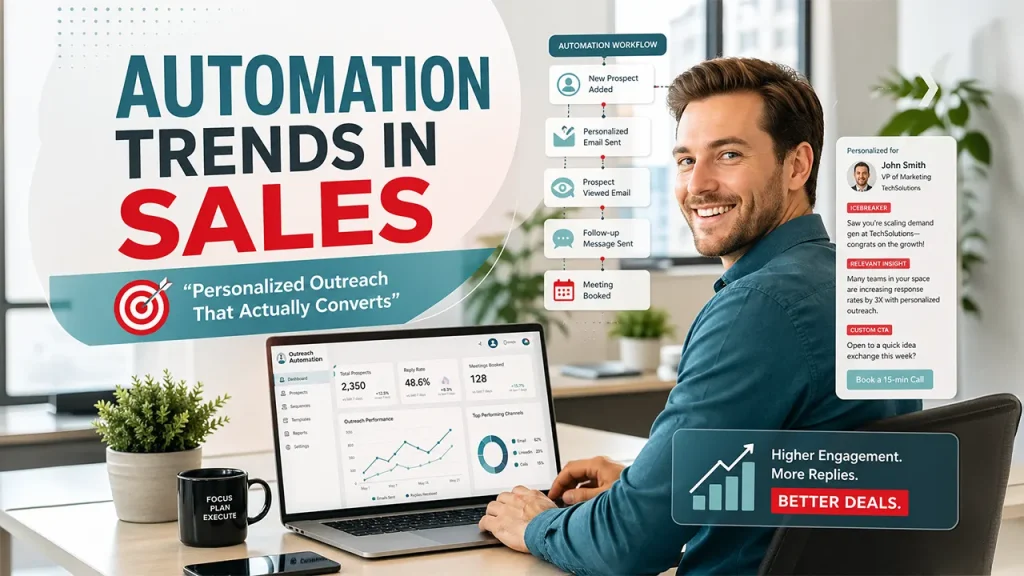
Implementing automation does not mean that you do not have to rely on human beings. It helps expand their capacity to be human on a great scale. This is what GuestPostCRM does. It automates offers, responses, and negotiation, but it leaves space for human review and inputs-
- Hyper-customization at Scale: This is the core objective. Automation allows you to ensure a tailored one-to-one messaging, leveraging the Reciprocity Principle to encourage a response. It ensures a customization quality of manual outreach and automated outreach.
- Behavior-based Triggers: Modern automation is getting better and better. It is changing all the time. With GuestPostCRM automation insights the platform looks at what happened with deals, negotiations and orders. This helps the platform make decisions when it comes to future deals. Other solutions also have triggers called webhooks. These triggers do something when a potential customer watches a video goes to a landing page or clicks on something on a webpage.
- AI-driven Research and Copywriting: Modern solutions offer research assistants, automatically extract crucial insights from LinkedIn profiles, standardizing job titles, and designing tailored icebreakers. This automates the most time-intensive manual outreach component, freeing representatives to focus on meaningful conversations and strategy.
- Programmatic Account-driven Marketing (ABM): For high-value clients, automation allows a greater level of precision and speed that is unattainable simply through manual effort. Let us take an example. A trigger event such as target account going through a pricing page can fire a webhook to the platform, which programmatically creates a Lypsync addressing specific individuals and their organization. This combination of hyper-customization as well as speed leads to a compelling experience that greatly improves automated outreach ROI.
When Should a Business Move from Manual Outreach to Automated Outreach?
The decision to switch from manual outreach to an automated outreach is an important decision any emerging business can take. It is not about neglecting what has worked but about recognizing the threshold beyond which manual outreach becomes more of a liability than an asset. Understanding when to move from manual outreach to automated outreach can unlock exponential growth, while delaying it can result in competitive disadvantage and stagnation. To understand whether your team needs automated outreach and how much, carry out a digital marketing audit and assess performance gaps.
What Are the Signs That Indicates That It Is Time to Go from Manual Outreach to Automation?
Your business will send you clear signals that it is straining because of the limitations of a manual process. Understanding such indicators is vital to make sure that the transition is effective and timely:
- The Lead Generation Has Become Stagnant: You see your team committing more, spending more effort. However, the volume of qualified leads and new meetings is not increasing. This is classic scalability limitation of manual outreach.
- Administrative Work Is Overwhelming Your Sales Team: Your most qualified sales representative remains busy with data entry, prospect research, and scheduling, and the actual work, i.e., closing leads get impacted.
- Dropped Leads or Inconsistent Follow-ups: You are losing crucial prospects since representatives forget to follow up or get busy with something else. The follow-up cadence changes considerably across the team, causing a leaky pipeline.
- Decreasing Reply Rates: When you have to cut through the noise, limited “personalization” no longer works. In manual outreach, you will not have more time to do more than insert the name of the prospect and company. Reply rates are declining or getting stagnated. This is a prime indication of the need for a more influential customization strategy.
- Lack of Capability to Accurately Predict: Since activity levels become inconsistent and information gets scattered across platforms, you are left with no reliable way to predict pipeline. Predicting next month’s lead volume becomes impossible, impacting your growth planning.
- Sales Representative Burnout and More SDR: Representatives get fatigued and frustrated. Manual outreach comes with a lot of work and demands and directly hits the morale of the employees, minimizing productivity and boosting turnover.
- Competitors Are Getting Ahead: One of the prime indicators that you are doing something wrong is seeing your competitors appear in more channels, more rapidly engaging prospects, and getting the deals that you are losing. Chances are they might be using automated outreach to get a decisive advantage.
Conclusion
The debate manual vs automated outreach essentially boils down to strategy and timing. Manual outreach can give you an opportunity to establish authentic relationships but limits your growth. Automation compounds your effort but can risk impersonal communication. Emerging businesses must adopt a hybrid approach, utilizing smart platforms to manage routine tasks while leaving space for human creativity and judgement. You should be clear on when to move from manual outreach to automated outreach to secure your ROI, avoid burnout, and position your agency for more stable and predictable growth.

.png)
.png)