





.png)
.png)
Anyone who has worked with any kind of third-party API can tell a good one from a bad one almost from the moment they begin working with it. The reasons for that all lie in good API design principles, which make sure that one API is as intuitive and obvious in use as possible, while another will require you to guess what each field means and what is wrong with the particular endpoints.
Good AI design is not just about making sure that the API works properly but also about making sure that it’s consistent and predictable as well, so that using it requires minimal effort on the part of the developer. This is what makes one API enjoyable to work with while another one is just endured until there’s an option to replace it with something else.
In this blog, we’ll get into what solid API design actually looks like, the core principles behind it, and how to apply them so your API holds up as it grows.
What Are API Design Principles?
API design principles are basically those elements that determine how an API works, what its architecture is like, and how easily it can be used by other developers. In other words, it doesn’t have to do with the mandatory requirements and is more like a bunch of habitual rules that ensure consistency and usability throughout an entire API.
Imagine, for example, two APIs which provide similar functionality, but one of them uses clear terminology, predictable error messages, and a consistent architecture, while the other one looks as if it has been developed by five different teams without any coordination among themselves. The key difference between these two APIs is the absence of the design principles in the second case.
It is not just a matter of aesthetics, because an API is the very first thing that a developer sees when using a product, and a poor API design could cause people to choose another product simply because of an easier API to work with.
Core Principles of API Design
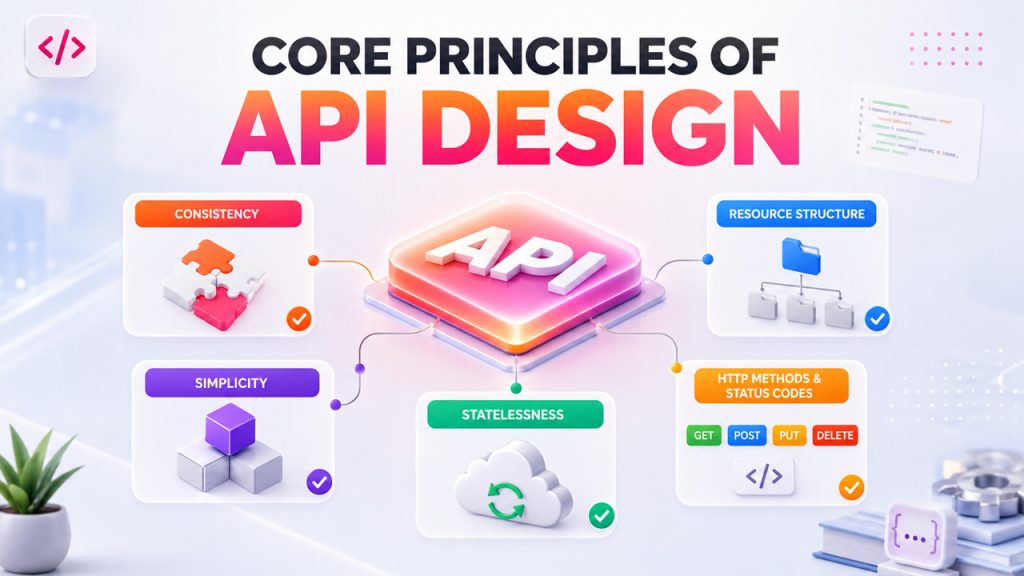
There is indeed no single rule book of API design, but there are some guiding principles that come time and again in those APIs which programmers love to use:
- Consistency: Naming conventions, response formats, and error structures should stay the same across every endpoint, so developers aren’t relearning patterns as they move through your API.
- Simplicity: The easiest APIs to use are the ones that don’t make developers think too hard. Clear naming and predictable behavior beat cleverness every time.
- Statelessness: Each request should carry everything needed to process it, without relying on the server remembering previous requests. This keeps things scalable and easier to debug.
- Clear resource structure: Endpoints should represent resources logically, using nouns rather than verbs, so the API reads intuitively rather than like a list of actions.
- Proper use of HTTP methods and status codes: GET, POST, PUT, and DELETE should be exactly what developers expect, and status codes should accurately reflect what happened, not just return a generic error for everything.
However, none of these principles works alone. Rather, it is their combination that provides reliability to API usage.
Benefits of Following Good API Design Principles
Thinking about proper API design up front will benefit you in ways that reach far beyond simply making sure your API “looks nice”:
- Increased adoption by developers: When an API is easy to use, developers waste less time trying to figure out how to use it. Well-documented platforms such as the Twilio WhatsApp API demonstrate how consistent design and clear documentation encourage faster integration and higher developer adoption.
- Fewer support inquiries: With proper naming conventions, expected errors, and structure, there will be fewer confused emails about why things are not working the way they are expected to work.
- Easier maintenance and scalability: An API designed properly can easily incorporate new features without messing up the old stuff.
- Increased stability of the system: By designing your API properly from the start, you reduce breaking changes down the road due to the solid foundation on which you’ve built everything.
- Increased trust by developers: By creating a consistent and well-documented API, you show commitment to your product and gain the trust of your developers.
Ultimately, good design isn’t just about aesthetics or following best practices for their own sake; it’s what determines whether developers stick around or quietly move on to a competitor’s API instead.
Where Good API Design Actually Matters

API design principles aren’t just theory; they show up in very real, very practical situations:
- Public developer APIs: Think Stripe or Twilio. Their APIs are often praised specifically because they’re predictable and well-documented, which is a huge part of why developers default to them over competitors. Scope and permission handling matter here too, as seen in how the Gmail API manages access levels for different integrations.
- Internal microservices: When dozens of internal teams are calling the same service, consistent design keeps things from turning into a maintenance nightmare as the company scales.
- Mobile app backends: A clean, well-structured API means fewer round trips and less wasted bandwidth, which directly affects how snappy an app feels to the end user.
- Third-party integrations: Partners integrating with your API are far more likely to stick with it if it behaves the way they'd expect, without needing constant back-and-forth support.
- API marketplaces: Where multiple providers offer similar functionality, a well-designed API often wins out purely on developer experience, even if a competitor's underlying service is technically just as good.
Basically, anywhere developers are the ones deciding to use your API or not, good design ends up being the quiet deciding factor most companies underestimate.
The Challenges and Limitations in API Design
Even with the best intentions in mind, good API design cannot be achieved easily at first, and it is important to know the common problems experienced by development teams.
The struggle for balance between flexibility and simplicity cannot be called a rare thing. Too rigid an API causes problems for developers who cannot implement anything outside of the expected scope. When it is too flexible, the inconsistency and inability to properly describe the API emerge. In this case, there is no choice but to develop through iterations, which means making changes based on experience.
Backward compatibility of APIs also brings lots of problems. If an application depends on the API that has already been released, it may break because of the change in the API itself. This is one of the reasons for the importance of versioning in design principles of APIs, but even with the proper versioning strategy in place, maintaining different versions of an API forever results in technical debt.
Documentation often lags behind the actual implementation of functionality, which also leads to problems.
But then there is the problem of convincing everyone internally. A well-thought-out design requires more work up front and collaboration between teams, and that can be tough to argue for when you are pressured to deliver functionality faster.
That does not mean that doing a good design is not worth the effort; it just means that it is an evolving art form and not a one-time thing.
Conclusion
At the end, good API design principles come down to one simple idea: make it easy for other developers to do their job. Everything else, consistency, clear naming, predictable errors, versioning- all of it exists to serve that one goal.
It’s not something you get perfect on day one, and that’s fine. The APIs developers actually love are usually the ones that got refined over time, shaped by real feedback from people building with them. What matters is starting with solid principles in place, so that growth becomes something your API can handle rather than something it breaks under.
If there’s one thing worth taking away, it’s this: developers will always gravitate toward the API that respects their time. Design with that in mind, and everything else tends to follow.



.png)
.png)