




.png)
.png)
On the surface, guest posting sounds simple. Find a website, pitch an idea, write an article, and get a backlink. But anyone who has managed guest posting at any real volume knows the actual process is far messier than that. Emails pile up, negotiations take weeks, someone forgets to follow up, an invoice remains unpaid, a link goes live, and then quietly disappears three weeks later.
It's not that teams are not putting in enough effort. The real problem is the absence of a structured guest post workflow; a system connects every stage of the process while keeping it visible and moving forward without things falling through the cracks.
This blog breaks down what a guest post workflow actually looks like, where the traditional approach breaks down, and how GuestPostCRM turns the whole process into something manageable and scalable.
What Is a Guest Post Workflow?
A guest post workflow is the complete sequence of steps followed to execute a guest posting campaign; from identifying target websites to confirming that a published link is live and active and the invoice is paid.
The process typically covers:
- Prospecting
- Outreach
- Negotiation
- Content creation,
- Editorial management
- Publication
- Post-publication tracking.
When this process is structured and consistent, it scales. When it isn't, even a small increase in volume can bring the whole operation to a halt.
Traditional Guest Post Workflow: Steps and Common Challenges

The traditional guest posting process works well enough when you have to manage a handful of placements a month. However, it starts falling apart when your business scales, and you receive hundreds of emails a month. Here is how most teams handle it and where each step starts to break down.
- Guest Post Prospecting: Someone manually looks for relevant guest posting websites that accept guest posts, check their authority, metrics, and make a list in a spreadsheet. This takes hours, and the data becomes outdated quickly if not acted upon within due time.
- Outreach: Then, they write pitches and send them individually from a Gmail inbox. There's no way of tracking, no templates, and no record of who responded and who didn't.
- Negotiation: Prices are discussed over email threads that are hard to search if you ever need them, easy to lose, and impossible to hand off to a colleague without a lengthy catch-up.
- Content Creation: Once a deal is agreed, content briefs are created manually. Deadlines are tracked on spreadsheets or, worse, in someone's memory.
- Editorial Management: Following up on submitted content, chasing editors, and confirming publication all require manual effort with no centralized record of what's been actioned and what has been missed out.
- Invoice and Payment Tracking: Invoices are created manually, sent separately, and chased individually when they go unpaid. There is no automated reminder, payment tracking, or link between the invoice and the order it belongs to.
- Link Verification: After publication, someone has to manually check that the link is live, correctly placed, and still there a month later.
Each of these steps works in isolation. But repeat them for twenty or thirty guest post offers or link placements, and the whole thing becomes hard to manage.
That’s where a purpose-built platform like GuestPostCRM steps in, connecting every stage into one streamlined workflow designed to handle guest posting at scale.
What Is GuestPostCRM?
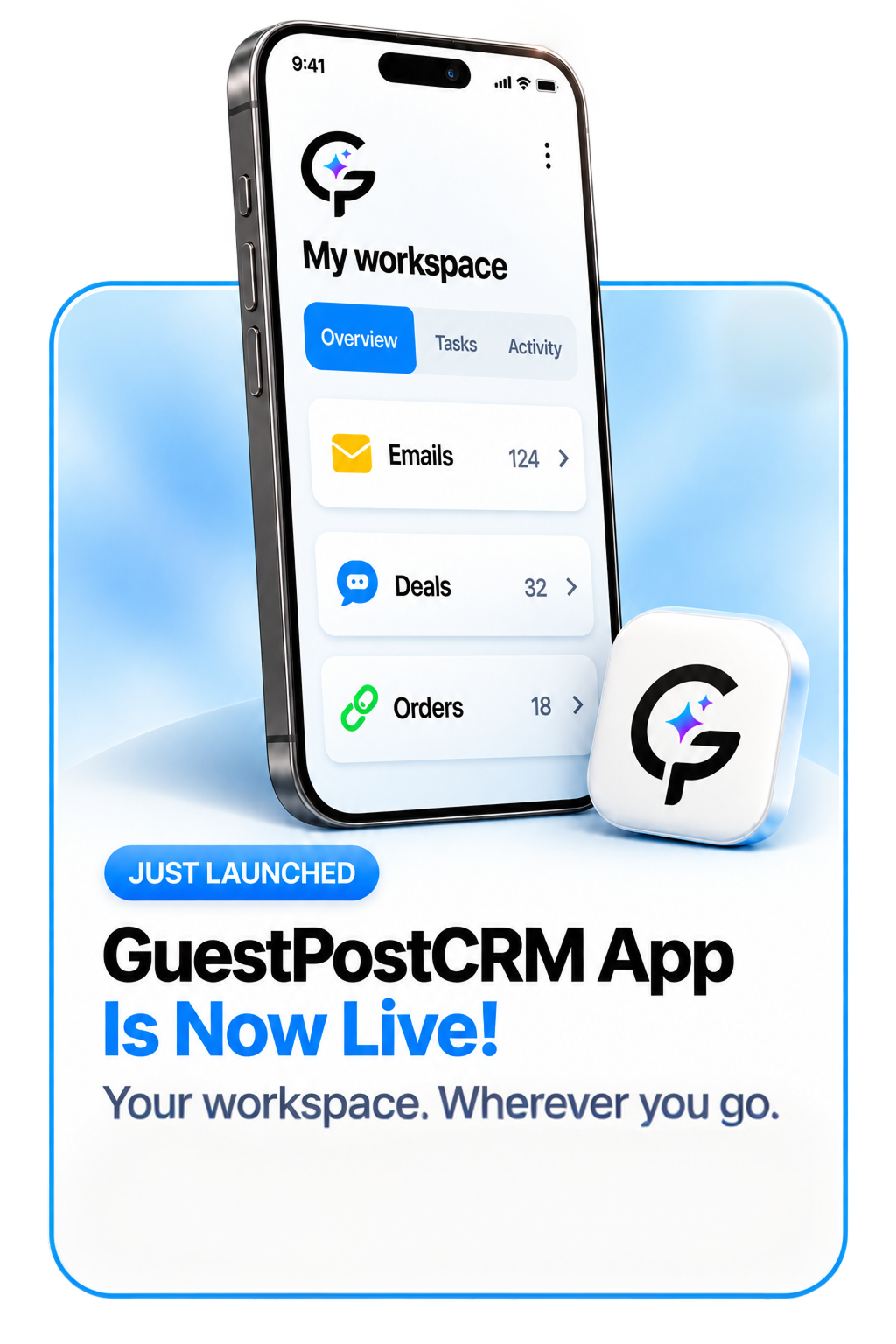
GuestPostCRM is a workflow automation and CRM platform that is built exclusively for managing guest posting businesses. It covers the complete guest posting lifecycle, from the first inbound inquiry to invoice payment and backlink monitoring inside one centralized workspace. It is not another generic CRM that’s been modified for SEO. It was designed from scratch around how guest posting actually works, which means every feature maps directly to a real step in the process.
Why Use GuestPostCRM for Guest Post Workflow Automation?
A structured workflow is only useful when it reduces manual work. Here’s how GuestPostCRM makes every stage faster, simpler, and easier to manage.
- Instead of scattered spreadsheets, and disconnected tools that don’t talk to each other, you get one organized system to manage guest posts.
- Its AI assistant automatically filters emails, detects senders, and schedules first replies without you having to lift a finger.
- Negotiations, deals, and orders are tracked inside a structured pipeline, so nothing is buried in an email thread.
- Invoices are generated automatically on order completion, with automated payment reminders and link removal if payment remains incomplete.
- Links are monitored after publication, so you know the moment something changes.
- It scales with your operation, whether you're a solo freelancer or a team managing hundreds of placements simultaneously
- It eliminates the manual admin that consumes most of a guest posting team's working day
How GuestPostCRM Automates the Guest Post Workflow

There is where the difference between traditional guest posting process and GuestPostCRM approach becomes apparent. Here's the full workflow inside the platform, step by step.
- Capture Incoming Guest Post Inquiries: An inbound guest post inquiry lands in your connected Gmail inbox. GuestPostCRM immediately picks it up and starts processing it without needing any manual sorting.
- AI Email Filtration: AI, then scans the email and rejects spam, duplicates, or no-reply notifications, and irrelevant messages. Only genuine guest posting and link placement opportunities are accepted in the primary inbox and move forward into the pipeline.
- Categorize Brand and Non-Brand Inquiries: The email is then categorized as brand or non-brand. Accordingly, a contact or account record is created automatically by fetching the sender’s details from the email.
- Detect Sender Identity and Inquiry Intent: GuestPostCRM’s AI feature analyses the sender's identity and the intent behind the message. It identifies whether the email is a guest post inquiry, a link insertion request, a pricing question, a collaboration proposal, or something else entirely. This determines which workflow gets triggered next.
- Send AI-Powered Guest Post Responses: A context-aware AI reply is generated and sent automatically. The AI selects the correct brand or non-brand template that you can even personalize based on the conversation and sends it within minutes. Your team can review and edit before it goes out, but in most cases, it doesn't need touching.
- Manage Offers and Guest Post Negotiations: Once the conversation progresses, offers are created automated and managed inside the CRM. Counteroffers, multi-round negotiations, pricing history, and AI-assisted negotiation replies are all handled in one place. Nothing lives in an email thread.
- Convert Accepted Offers Into Deals: When the client accepts the offer, it converts into a structured deal with one click. Client details, agreed pricing, website selection, and deal summary are all generated automatically.
- Manage Guest Post Orders and Deliverables: The deal converts into an order that you can track. The order summary is sent to the client. Moreover, you can monitor order status, delivery progress, document URLs, internal and external links, and all SEO deliverables from a single dashboard.
- Automate Invoicing, Payments, and Reminders: When the order gets completed, an invoice is generated and sent automatically. Following this, payment reminders are automatically scheduled to go out at 7,9 and 11 days if the invoice goes unpaid. You can customize it as per your convenience. If payment still doesn't arrive after the final reminder, the placed link is removed automatically.
- Track Published Guest Post Backlinks: After publication, every backlink is monitored continuously. You receive alerts if a link is removed, changed, or expires, so nothing slips past you after delivery.
Who Can Benefit From GuestPostCRM

GuestPostCRM is built for anyone who manages guest posts at volume. It is not limited to one type of business. This guest posting software can adapt to any size and structure.
Guest Posting Agencies: They use it to manage and keep up with high volumes of client campaigns simultaneously. GuestPostCRM keeps each client’s pipeline, orders, and invoices recorded separately. For teams looking for a proper Agency Workflow Management Software, GuestPostCRM covers the entire operation end to end.
SEO Agencies: They typically manage guest posting as part of broader link building campaigns. GuestPostCRM’s automated communication and deal tracking helps them keep every account moving without needing any manual effort or coordination.
Online Publishers and Write-For-Us Websites: They use it to manage inbound guest post requests, filter the genuine ones, replying, negotiating, and automated invoice creating without throwing their inboxes into chaos that comes with high inquiry volumes.
Have an idea for a guest post? If you'd rather contribute than just read about the process, you can pitch your ideas for our Write for Us page and get published on GuestPostCRM directly.
Link Building Teams: They use it to maintain a structured outreach workflow across multiple websites and clients, with full visibility into every active deal, order, and placed link.
Freelance Link Builders: They use it to get the operational infrastructure of a full agency team without the headcount, automating the admin, so they can focus on the work itself.
If your business involves placing or receiving guest posts at any meaningful scale, GuestPostCRM is built for your routine workflow.
Conclusion
Guest posting is something that has always needed effort. Most teams find that out the hard way when they compare manual vs automated outreach side by side and realize how much time the manual version quietly eats up. However, effort alone isn’t enough to build a scalable operation; a structured guest post workflow does. The traditional approach works well until you receive hundreds of guest posts inquiries a month, and for most teams, that breaking point comes sooner than expected.
That's where GuestPostCRM shines. It removes the fragmentation that slows most guest posting businesses down. It replaces this friction with a single, connected, and automated system that handles everything from the first email inquiry to the final payment. If you're serious about scaling your guest posting operation, the workflow is where it starts.



.png)
.png)